Angle facts (AQA GCSE Further Maths): Revision Notes
📚Revision Notes
Angle facts
When studying geometry, understanding angle relationships is crucial for solving problems involving intersecting lines. There are two fundamental angle facts that you need to master when two straight lines cross each other.
Vertically opposite angles
When two straight lines cross each other, they create four angles at the point of intersection. The angles that are directly across from each other (diagonally opposite) are called vertically opposite angles, and they are always equal in size.
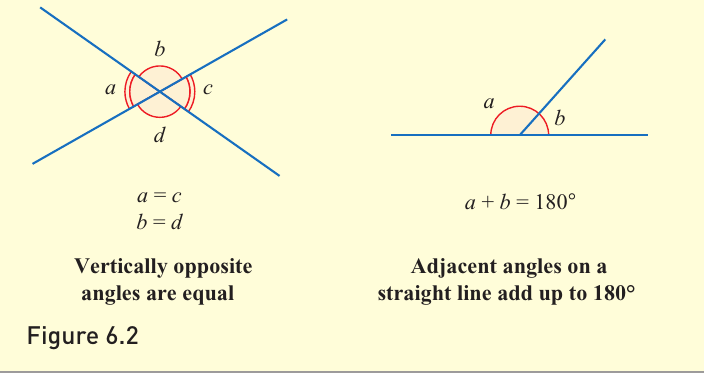
In the diagram above, you can see that when two lines intersect:
- Angle equals angle (they are vertically opposite)
- Angle equals angle (they are also vertically opposite)
Note
This happens because the angles are formed by the same two lines, just viewed from opposite directions. Think of it like looking at the same opening from different sides - the size remains the same.
Adjacent angles on a straight line
The second important angle fact involves angles that are next to each other along a straight line. When two angles share a common side and together form a straight line, they are called adjacent angles on a straight line.
These adjacent angles always add up to 180 degrees, which makes sense because a straight line itself represents 180 degrees.
Note
It's like cutting a straight line into two parts - no matter how you cut it, the two pieces must add up to the whole.
From the same diagram, you can see that:
- Angle
This rule applies to any pair of adjacent angles that sit on a straight line.
Key formulas to remember
Important
For vertically opposite angles:
- If two lines intersect, then vertically opposite angles are equal
- and
For adjacent angles on a straight line:
- Adjacent angles on a straight line sum to
Common exam applications
These angle facts are often used together in exam questions. You might be given one angle and asked to find others, or you might need to set up equations using these relationships.
Note
Remember that these rules work regardless of how the lines are positioned - whether they're horizontal, vertical, or at any other angle. The key is to identify which angles are vertically opposite and which are adjacent on a straight line, then apply the appropriate rule.
Summary
Key Points to Remember:
- Vertically opposite angles are always equal when two lines intersect
- Adjacent angles on a straight line always add up to 180°
- These rules apply no matter how the lines are positioned or what size the angles are
- Look for the intersection point to identify which angles are vertically opposite
- Check if angles share a side and form a straight line to identify adjacent angles