Circle theorems (AQA GCSE Further Maths): Revision Notes
📚Revision Notes
Circle theorems
Circle theorems are essential tools in geometry that help us understand the relationships between angles, arcs, and lines in circles. These theorems form the foundation for solving many geometric problems and are frequently tested in GCSE mathematics.
Central angle and circumference angle relationship
One of the most important circle theorems states that the angle at the centre of a circle is exactly double the angle at the circumference when both angles are subtended by the same arc.
Key rule: Central angle = 2 × Circumference angle
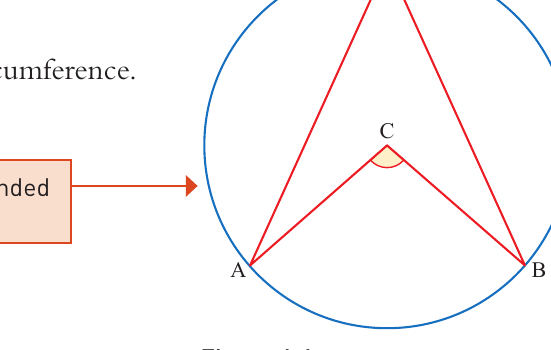
Here's how this works:
- Point C is the centre of the circle
- Points A, B, and D are on the circumference
- Both angles are looking at the same arc AB
- The angle at the centre (angle ACB) will always be twice the angle at the circumference (angle ADB)
Important
Both angles must be subtended from the same arc for this relationship to work.
Angles in a semicircle
When you draw any triangle inside a semicircle where one side is the diameter, something special always happens - the angle opposite the diameter is always 90°.
Theorem: Any angle inscribed in a semicircle equals 90°
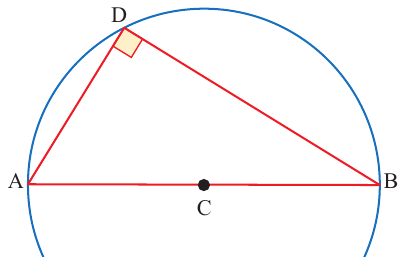
This diagram shows:
- AB is the diameter of the semicircle
- D is any point on the semicircle's arc
- Angle ADB will always be 90°, no matter where point D is positioned
Note
This is sometimes called Thales' theorem and is incredibly useful for identifying right angles in geometric problems.
Angles in the same segment
When two or more angles are subtended by the same arc from points on the same side of the chord, these angles are always equal.
Theorem: Angles subtended by the same arc are equal
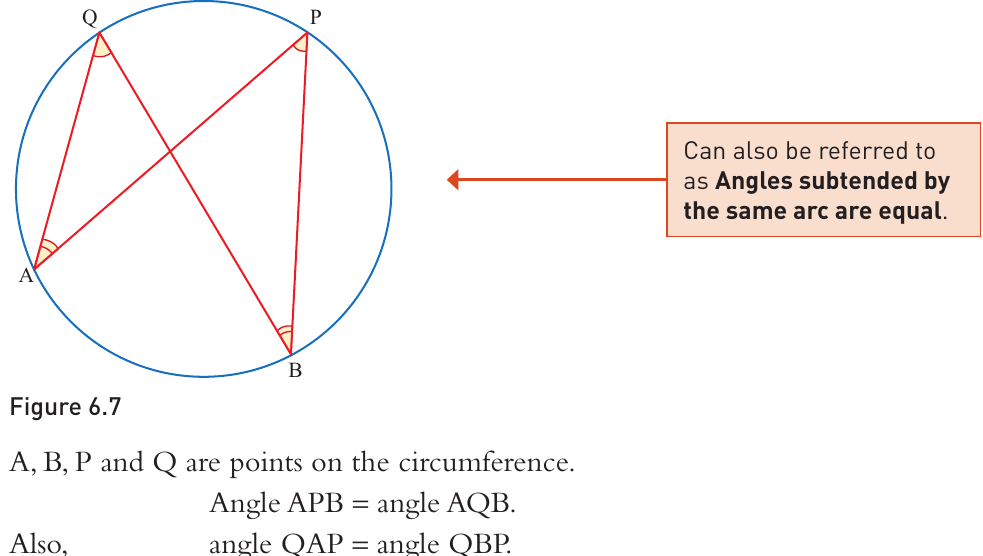
In this example:
- Points A, B, P, and Q are all on the circumference
- Angle APB and angle AQB are both subtended by arc AB
- Therefore: angle APB = angle AQB
- Similarly: angle QAP = angle QBP
Note
This theorem is particularly useful for finding unknown angles when you know one angle in the same segment.
Cyclic quadrilaterals
A cyclic quadrilateral is a four-sided shape where all vertices lie on the circumference of a circle. These special quadrilaterals have a unique property regarding their opposite angles.
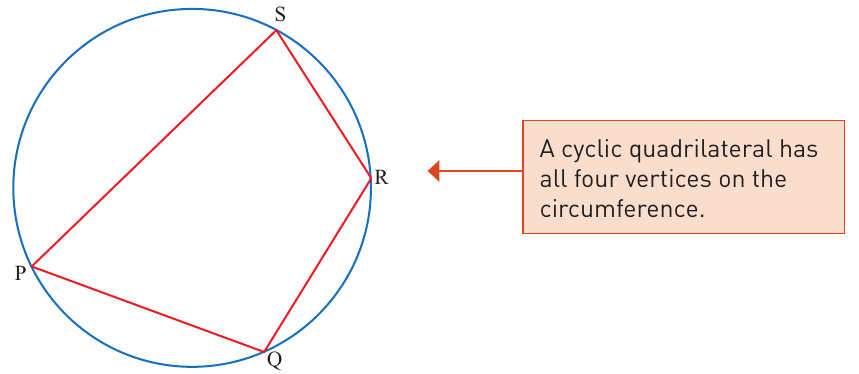
Theorem: Opposite angles in a cyclic quadrilateral add up to 180°
This means:
- Angle P + Angle R = 180°
- Angle Q + Angle S = 180°
This property helps us identify cyclic quadrilaterals and solve for unknown angles within them.
Alternate segment theorem (tangent-chord angles)
When a tangent line touches a circle and forms an angle with a chord, this angle equals the angle in the alternate segment.
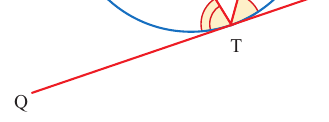
Theorem: The angle between a tangent and a chord equals the angle in the alternate segment
Key points:
- QT is a tangent to the circle at point T
- The angle between the tangent QT and chord TA equals the angle in the segment on the opposite side of the chord
- This relationship works for any chord from the point of tangency
Worked examples
Let's work through some step-by-step examples to see how these theorems apply in practice.
Example
Worked Example 1: Finding angles using central and circumference relationship
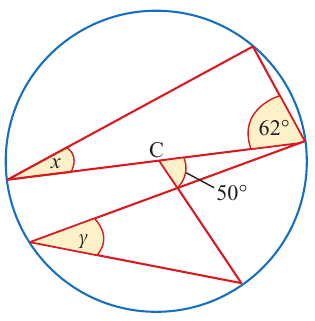
Problem: Find angles x and y. C is the centre of the circle.
Solution:
- We can see angle at centre = 62° + 50° = 112°
- Using the central angle theorem: angle at circumference = 112° ÷ 2 = 56°
- Since angles in the same segment are equal, we can find the remaining angles
- The angles x and y can be calculated using the fact that angles around the centre sum to 360°
Example
Worked Example 2: Cyclic quadrilateral problem
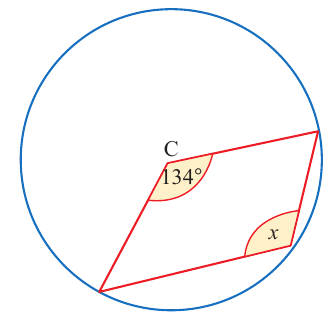
Problem: Find angle x in this cyclic quadrilateral.
Solution:
- We know that opposite angles in a cyclic quadrilateral sum to 180°
- The angle shown is 134°
- Therefore: x + 134° = 180°
- So: x = 180° - 134° = 46°
Example
Worked Example 3: Tangent and inscribed angle
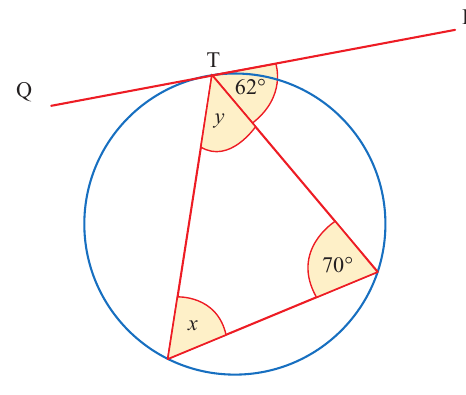
Problem: Find angles x and y. QTP is a tangent.
Solution:
- First, identify the inscribed angles: 62° and 70°
- Use the alternate segment theorem: the tangent-chord angle equals the angle in the alternate segment
- The angle between the tangent and chord at T equals the inscribed angle on the opposite side
- Calculate using angle relationships in the triangle and the tangent properties
Example
Worked Example 4: Central angle with arc measurement
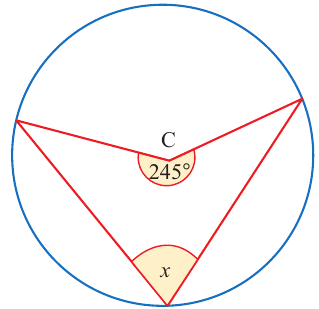
Problem: Find angle x. C is the centre of the circle.
Solution:
- The central angle shown is 245°
- This represents the reflex angle at the centre
- The angle x (inscribed angle) will be half of the corresponding arc
- Since the total circle is 360°, the minor arc = 360° - 245° = 115°
- Therefore: x = 115° ÷ 2 = 57.5°
Example
Worked Example 5: Complex tangent problem
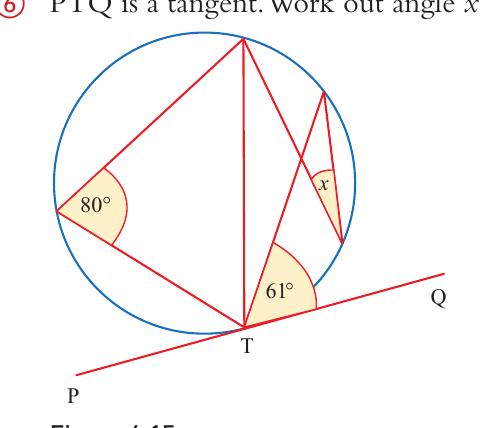
Problem: PTQ is a tangent. Find angle x.
Given angles: 80° and 61°
Solution:
- Use the alternate segment theorem
- The tangent-chord angle at T equals the inscribed angle in the alternate segment
- Apply angle properties of triangles (angles sum to 180°)
- Work systematically through the relationships to find x
Example
Worked Example 6: Inscribed angles with algebraic expressions
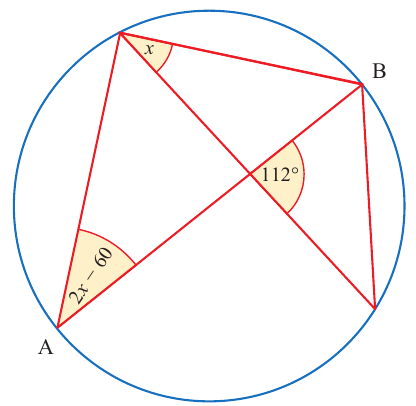
Problem: Find angle x.
Given: Central angle = 112°, one angle = 2x + 60°, another angle = x°
Solution:
- Use the relationship between central and inscribed angles
- The central angle is double the inscribed angle
- Set up the equation: 112° = 2 × (inscribed angle)
- Therefore: inscribed angle = 56°
- Use angle relationships in the triangle to solve for x
Common exam tips
Note
Essential Exam Strategies:
-
Always identify the theorem first: Look at the diagram and decide which circle theorem applies before starting calculations.
-
Mark given information clearly: Label all known angles and identify the centre, tangents, and key points.
-
Check your angle types: Make sure you can distinguish between central angles, inscribed angles, and tangent-chord angles.
-
Use angle properties together: Often you'll need to combine circle theorems with basic angle facts (angles in triangles sum to 180°, etc.).
-
Draw clear diagrams: If a diagram isn't provided, sketch one to help visualise the problem.
Summary
Key Points to Remember:
- The central angle is always double the inscribed angle when they subtend the same arc
- Any angle in a semicircle equals 90° - this is always true
- Angles subtended by the same arc are equal when viewed from the same side
- Opposite angles in a cyclic quadrilateral always sum to 180°
- The tangent-chord angle equals the angle in the alternate segment - a powerful theorem for solving complex problems