Trigonometry in two dimensions (AQA GCSE Further Maths): Revision Notes
📚Revision Notes
Trigonometry in two dimensions
Introduction to trigonometric ratios
Trigonometry helps us work with triangles, particularly right-angled triangles. The three main trigonometric functions - sine (sin), cosine (cos), and tangent (tan) - create relationships between the angles and sides of right triangles.
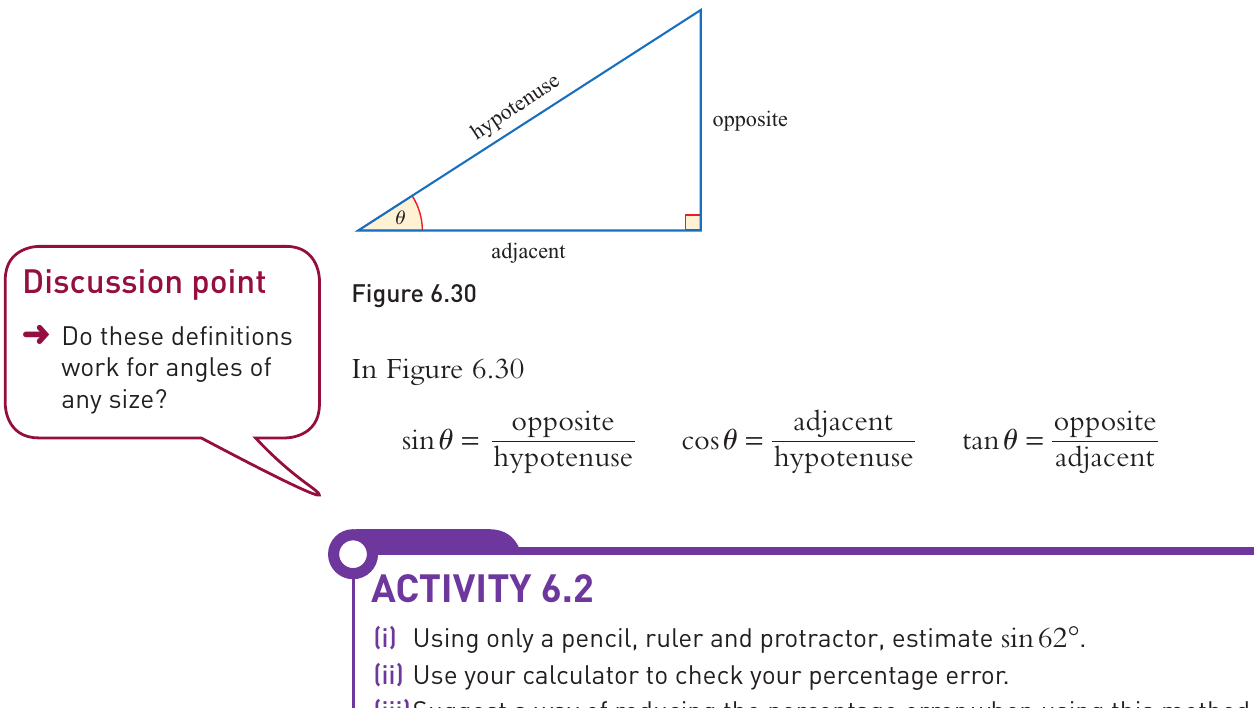
In any right triangle, we can identify three key parts relative to a given angle θ (theta):
- Hypotenuse: The longest side, opposite the right angle
- Opposite: The side directly across from the angle θ
- Adjacent: The side next to angle θ (but not the hypotenuse)
The fundamental trigonometric ratios are defined as:
- sin θ = opposite/hypotenuse
- cos θ = adjacent/hypotenuse
- tan θ = opposite/adjacent
Note
A helpful way to remember these ratios is using the mnemonic SOHCAHTOA:
- Sine = Opposite over Hypotenuse
- Cosine = Adjacent over Hypotenuse
- Tangent = Opposite over Adjacent
Finding missing sides
When you know an angle and one side of a right triangle, you can use trigonometric ratios to find the other sides. The key is choosing the correct ratio based on what information you have and what you need to find.
Example: Finding the opposite side
Example
Worked Example: Finding the Opposite Side
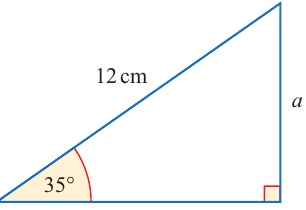
To find side length 'a' when you know the hypotenuse is 12 cm and the angle is 35°:
Since we want the opposite side and we know the hypotenuse, we use sine:
Rearranging: Therefore: cm (to 1 decimal place)
Example: Finding the hypotenuse
When you know the adjacent side and need the hypotenuse, use cosine.
Example
Worked Example: Finding the Hypotenuse
If the adjacent side is 4.2 m and the angle is 18°:
Rearranging: Therefore: m (to 3 significant figures)
Finding missing angles
When you know two sides of a right triangle, you can find the angles using inverse trigonometric functions (, , ).
Example: Using tangent to find an angle
Example
Worked Example: Finding an Angle Using Tangent
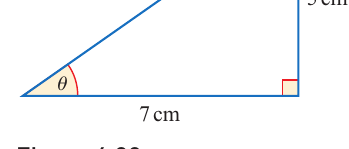
In a triangle where the opposite side is 5 cm and the adjacent side is 7 cm:
To find θ: (to 1 decimal place)
Real-world applications
Trigonometry is particularly useful for solving problems involving angles of elevation and depression. These angles are always measured from the horizontal line.
Angles of elevation and depression
Note
- Angle of elevation: Measured upward from horizontal
- Angle of depression: Measured downward from horizontal
Example: Bird flight problem
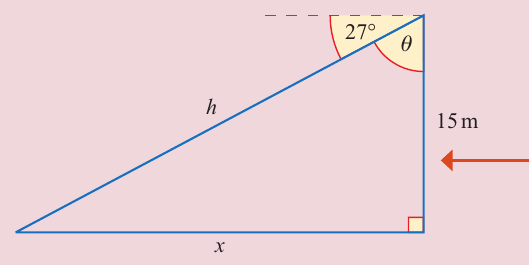
A bird flies from the top of a 15 m tree at an angle of depression of 27° to catch a worm on the ground.
Example
Worked Example: Bird Flight Problem
To find how far the bird flies (hypotenuse h):
- The angle with the horizontal is
- m
To find the horizontal distance (x): Using Pythagoras' theorem: m from the bottom of the tree
Special angles: 30°, 45°, and 60°
These angles have exact trigonometric values that you should memorise for non-calculator questions.
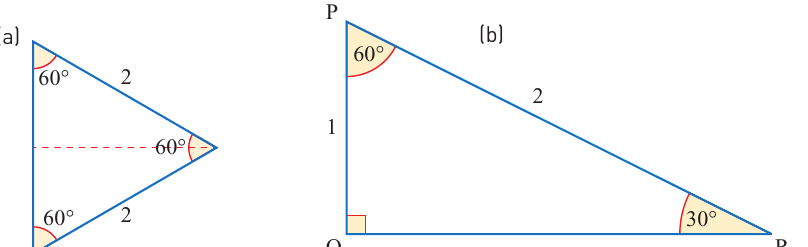
Important
Essential Values to Memorise:
For a 45° angle (from an isosceles right triangle):
For 30° and 60° angles (from an equilateral triangle split in half):
- , ,
- , ,
Working with exact values
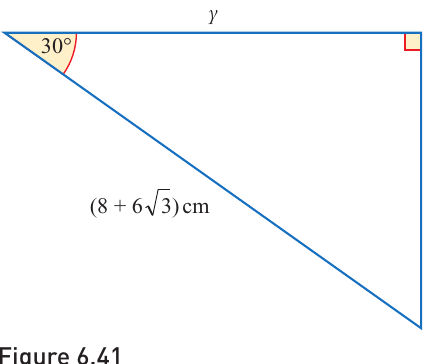
When solving problems with special angles, always give answers in exact form using surds rather than decimal approximations.
Example
Worked Example: Using Exact Values
For a 30° angle in a right triangle:
Since :
Solving:
Problem-solving strategies
Step-by-step approach
A systematic approach is essential for success in trigonometry problems:
- Draw a clear diagram labelling all known information
- Identify what you need to find and mark it clearly
- Choose the appropriate trigonometric ratio based on the known and unknown sides
- Set up the equation and solve algebraically
- Check your answer makes sense in the context
Common exam tips
Note
- Always check which sides are opposite, adjacent, and hypotenuse relative to the angle you're using
- For angles of depression, remember they create alternate angles with angles of elevation
- When working with exact values, rationalise denominators where necessary
- Round final answers appropriately according to the question's requirements
- Store full calculator values during multi-step calculations to avoid rounding errors
Avoiding common mistakes
Important
Common Pitfalls to Avoid:
- Don't confuse opposite and adjacent sides - always identify them relative to your chosen angle
- Remember that angles of depression are measured downward from horizontal, not from vertical
- When using inverse trigonometric functions, ensure your calculator is in the correct mode (degrees or radians)
- For exact value questions, don't use a calculator - work with the known exact ratios
Summary
Key Points to Remember:
- SOHCAHTOA helps you remember the basic trigonometric ratios: , ,
- Special angle values must be memorised: , ,
- Always draw diagrams clearly labelling the sides as opposite, adjacent, and hypotenuse relative to your chosen angle
- Angles of elevation look up from horizontal, while angles of depression look down from horizontal
- Store full calculator values during multi-step problems to maintain accuracy in your final answer