Geometry II (AQA GCSE Further Maths): Revision Notes
📚Revision Notes
Lines and planes in three dimensions
Understanding basic concepts
When working in three-dimensional space, we need to understand how lines and planes behave differently compared to two-dimensional geometry. A plane is simply a flat surface that extends infinitely in all directions, and importantly, it doesn't have to be horizontal - it can be tilted at any angle.
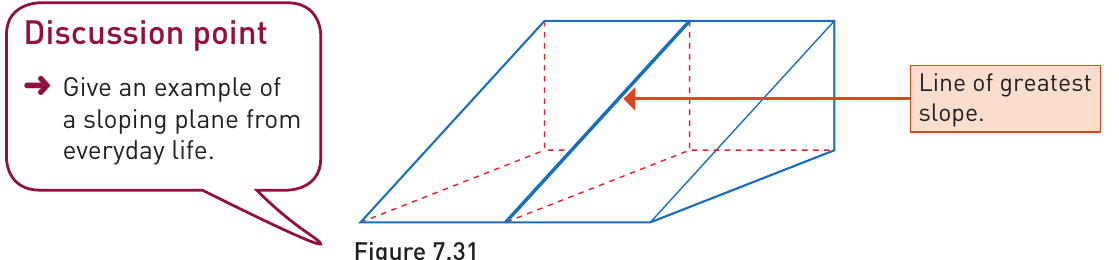
One key concept is the line of greatest slope on a sloping plane. This is the steepest path down the plane - imagine rolling a ball down a tilted surface, and it will naturally follow this line of greatest slope because gravity pulls it along the steepest route.
Note
The line of greatest slope is the path that a ball would naturally follow when rolling down an inclined plane due to gravity. This concept is crucial for understanding how objects move on sloped surfaces in real-world applications.
In three-dimensional problems, you need to understand the various relationships that can exist between lines and planes, as these form the foundation for solving more complex problems.
Relationships between lines in three dimensions
When dealing with two lines in three-dimensional space, there are three possible relationships, unlike in two dimensions where lines can only meet or be parallel.
The three possibilities are:
- Parallel lines: The lines run in the same direction and never meet
- Intersecting lines: The lines cross each other at a point
- Skew lines: The lines don't meet and aren't parallel - they exist in different planes
Important
Skew lines are unique to three-dimensional geometry. In 2D, lines can only be parallel or intersecting, but in 3D, lines can be skew - meaning they don't intersect and aren't parallel because they exist in different planes.
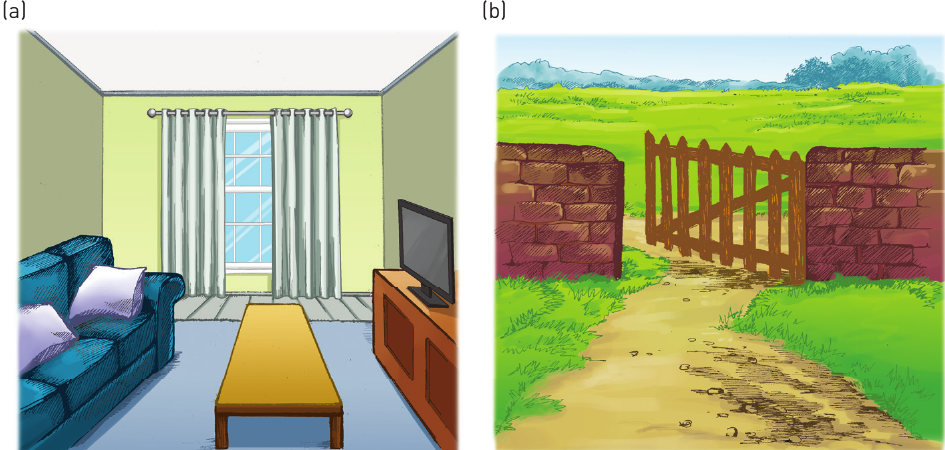
A great example of skew lines is a road passing under a bridge. The road below and the road on the bridge are skew lines because they don't intersect and aren't parallel to each other.
Relationships between a line and a plane
When considering how a line can relate to a plane, there are three possibilities:
- The line is parallel to the plane: Like a curtain rail running parallel to the floor
- The line intersects the plane at a single point: Like when you're writing and your pen meets the paper at one point
- The line lies completely within the plane: Like when you put your pen down flat on the paper
Finding the angle between a line and a plane
To find the angle between a line and a plane, you need to follow a specific method:
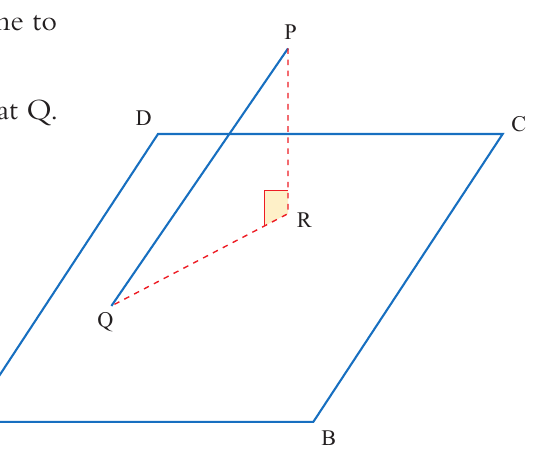
- Draw a perpendicular line from any point on the given line to the plane
- Draw a line within the plane from where the perpendicular meets the plane to where the original line intersects the plane
- The angle between these two lines is the angle between the original line and the plane
Note
This method works because the angle between a line and a plane is defined as the angle between the line and its projection onto the plane. The projection creates a right triangle that makes the angle calculation straightforward.
Relationships between two planes
Two planes in three-dimensional space can relate in just two ways:
- Parallel planes: Like opposite walls in a room - they never meet
- Intersecting planes: The planes meet along a straight line, like how a wall meets the ceiling
Important
When planes intersect, they always meet in a straight line, never at just a single point. This is a fundamental property of plane geometry in 3D space.
Finding the angle between two planes
When two planes intersect, you can find the angle between them using this method:
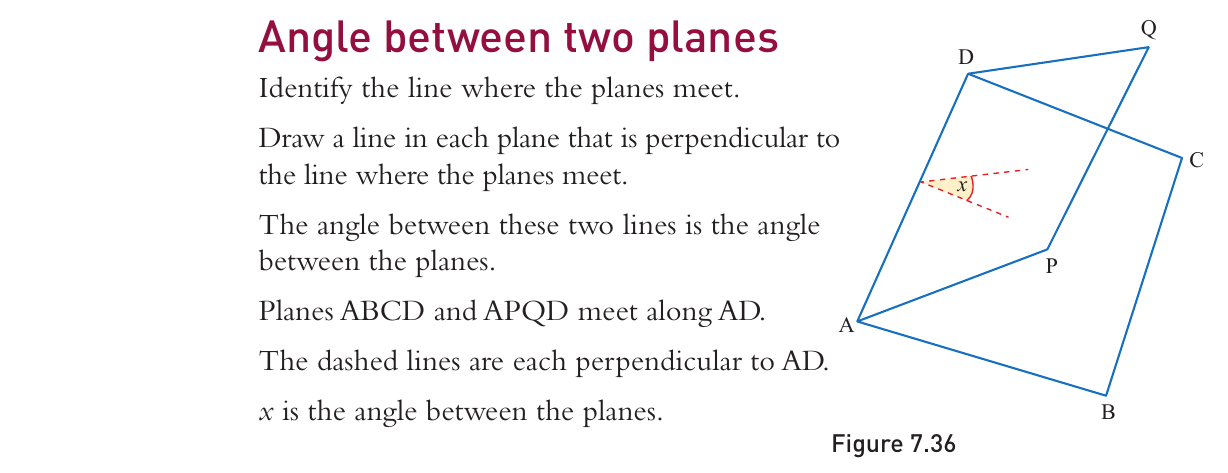
- Identify where the two planes meet (their line of intersection)
- In each plane, draw a line that is perpendicular to the line of intersection
- The angle between these two perpendicular lines gives you the angle between the planes
This angle is also called the dihedral angle between the planes.
Worked example: wedge problem
Example
Worked Example: Finding Angles in a Wedge
Problem: A wedge ABCDEF has dimensions AB = 8 cm, BC = 6 cm, and CD = 2 cm. Angle BCD is 90°. Find the length AC, the length AD, and the angles between various planes.
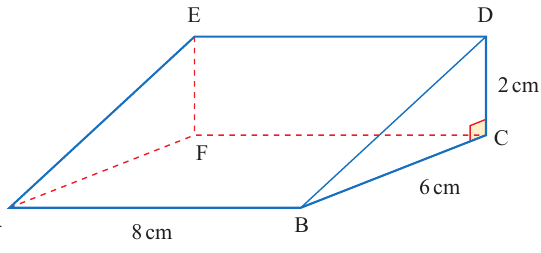
Solution process:
Step 1: Find AC using Pythagoras' theorem in triangle ABC
- Therefore cm
Step 2: Find AD using Pythagoras' theorem in triangle ACD
- Therefore cm (to 1 decimal place)
Step 3: Find angle between planes DA and ABCF
- Use trigonometry:
- Therefore (to 1 decimal place)
Step 4: Find angle between planes ABDE and ABCF
- Use trigonometry:
- Therefore (to 1 decimal place)
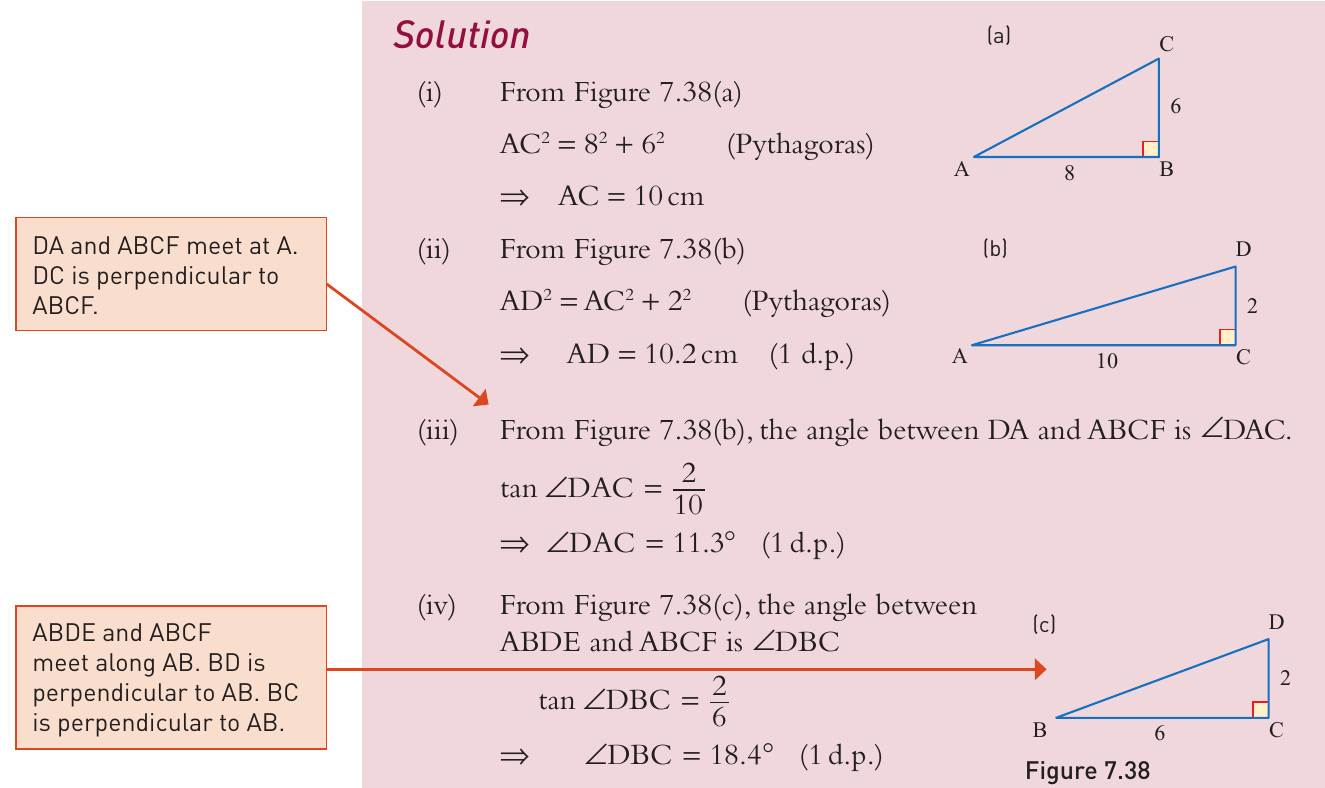
The key insight is to break the 3D problem into manageable 2D right triangles, then use basic trigonometry to find the required angles.
Worked example: radio mast problem
Example
Worked Example: Radio Mast Elevation Problem
Problem: A straight road AB is 400m long. A vertical radio mast XY stands at some distance from the road. The angle of elevation from A to the top Y is 30°, angle XAB = 25°, and angle AXB = 90°. Calculate the distance AXE, the height of the mast, and the distance from X to the road.
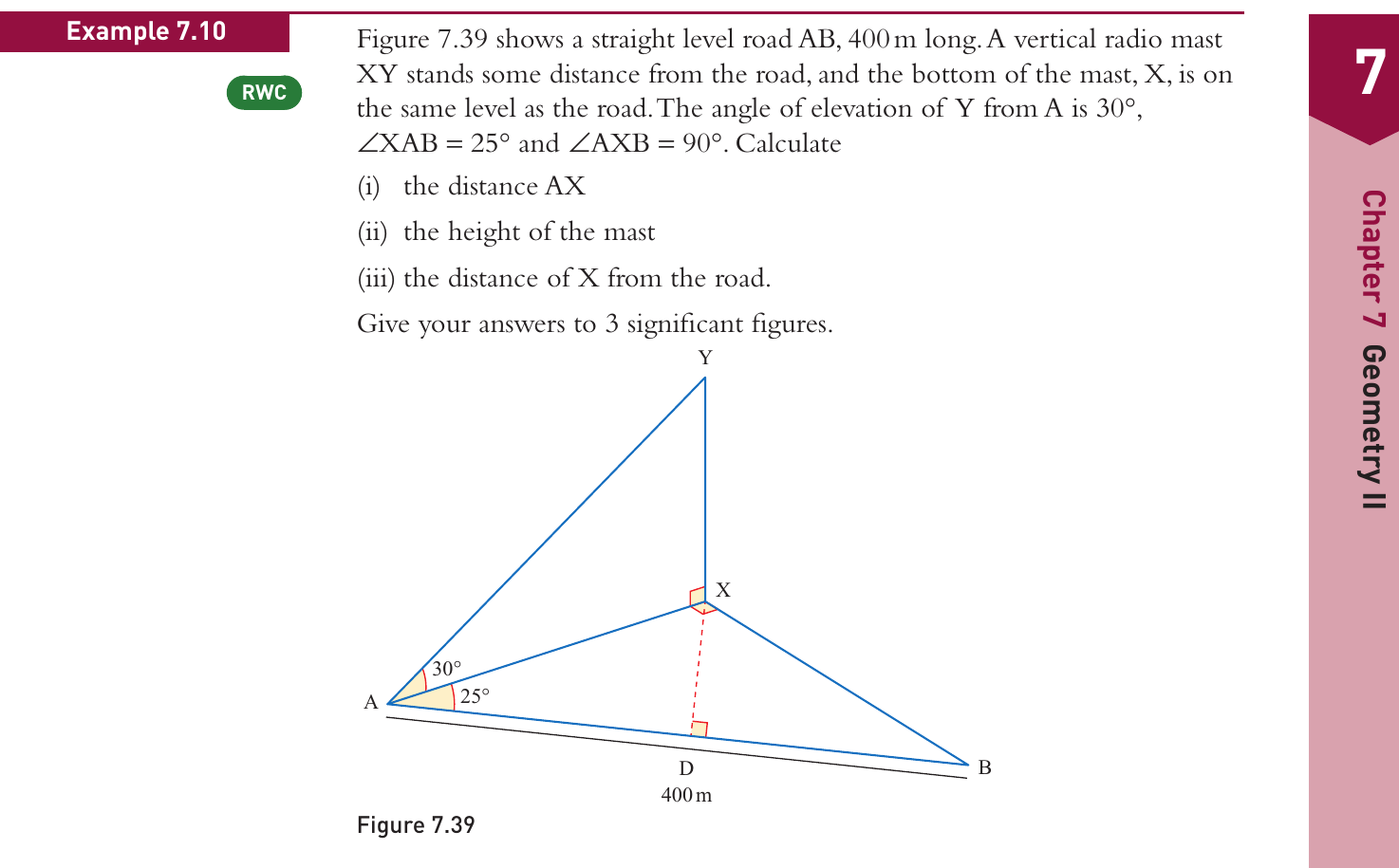
Solution process:
Step 1: Find distance AXE
- From the triangle:
- Therefore m (to 3 significant figures)
Step 2: Find height of mast XY
- From the right triangle:
- Therefore m (to 3 significant figures)
Step 3: Find distance from X to the road
- Therefore the distance = 153m (to 3 significant figures)
This problem demonstrates how 3D geometry often involves breaking complex situations into simpler 2D triangles and applying basic trigonometry.
Worked example: pyramid angle problem
Example
Worked Example: Pyramid Angle Calculation
Problem: Pyramid VABCD has a square horizontal base ABCD. Vertex V is directly above the centre X of the base. M is the midpoint of BC, AB = 8 metres, and VX = 15 metres. Find the angle between planes ABCD and VBC.
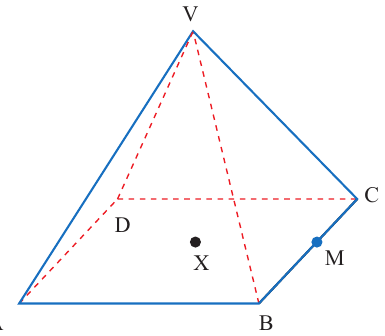
Solution process:
The key insight is that the planes meet along BC, so we need to find perpendicular lines to BC in each plane.
- MX is perpendicular to BC in plane ABCD
- VM is perpendicular to BC in plane VBC
- Therefore, angle VMX is the angle between the planes
From the geometry:
- m (since M is midpoint and X is centre)
- Using trigonometry:
- Therefore angle (to 1 decimal place)

Worked example: cuboid diagonal problem
Example
Worked Example: Cuboid Diagonal and Angle Calculation
Problem: A cuboid has square base ABCD of side 8 cm and height 4 cm. M is the midpoint of AC. Calculate the exact length of DM and find the angle between planes ABCD and ACH.
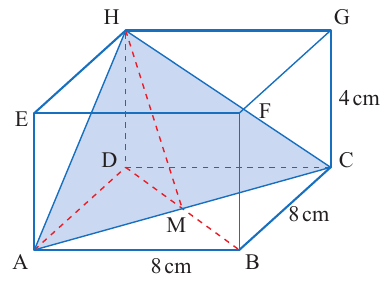
Solution process:
Step 1: Find DM using the diagonal of the square base
- cm
Step 2: Find the angle between the planes
- The angle required is
- Therefore the required angle = 35.3°
This problem shows how finding distances and angles in 3D often involves working with square roots and exact values.
Pythagoras' theorem in three dimensions
The famous Pythagoras' theorem extends beautifully into three dimensions. While the 2D version states that for a right triangle, the 3D version becomes:
Important
3D Pythagoras Theorem:
Where a, b, and c are the three perpendicular dimensions of a rectangular box, and d is the space diagonal connecting opposite corners.
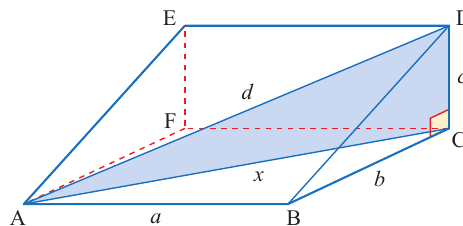
This theorem is incredibly useful for finding distances between points in 3D space, especially in rectangular solids like cuboids.
Example
Worked Example: 3D Pythagoras Application
Problem: ABCDEFGH is a cuboid with the dimensions shown. Calculate the length of diagonal AF.
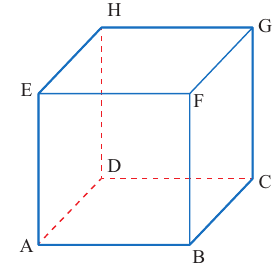
Solution: Using the 3D Pythagoras theorem:
- cm (to 3 significant figures)
This demonstrates how the 3D Pythagoras theorem makes calculating space diagonals straightforward.
Using sine and cosine rules in 3D problems
The sine and cosine rules from 2D trigonometry also apply in three-dimensional problems. You often need to identify the appropriate triangles within the 3D figure and apply these rules.
Note
Key Trigonometric Rules:
Sine rule:
Cosine rule:
These rules work in any triangle, whether it's part of a 2D or 3D problem.
Worked example: sine and cosine in 3D
Example
Worked Example: Using Sine and Cosine Rules in 3D
Problem: ABCDEFGH is a cuboid with given dimensions. Calculate angles HDF and DHF.
The solution involves:
- Finding the lengths of the sides of triangle HDF using 2D and 3D Pythagoras
- Applying the cosine rule to find angle HDF
- Using the sine rule to find angle DHF
This type of problem shows how 3D geometry often requires a combination of techniques, moving between 2D triangles within the 3D figure and applying various trigonometric rules.
Pyramids and cones
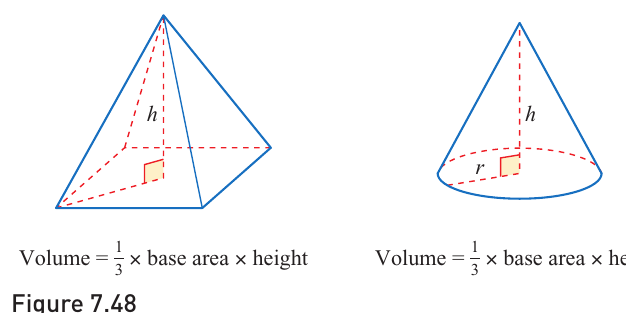
Pyramids and cones are important 3D shapes that share a common volume formula. Both shapes have a base and come to a point (apex), and both have the same volume calculation method.
Important
Volume formula for pyramids and cones:
This formula works whether the base is a square (pyramid), triangle (triangular pyramid), circle (cone), or any other shape. The key is that the height must be measured perpendicular to the base.
Example
Worked Example: Pyramid and Cone Volume Comparison
Problem: A cone with base radius 6 cm and height cm has the same volume as a pyramid with square base of side cm. What is the height of the pyramid?
Solution: Let = height of pyramid
Volume of pyramid = Volume of cone
This problem demonstrates how the volume formula applies equally to both pyramids and cones, making it easy to compare volumes or find missing dimensions.
Key formulas summary
Summary
Essential Formulas to Remember:
- 3D Pythagoras theorem:
- Volume of pyramid or cone:
- Area of triangle:
- Sine rule:
- Cosine rule:
Common exam strategies
When solving 3D geometry problems, follow these proven strategies:
- Draw clear diagrams - Label all known information and what you need to find
- Break down 3D problems - Look for 2D triangles within the 3D shape
- Use right angles - They often provide the key to using Pythagoras' theorem
- Identify perpendicular lines - Essential for finding angles between lines and planes
- Work systematically - Find unknown lengths before attempting to find angles
- Check your answers - Do they make geometric sense?
Note
Remember that most 3D problems can be solved by identifying the right 2D triangles within the 3D shape and applying familiar 2D techniques like Pythagoras' theorem and basic trigonometry.
Summary
Key Points to Remember:
- A plane is a flat surface that can be tilted at any angle, not just horizontal
- In 3D space, two lines can be parallel, intersecting, or skew (a third option not available in 2D)
- To find angles between lines and planes, or between two planes, always work with perpendicular lines
- The 3D version of Pythagoras' theorem () is essential for finding distances in rectangular solids
- Both pyramids and cones use the same volume formula: