The cosine rule (AQA GCSE Further Maths): Revision Notes
📚Revision Notes
The cosine rule
What is the cosine rule?
The cosine rule is a powerful mathematical tool that helps us find unknown sides or angles in any triangle. Unlike the sine rule, the cosine rule is particularly useful when you have specific information about a triangle - either when you know two sides and the included angle, or when you know all three sides but need to find an angle.
The cosine rule works for any triangle, whether it's acute, obtuse, or right-angled, making it more versatile than some other triangle-solving methods.
Note
The cosine rule is especially powerful because it works where the sine rule might fail. When you don't have a complete side-angle pair, or when you're dealing with the ambiguous case of the sine rule, the cosine rule provides a reliable alternative.
The two main formulas
There are two versions of the cosine rule, and choosing the right one depends on what you're trying to find:
For finding a side length (when you know two sides and the included angle):
For finding an angle (when you know all three sides):
In these formulas, the letters , , and represent the lengths of the sides of the triangle, while , , and represent the angles opposite to those sides respectively. This is standard triangle notation that you'll see throughout geometry.
Important
Choosing the Right Formula:
- Use when you have SAS (Side-Angle-Side) information
- Use when you have SSS (Side-Side-Side) information
Remember: "SAS for sides, SSS for angles"
The cosine rule can also be written in alternative forms depending on which side or angle you're looking for:
How the cosine rule works - the proof
Understanding where the cosine rule comes from helps you remember and apply it correctly. The rule is derived using the Pythagorean theorem applied to a cleverly constructed diagram.
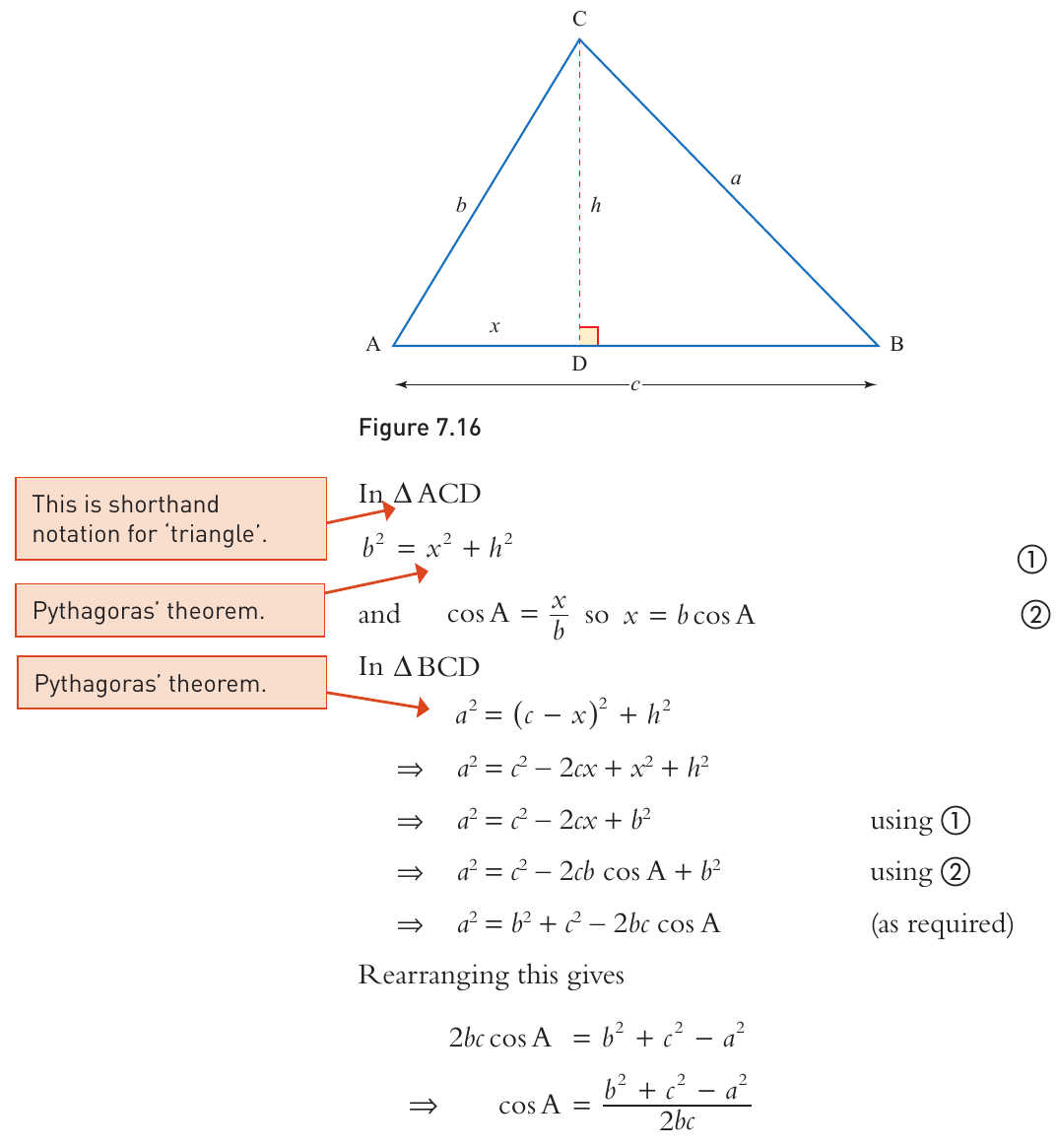
The proof starts with triangle ABC, where we draw a perpendicular line (altitude) from vertex C down to the base AB, creating point D. This altitude has height and divides the base into two segments of lengths and .
This creates two right-angled triangles: triangle ACD and triangle BCD. By applying the Pythagorean theorem to both triangles and using trigonometric relationships, we can derive the cosine rule formula through algebraic manipulation.
Note
Key Insight in the Proof: The crucial step is recognising that , which means . When we substitute this into our Pythagorean relationships and simplify, we arrive at the familiar cosine rule formula: .
Think of the cosine rule as "Pythagoras with an extra correction term" - the part adjusts for the angle that isn't 90°.
Worked example - finding a side length
Let's see how to use the cosine rule to find an unknown side when you know two sides and the included angle.
Example
Worked Example: Finding a Side Length
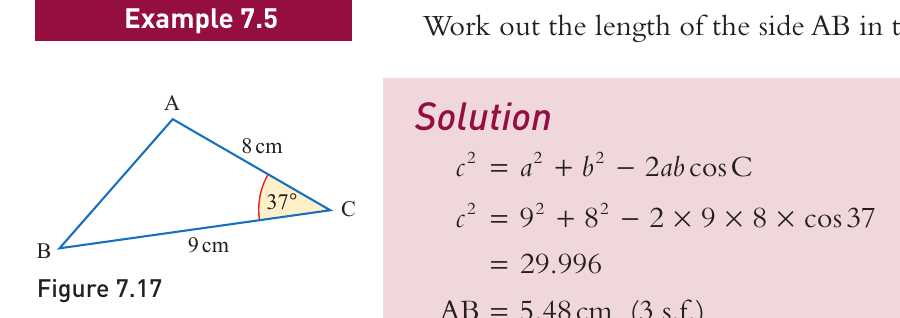
Problem: In triangle ABC, AC = 8 cm, BC = 9 cm, and angle C = 37°. Find the length of side AB.
Solution: Since we know two sides and the included angle, we use the first form of the cosine rule:
Substituting our known values:
Therefore: cm (to 3 significant figures)
Worked example - finding an angle
Now let's see how to find an unknown angle when you know all three sides.
Example
Worked Example: Finding an Angle
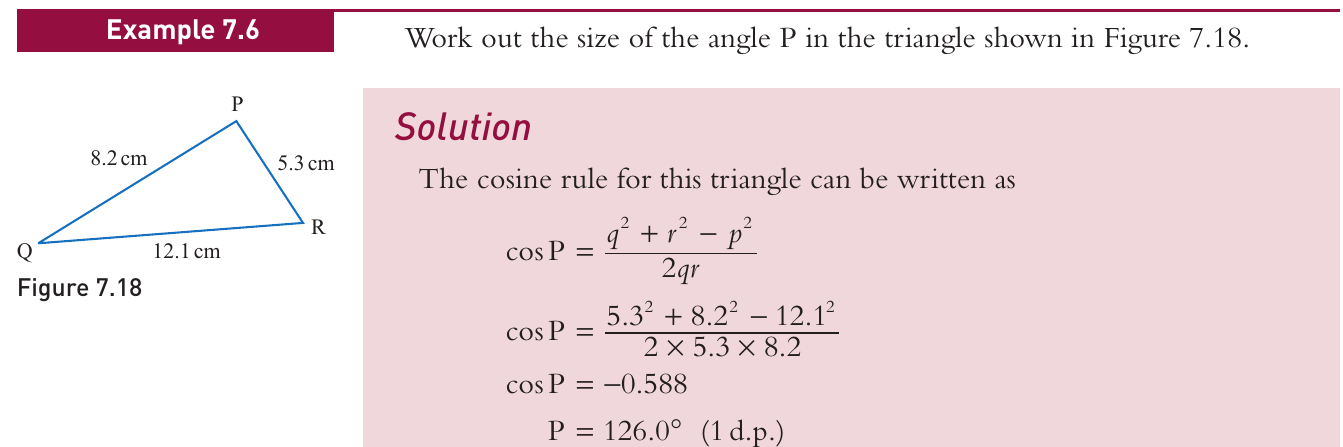
Problem: In triangle PQR, PQ = 8.2 cm, PR = 5.3 cm, and QR = 12.1 cm. Find angle P.
Solution: Since we know all three sides, we use the second form of the cosine rule:
Where and are the sides adjacent to angle P, and is the opposite side.
Therefore: (to 1 decimal place)
Note that this gives us an obtuse angle, which makes sense since the longest side (12.1 cm) is opposite to this angle.
Common mistakes and exam tips
Important
Common Mistakes to Avoid:
Calculator errors: When working with the cosine rule on non-calculator papers, evaluate the terms , , and separately. A common mistake is to calculate first and then multiply by , but this is incorrect. The correct order of operations is crucial.
Forgetting to square root: When finding a side length, remember that the cosine rule gives you the square of the side length. Don't forget to take the square root to get your final answer!
Using the wrong formula: Make sure you choose the right version of the cosine rule. Use when finding a side, and when finding an angle.
Obtuse angles: When finding angles, don't be surprised if you get an obtuse angle (greater than 90°). The cosine of an obtuse angle is negative, which is perfectly normal in triangle calculations.
Summary
Key Points to Remember:
-
The cosine rule works for ANY triangle and is especially useful when you know two sides and the included angle (SAS) or all three sides (SSS)
-
There are two main forms: for finding sides, and for finding angles
-
The cosine rule is derived from the Pythagorean theorem and can be thought of as "Pythagoras with an extra correction term"
-
Always check your calculator work carefully and remember to square root when finding side lengths
-
Be prepared for obtuse angles when finding angles - a negative cosine value indicates an angle greater than 90°