The sine rule (AQA GCSE Further Maths): Revision Notes
📚Revision Notes
The sine rule
Introduction to the sine rule
The sine rule is one of two fundamental trigonometric rules that can be applied to any triangle, making it particularly valuable when working with scalene triangles (triangles where all sides and angles are different). Unlike basic trigonometric ratios which only work in right-angled triangles, the sine rule extends our ability to solve problems involving any type of triangle.
Note
The key advantage of the sine rule is that it works with any triangle, not just right-angled ones. This makes it an essential tool for solving problems involving triangles where traditional SOH CAH TOA methods cannot be applied.
The sine rule emerges from the relationship between a triangle's area and its sides and angles. For any triangle, we know that the area can be calculated using different combinations of sides and angles. This leads us to a powerful relationship that connects each angle in a triangle with the length of its opposite side.
Triangle notation and the sine rule formula
Before diving into the sine rule, it's essential to understand standard triangle notation. In any triangle, we label the vertices with capital letters (A, B, C) and the sides with corresponding lowercase letters, where each side is opposite to its corresponding vertex.
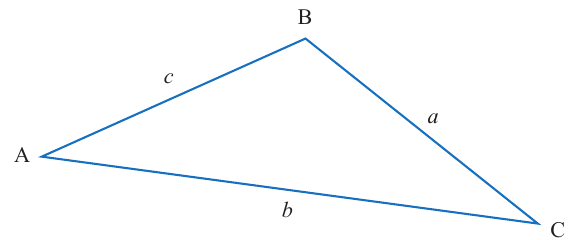
The sine rule states that in any triangle, the ratio of each side to the sine of its opposite angle is constant. This can be written in two equivalent forms:
Form 1 (ratio form):
Form 2 (fraction form):
When to use each form of the sine rule
Understanding which form to use is crucial for efficient problem-solving:
Note
Choosing the Right Form:
-
Use Form 1 () when you need to find an unknown angle. This form is more convenient because it puts the sine of the angle in the numerator.
-
Use Form 2 () when you need to find an unknown side length. This form is better because it puts the side length in the numerator, making calculations more straightforward.
When the sine rule applies
The sine rule can be used in any triangle, but it's particularly useful when:
- You have two angles and one side (AAS or ASA)
- You have two sides and an angle opposite one of them (SSA)
However, remember that if you're dealing with a right-angled triangle, basic trigonometric ratios (SOH CAH TOA) and Pythagoras' theorem are often simpler to use, though the sine rule will still work.
Worked example: finding a side length
Example
Worked Example: Finding Side Length BC
Let's work through finding the length of side BC in a triangle where we know some angles and one side.
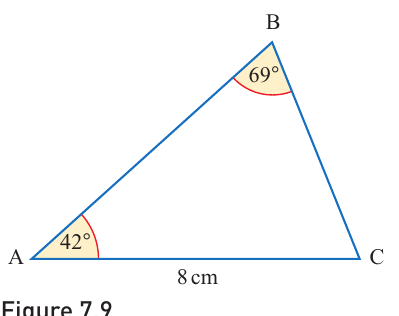
Given information:
- Angle A = 42°
- Angle B = 69°
- Side AC = 8 cm
- Need to find: side BC
Step-by-step solution:
Step 1: Identify what we're looking for. We want to find side BC, which is the side opposite angle A. Since we're finding a side length, we'll use Form 2 of the sine rule.
Step 2: Set up the sine rule equation:
Step 3: Apply our known values:
Step 4: Solve for BC:
Important
Calculation Tip: Always perform the entire calculation on your calculator without rounding intermediate steps, only rounding your final answer to the required precision. This prevents accumulation of rounding errors.
Worked example: finding an angle with the ambiguous case
When using the sine rule to find an angle, you need to be particularly careful because there might be two possible solutions. This occurs when you have two sides and an angle opposite one of them (the SSA case).
Example
Worked Example: Finding an Angle with the Ambiguous Case
Given information:
- Triangle PQR with angle R = 32°
- Side r = 4 cm
- Side p = 7 cm
- Need to find: angle P
Step-by-step solution:
Step 1: Since we're finding an angle, we use Form 1 of the sine rule:
Step 2: Set up our equation:
Step 3: Solve for sin P:
Step 4: Find the angles. Our calculator gives us P = 68.0°. However, since sine is positive in both the first and second quadrants, there's potentially another solution: P = 180° - 68.0° = 112.0°.
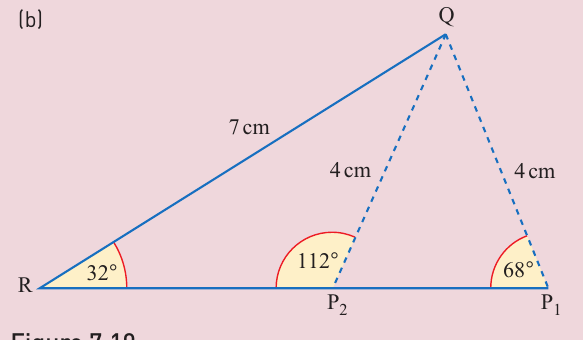
Both solutions are mathematically possible, creating two different triangles as shown in the diagram.
Important
The Ambiguous Case Warning: Always verify that your second solution creates a valid triangle. Check that the angles in each triangle sum to 180°. Sometimes one of the solutions will give an impossible triangle where the angle sum exceeds 180°.
Common exam traps and tips
Important
The Ambiguous Case Trap
The most common mistake students make is forgetting about the possibility of two solutions when finding an angle using the sine rule. Remember:
- When finding an angle using the sine rule, always consider both the acute and obtuse solutions
- Check that both potential triangles are geometrically possible
- The longest side must be opposite the largest angle, and the shortest side must be opposite the smallest angle
Note
Calculation Accuracy Tips
- Perform calculations entirely on your calculator before rounding
- Only round your final answer to the required number of decimal places or significant figures
- Be especially careful with angle calculations where small rounding errors can lead to significantly different results
Note
Choosing the Right Method
- For right-angled triangles, basic trigonometry (SOH CAH TOA) is usually simpler
- For scalene triangles, the sine rule is often the most appropriate method
- Always check what information you have and what you need to find before choosing your approach
Key relationships to remember
Note
Fundamental Connections
The sine rule connects three fundamental relationships in any triangle:
- Each angle is linked to its opposite side
- The ratios remain constant throughout the triangle
- The rule works for any triangle, regardless of its shape or size
Understanding these connections helps you set up problems correctly and avoid common mistakes in examinations.
Remember!
Summary
Key Points to Remember:
- The sine rule formula: or
- Form 1 is best for finding angles, Form 2 is best for finding side lengths
- Always check for two possible solutions when finding angles - this is the ambiguous case
- The sine rule works for any triangle, but simpler methods might be available for right-angled triangles
- Calculate everything on your calculator first, then round only the final answer to avoid accumulating errors