Housing challenge in the UK (AQA GCSE Geography): Revision Notes
📚Revision Notes
Housing challenge in the UK
The UK is experiencing a significant housing crisis that affects millions of people across the country. Understanding the scale and complexity of this challenge is crucial for appreciating its impact on society and the economy.
What is the UK housing shortage?
Population and demographic pressures
The UK's housing shortage stems from several interconnected demographic factors that have intensified over recent decades. The scale of population growth has been remarkable, with the UK population now exceeding 67 million people, creating unprecedented demand for housing.
In 2022, there were 28.2 million households in the UK, representing a substantial increase of 6.1% (1.6 million households) since 2012. This growth has several key characteristics:
- The population is unevenly distributed across the country, with the highest population densities concentrated in the southeast region
- There has been a notable growth in single-person households, which increases the overall demand for housing units
- These demographic changes have led to a critical shortage of housing, particularly affecting London and the southeast regions
Important
It is estimated that approximately 8 million people are directly affected by the UK's housing crisis, representing a significant portion of the population facing housing insecurity.
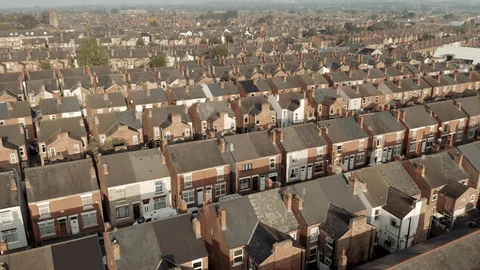
Current housing supply challenges
The supply of new housing in the UK falls significantly short of what is needed to meet demand. The gap between government ambitions and actual delivery highlights the complexity of addressing the housing crisis.
Government targets versus reality:
- The UK government has set an ambitious target of building 300,000 new houses per year
- However, the National Housing Federation (NHF) estimates that 340,000 houses per year are actually needed to meet current demand
- Of these, 145,000 should be affordable housing to address the needs of lower-income households
Actual housing supply:
- The new housing supply in 2019/20 was only 243,000 homes
- This represents a significant decrease from the peak of new house building in 1966, when 350,000 new houses were constructed
- The gap between what is needed and what is being built continues to widen each year
Note
Housing shortage refers to the situation where the demand for housing exceeds the available supply, leading to increased prices and reduced accessibility for many people.
Housing demand versus supply analysis
Understanding the relationship between housing demand and supply is essential for grasping the scale of the housing challenge. The mathematical relationship between these factors clearly demonstrates the extent of the crisis.
Supply and demand gap calculation
Example
Worked Example: Calculating the Housing Shortfall
Using 2023 data to calculate the annual housing shortfall:
Step 1: Identify the demand and supply figures
- Estimated annual demand: 340,000 houses
- Actual annual supply: 243,000 houses
Step 2: Calculate the shortfall Shortfall = Demand - Supply Shortfall = 340,000 - 243,000 = 97,000 houses per year
This substantial gap means that the housing crisis continues to worsen annually, as demand consistently outstrips supply.
Development patterns
To address housing shortages, several development approaches are being used, though each comes with its own challenges and controversies:
- Planning permission is increasingly being granted for developments on the urban fringe of towns and cities
- New homes are also being built on the opposite side of the Green Belt, leading to the creation of commuter towns and villages
- These developments often face opposition from environmental groups like the Campaign for the Protection of Rural England (CPRE), who argue that building on brownfield sites would be more sustainable
Unsuitable housing conditions
The housing challenge extends beyond simple shortages to include the quality and suitability of existing accommodation. Poor housing conditions create a cascade of social problems that affect individuals, families, and communities.
Scale of the problem
According to Shelter, the homelessness charity, approximately 3 in 10 people in the UK live in unsuitable housing conditions. This represents a staggering scale of housing inadequacy that affects over 3.7 million people who are living in overcrowded accommodation.
Note
Unsuitable accommodation includes housing that is overcrowded, unaffordable, or substandard in terms of safety and living conditions.
Types of unsuitable housing
Overcrowded housing:
- The most significant issue affecting housing quality
- Over 3.7 million people in the UK are affected by living in overcrowded conditions
- This occurs when there are insufficient rooms or space for the number of occupants
Unaffordable housing:
- Housing that costs more than households can reasonably afford
- Often defined in relation to local income levels and housing costs
Substandard housing:
- Accommodation that fails to meet basic safety and habitability standards
- May include issues with heating, insulation, structural safety, or sanitation
Consequences of unsuitable housing
Living in unsuitable housing conditions leads to serious social and health problems that extend far beyond the individual household:
- Ill-health: Poor living conditions contribute to physical and mental health problems
- Disruption to children's education: Overcrowded or unstable housing affects children's ability to study and develop
- Homelessness: Unaffordable housing can lead to people losing their homes entirely
- Unsafe conditions: Substandard housing poses risks to residents' safety and wellbeing
House prices and affordability crisis
The relationship between house prices and earnings reveals stark regional inequalities that make homeownership impossible for many people, even those in professional occupations.
Regional price variations
House prices across the UK vary dramatically, creating significant regional differences in housing affordability. The price-to-earnings ratio is a key indicator of housing affordability.
Most expensive regions (2022 data):
- London: £534,977 average house price, £55,234 average earnings (9.7 price-to-earnings ratio)
- South East: £385,790 average house price, £41,377 average earnings (9.3 ratio)
- East of England: £330,883 average house price, £38,739 average earnings (8.5 ratio)
More affordable regions:
- North East: £162,692 average house price, £35,134 average earnings (4.6 ratio)
- Northern Ireland: £177,265 average house price, £34,565 average earnings (5.1 ratio)
- Scotland: £194,621 average house price, £38,070 average earnings (5.1 ratio)
Affordability challenges
The housing affordability crisis is characterised by several concerning trends that affect both buyers and renters:
- London and the South East regions have the least affordable housing in the country
- Average house prices are more than nine times the average salary in the most expensive areas
- Mortgage lenders typically lend borrowers up to 4.5 times their annual salary
Important
In 2024, an Office for National Statistics (ONS) survey found that 35% of people paying a mortgage or rent were struggling to afford their payments, indicating widespread financial stress related to housing costs.
Affordable housing has no single agreed definition, but the National Housing Federation describes it as "what is considered an affordable price in the local area." The government defines affordable homes as those which cost 80% of the average market value in the area. However, even this reduced cost often remains unaffordable for many households.
Supply of affordable housing
The shortage of affordable housing represents one of the most critical aspects of the housing crisis, as it directly affects the most vulnerable members of society who cannot access market-rate housing.
Current shortfall in affordable housing
The gap between need and supply in affordable housing is particularly severe:
- The National Housing Federation estimates that 145,000 affordable homes need to be built each year
- The current supply of affordable housing is only 58,000 homes annually
- This means there is a shortfall of approximately 87,000 affordable homes per year
Example
Worked Example: Affordable Housing Gap
Step 1: Identify annual requirements and supply
- Annual need: 145,000 affordable homes
- Annual supply: 58,000 affordable homes
Step 2: Calculate the shortfall Shortfall = Need - Supply Shortfall = 145,000 - 58,000 = 87,000 affordable homes per year
This represents a 60% shortfall in affordable housing provision.
Historical trends
The supply of affordable housing has fluctuated significantly over recent decades, with policy changes and economic conditions affecting delivery:
- In 2015, there was the lowest supply of affordable housing for 25 years, with only 32,000 new affordable homes built
- By 2021/22, there had been an increase in the supply of new affordable housing to 60,000 homes
- Despite this improvement, the supply still falls well short of what is needed to address the crisis
Policy implications
The data shows that while there has been some recent improvement in affordable housing supply, much more needs to be done to address the fundamental shortage. The gap between what is needed (145,000) and what is being delivered (60,000) represents a critical policy challenge that requires sustained government intervention and investment.
Summary
Key Points to Remember:
- The UK housing crisis affects approximately 8 million people and stems from population growth exceeding housing supply
- There is an annual shortfall of 97,000 houses, with only 243,000 built against a need for 340,000
- 3 in 10 people live in unsuitable housing conditions, including overcrowded, unaffordable, or substandard accommodation
- London has the least affordable housing, with house prices 9.7 times average earnings, compared to 4.6 times in the North East
- Only 58,000 affordable homes are built annually, but 145,000 are needed, creating a massive shortfall in affordable housing supply
- 35% of households are struggling to afford their mortgage or rent payments, indicating widespread housing stress