Graph Transformations (AQA GCSE Maths): Revision Notes
📚Revision Notes
Graph transformations
Understanding function notation
Before diving into transformations, it's important to understand function notation. When you see , don't worry - it's not complicated! This is simply a way of writing "some expression involving x". Think of as a shorthand way of referring to any function without having to write out the full equation each time.
Note
Understanding function notation is crucial before learning transformations. The symbol represents any mathematical function, and once you're comfortable with this notation, transformations become much easier to understand and apply.
Vertical translations:
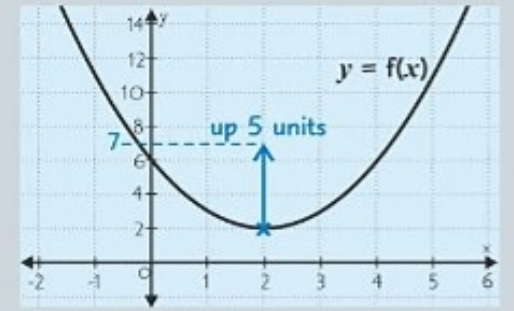
Vertical translations are transformations that move the entire graph up or down along the y-axis. When you add or subtract a number to the end of a function, you're creating a vertical translation.
The general form is:
- When 'a' is positive, the graph moves up by 'a' units
- When 'a' is negative, the graph moves down by 'a' units
This transformation is achieved by simply adding a constant to the function. Every point on the original graph will have the same x-coordinate, but the y-coordinate will be increased (or decreased) by the value of 'a'.
Example
Worked Example: Vertical Translation
If the minimum point of is at coordinates , then after applying the transformation :
Step 1: Identify the original point: Step 2: Apply the transformation by adding 5 to the y-coordinate: Step 3: The new minimum point is at
The shape remains exactly the same - it's just moved 5 units higher.
Important
Key Point: For vertical translations, the transformation affects the y-coordinates only. The x-coordinates remain unchanged, and the shape of the graph stays identical.
Horizontal translations:
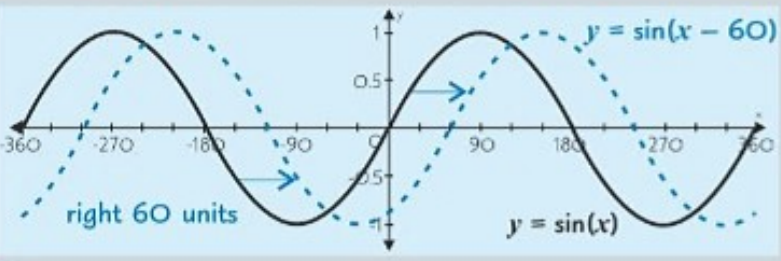
Horizontal translations move the entire graph left or right along the x-axis. This transformation involves changing what goes inside the function brackets.
The general form is:
- When 'a' is positive, the graph moves right by 'a' units
- When 'a' is negative, the graph moves left by 'a' units
Important
Common Mistake Alert: This might seem counterintuitive at first - subtracting moves the graph to the right! Think of it this way: if you want the function to have the same y-value at that it originally had at , you need to use .
Example
Worked Example: Horizontal Translation
If crosses the x-axis at , then will cross the x-axis at .
Step 1: Original crossing point: Step 2: Apply transformation Step 3: New crossing point:
The entire sine curve has shifted 60 degrees to the right.
Reflections: and
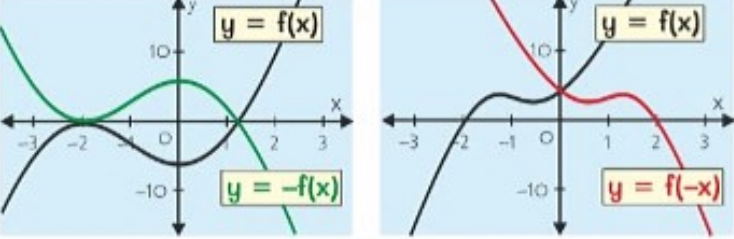
Reflections create mirror images of the original graph across either the x-axis or y-axis. There are two types of reflections you need to know.
Reflexion across the x-axis:
When you place a negative sign in front of the entire function, you get a reflexion across the x-axis. Every point on the original graph will have the same x-coordinate, but the y-coordinate will be multiplied by -1.
Reflexion across the y-axis:
When you place a negative sign inside the function brackets (affecting the x-values), you get a reflexion across the y-axis. Every point on the original graph will have the same y-coordinate, but the x-coordinate will be multiplied by -1.
Important
Memory Aid for Reflections:
- flips the graph over the x-axis
- flips the graph over the y-axis
Notice how the negative sign's position tells you which axis to flip across!
Working with coordinate transformations
When applying transformations, it's helpful to identify key points on the original graph (like maximum points, minimum points, or intercepts) and then apply the transformation rules to find where these points end up on the new graph.
Example
Worked Example: Multiple Transformations
If you know that the maximum point of is at , you can work out where this point moves to under different transformations:
For :
- Original point:
- Apply reflexion across y-axis: -coordinate becomes
- New point:
For :
- Original point:
- Apply vertical translation down 4 units: -coordinate becomes
- New point:
For :
- Original point:
- Apply horizontal translation right 2 units: -coordinate becomes
- Apply vertical translation up 1 unit: -coordinate becomes
- New point:
Note
The shape of the graph never changes - only its position or orientation. This is a fundamental principle that applies to all transformations.
Summary
Key Points to Remember:
- Vertical translations (): Add to the function to move up, subtract to move down
- Horizontal translations (): Subtract from x to move right, add to x to move left
- Reflection in x-axis (): Negative sign outside the function flips over x-axis
- Reflection in y-axis (): Negative sign inside the function flips over y-axis
- The shape of the graph never changes - only its position or orientation