y = mx + c (AQA GCSE Maths): Revision Notes
📚Revision Notes
The equation of a straight line: y = mx + c
Understanding the standard form
The equation is the most common way to write straight-line equations, and it's particularly useful for GCSE exams. This format is called the standard form or slope-intercept form.
In this equation:
- m represents the gradient (or slope) of the line
- c represents the y-intercept (the point where the line crosses the y-axis)
Note
The standard form makes it immediately clear what the key features of the line are - you can read the gradient and y-intercept directly from the equation without any calculation.
Rearranging equations into standard form
Many straight-line equations don't initially appear in the format. The first step is often to rearrange them into this standard form. This involves using algebraic manipulation to isolate y on one side of the equation.
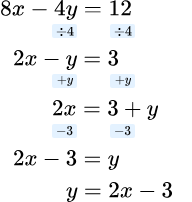
Important
When rearranging, be careful not to mix up the positions of and . Remember that is always the coefficient of (the number in front of ), whilst is the constant term that stands alone.
Finding the equation from a graph
When you're given a graph of a straight line, you can determine its equation by identifying two key features:
- The y-intercept (c): Look for where the line crosses the y-axis
- The gradient (m): Calculate how much the line rises or falls for each unit it moves horizontally
The gradient is calculated using the formula:
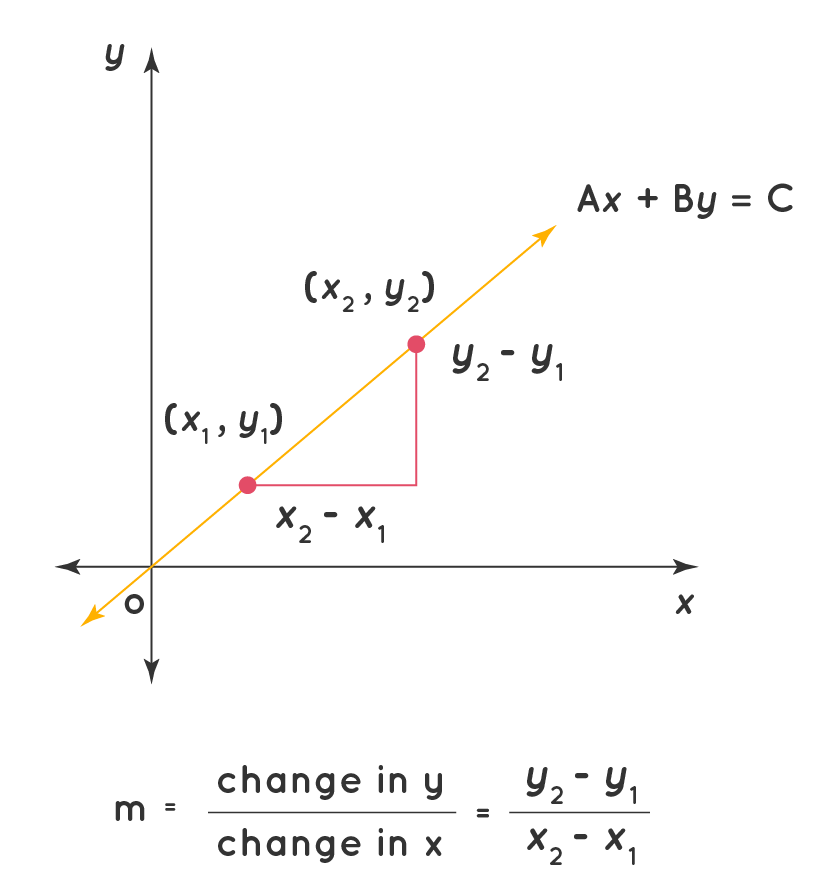
Once you have both values, simply substitute them into the format to get your equation.
Note
When reading from a graph, always use a ruler to ensure accuracy, and choose points that lie exactly on grid lines where possible to avoid rounding errors.
Finding the equation using two points
If you're given two points that lie on a straight line, you can find the equation using this method:
- Calculate the gradient: Use the formula
- Substitute into the general form: Use and substitute one of the points along with your calculated gradient
- Solve for c: Rearrange to find the y-intercept value
- Write the final equation: Substitute both and back into
Example
Worked Example: Finding the equation from two points
If a line passes through points and :
Step 1: Calculate the gradient
Step 2: Use one point to find Using point : So , therefore
Step 3: Write the final equation
Important reminders
Converting between different forms of linear equations is a common exam requirement. You might be asked to express your answer in forms like , but the method is usually the most straightforward approach to start with.
Practice identifying the gradient and y-intercept from both graphs and equations, as this skill appears frequently in GCSE mathematics papers.
Important
Always double-check your work by substituting both original points back into your final equation to verify it's correct.
Summary
Key Points to Remember:
- The standard form makes it easy to identify key features of straight lines
- is the gradient (steepness) and is the y-intercept (where the line crosses the y-axis)
- Always rearrange equations to get by itself on one side
- You can find equations from graphs by reading the y-intercept and calculating the gradient
- Two points are sufficient to determine any straight-line equation using the gradient formula