Vectors (AQA GCSE Maths): Revision Notes
📚Revision Notes
Vectors
What are vectors?
Vectors describe how to move from one point to another, showing both the distance you travel and the direction you go. At first glance, they might seem a bit unusual, but once you understand the key concepts, they become much more manageable.
Note
Think of vectors as instructions for movement - they tell you exactly how far to go and which way to head. Unlike regular numbers, vectors carry information about both magnitude (size) and direction.
Vector notation
There are several different ways we can write vectors, and it's important to know them all for your exams.
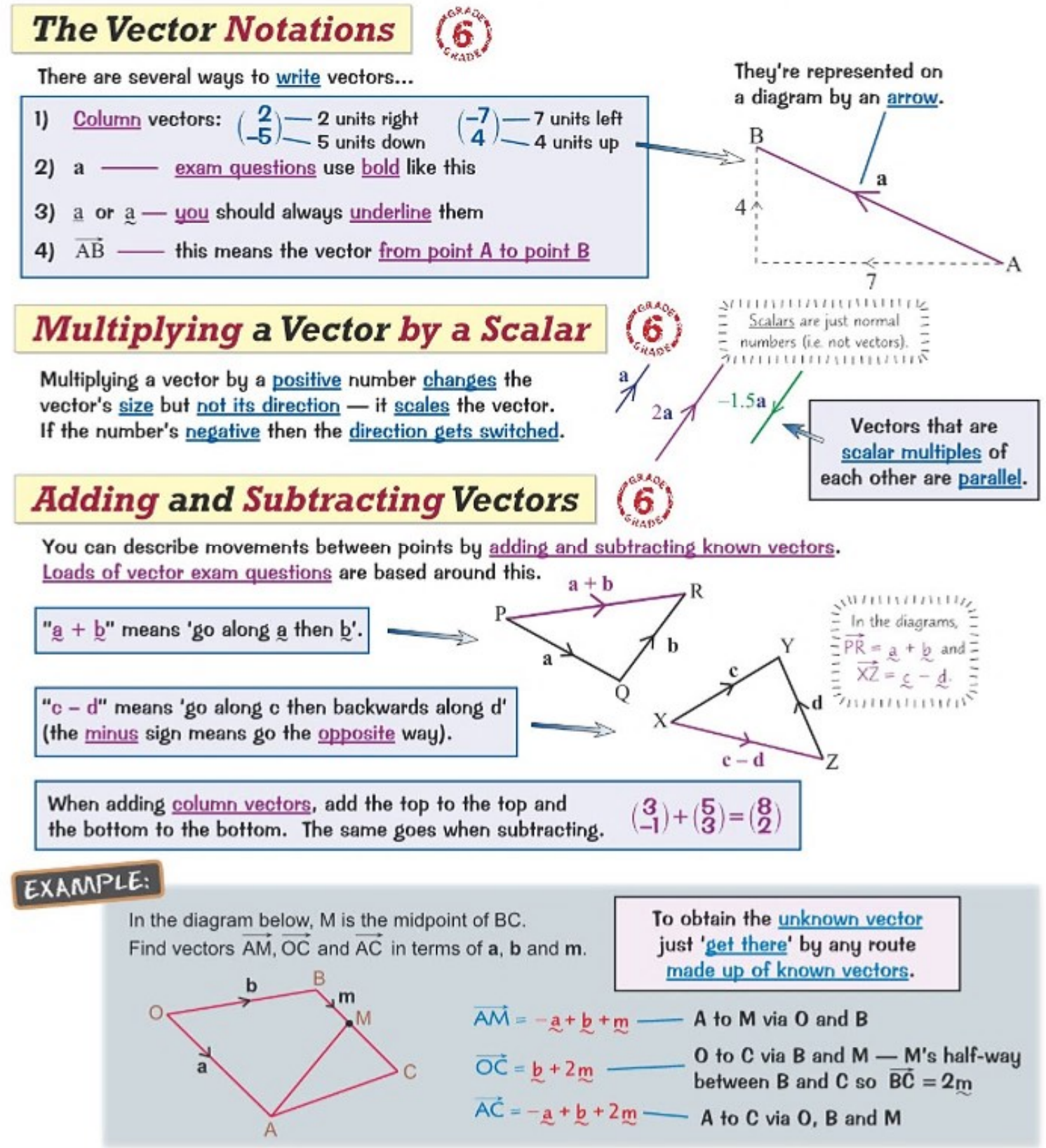
Column vectors are written as two numbers in brackets, one above the other. The top number shows horizontal movement (positive means right, negative means left), and the bottom number shows vertical movement (positive means up, negative means down). For example, the vector means move 2 units right and 5 units down.
Letter notation is used in exam questions where vectors are represented by letters like a or b. In handwritten work, you should always underline these letters to show they represent vectors.
Position vectors like show movement from point A to point B, with the arrow indicating the direction.
Note
Exam Tip: Always check which notation style your exam question uses. You'll need to be comfortable switching between column vectors, letter notation, and position vector notation depending on the context.
Multiplying vectors by scalars
When we multiply a vector by a number (called a scalar), we change the vector's size but keep it pointing in the same direction - unless the number is negative, which flips the direction completely.
Multiplying by a positive number scales the vector up or down while maintaining its direction. For instance, if vector a represents a certain movement, then represents the same movement but twice as long.
When we multiply by a negative number, the vector not only changes size but also reverses direction. So would be 1.5 times longer than a but pointing in the opposite direction.
Important
Key Concept: Vectors which are scalar multiples of each other are parallel. This means they point in the same direction (or exactly opposite directions if one scalar is negative). This property is fundamental for proving that points lie on straight lines.
Example
Worked Example: Scalar Multiplication
If , then:
- (same direction, twice as long)
- (opposite direction, half as long)
Adding and subtracting vectors
Vector addition and subtraction help us describe movements between different points by combining known vectors.
Vector addition means "go along vector a, then go along vector b". This creates a path from your starting point to your final destination.
Vector subtraction means "go along vector c, then go backwards along vector d". The minus sign tells us to travel in the opposite direction to vector d.
When working with column vectors, we add or subtract them by combining the top numbers together and the bottom numbers together.
Example
Worked Example: Vector Addition
This means: move 3 right and 1 down, then move 5 right and 3 up, giving a total movement of 8 right and 2 up.
Proving points lie on straight lines
One of the most important applications of vectors is proving that three points are collinear (lie on the same straight line).
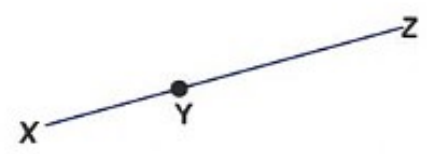

The key principle is that if three points X, Y, and Z lie on a straight line, then the vector must be a scalar multiple of vector . This is because both vectors point along the same line, just with different lengths.
Important
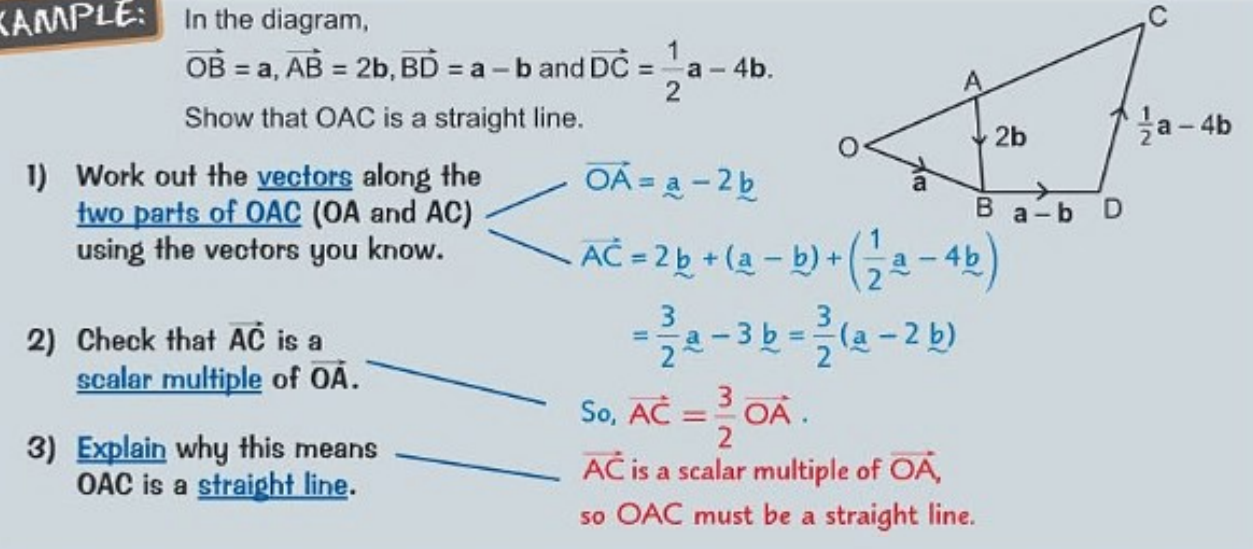
Critical Method: To prove collinearity, you must show that one vector is a scalar multiple of another. Simply showing that vectors have the same direction is not sufficient - you need to demonstrate the exact scalar relationship.
Example
Worked Example: Proving Collinearity
To prove that points X, Y, and Z are collinear:
Step 1: Calculate the vectors between the points using the given information
- Find and
Step 2: Show that one vector is a scalar multiple of another
- Demonstrate that for some scalar
Step 3: Explain that this scalar relationship proves the points form a straight line
- State: "Since , the vectors are parallel and share point Y, therefore X, Y, and Z are collinear."
Ratios in vector problems
Ratios help us find the lengths of different sections along a straight line when we know how the line is divided.
If we know that , this tells us that and . This is particularly useful when dealing with parallelograms and other geometric shapes where we need to find unknown vectors.
When working with ratios, we can use information about parallel sides and the given ratio to find missing vectors step by step.
Note
Helpful Strategy: When tackling ratio problems, always start by identifying what you know and what you need to find. Draw a diagram if possible, and remember that ratios give you the proportional relationship between different parts of the same line.
Summary
Key Points to Remember:
- Vector notation can be written as column vectors, underlined letters, or position vectors like
- Multiplying by positive scalars changes size but keeps direction; negative scalars also reverse direction
- Vector addition means "go along the first vector, then the second"; subtraction means "go along the first, then backwards along the second"
- Points are collinear if vectors between them are scalar multiples of each other
- Ratios help us find proportional lengths along straight lines in vector problems