Atomic Structure (AQA GCSE Physics Combined Science): Revision Notes
📚Revision Notes
4.1.1 Atomic Structure
Note
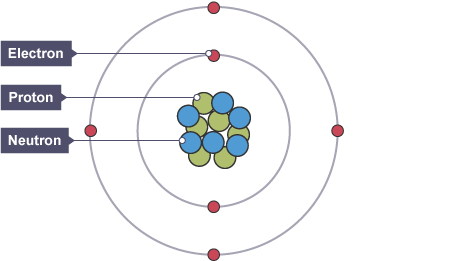
A positively charged nucleus (which contains neutrons and protons) is surrounded by negatively charged electrons.
| Subatomic Particle | Relative Mass | Relative Charge |
|---|---|---|
| Proton | 1 | +1 |
| Neutron | 1 | 0 |
| Electron | 0 (0.0005) | -1 |
Typical radius of an atom: metres
-
And the radius of the nucleus is 10,000 times smaller
-
Most (nearly all) of the mass of the atom is concentrated in the nucleus Electron Arrangement:
-
Electrons lie at different distances from the nucleus (different energy levels). The electron arrangements may change with the interaction with EM radiation.
Atomic Structure: Developing the Model of the Atom
Historical Development
- Greeks:
- Atoms are tiny spheres which cannot be divided.
- Thomson's Plum Pudding Model:
- An atom is a ball of positive charge with negative electrons embedded in it.
1909 - Rutherford's Alpha Scattering Experiment
- Fired a beam of alpha particles (positively charged) at a thin sheet of gold foil.
- Most particles went straight through → Atom is mostly empty space.
- Some were deflected → The Centre of the atom must have a positive charge, repelling particles that come close to it.
- Some bounced straight back → Mass is concentrated in the centre.
- This research led to the development of the first nuclear model.
Bohr's Model
- Electrons orbit the nucleus at specific distances.
- Orbits are called energy levels or shells.
Updated Nuclear Model
- Positive Nucleus: Contains protons and neutrons.
- Electron Energy Levels: Electrons occupy energy levels or shells around the nucleus.
James Chadwick
- Proved the existence of the neutron which explained the imbalance between atomic and mass numbers.
Current Model of the Atom
- Nucleus: Contains protons and neutrons.
- Electrons: Occupy energy levels or shells around the nucleus.
Atomic Structure and Energy Levels
Subatomic Particles
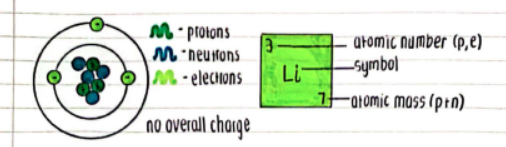
- Protons (p)
- Positive charge
- Neutrons (n)
- Neutral charge
- Electrons (e)
- Negative charge
- Overall Charge
- Atoms have no overall charge.
Atomic Representation
- Atomic Number (p, e):
- Number of protons and electrons in the atom.
- Atomic Mass (p + n):
- The sum of protons and neutrons in the atom.
- Symbol:
- Element symbol (e.g., Li for Lithium).
Energy Levels
- Higher Energy Levels:
- Energy levels further from the nucleus are at a higher energy.
- Absorption and Emission of Electromagnetic Radiation:
- If the atom absorbs electromagnetic radiation, an electron can move from a lower energy level to a higher energy level.
- The atom can then emit electromagnetic radiation, causing the electron to return to the lower energy level.