Waves in Air, Fluids & Solids (AQA GCSE Physics Combined Science): Revision Notes
📚Revision Notes
6.1.6 Required Practical: Measuring Wave Properties
Properties of Waves
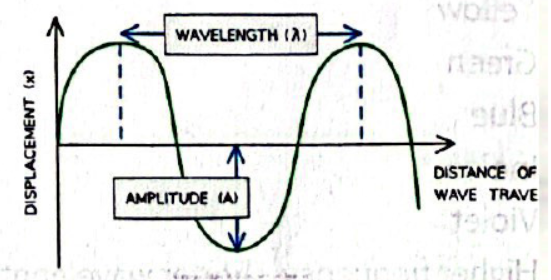
- Amplitude: The maximum displacement of a point on a wave from its undisturbed position.
- Wavelength (λ): The distance of a point on one wave to the equivalent point on an adjacent wave.
- For longitudinal waves, the wavelength is from one compression to the next compression.
- Frequency (Hz): The number of waves passing a point each second.
- 1 Hz = 1 wave per second.
- Period: The time in seconds for one wave to pass a point.
Interaction of Waves with Materials
- Different materials absorb, transmit, or reflect electromagnetic waves.
- Microwaves: Absorbed by foods containing water molecules, reflected by metals.
- Light Waves: Absorbed by black surfaces, reflected by shiny, metallic surfaces.
Properties of Waves
How Atoms Generate Electromagnetic Waves
When electromagnetic waves are generated or absorbed, changes occur in the atoms or nuclei:
- Heating Atoms: When we heat atoms, we cause electrons to move from one energy level to a higher one.
- Electron Movement: When the electron moves back to its original energy level, an electromagnetic wave is generated.
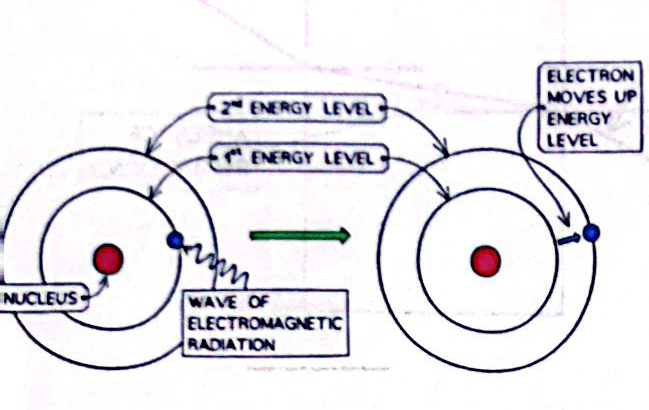
How the Nucleus Generates Electromagnetic Waves
- Gamma Rays: Gamma rays can be emitted from the nucleus of radioactive atoms. Once emitted, the nucleus has less energy than it had at the start.
- When electromagnetic waves are absorbed, they can cause changes to atoms.
- Electromagnetic waves can be emitted or absorbed over a wide range of frequencies (radio waves to gamma rays).
Hazards of Electromagnetic Radiation
- Ultraviolet Waves: Increase the risk of skin cancer and cause the skin to age prematurely.
- X-rays and Gamma Rays: Ionising radiation which knocks electrons off atoms when absorbed, causing gene mutations and increasing the risk of cancer.
Measurement
- Dose of Radiation: Measured in sieverts (Sv) or millisieverts (mSv).
How Radio Waves are Produced
- Production: Radio waves can be produced when electrons oscillate in electrical circuits. These radio waves can be absorbed (e.g., by an electrical circuit in an aerial), causing electrons in the circuit to oscillate, creating an alternating current with the same frequency as the radio waves.