The Motor Effect (AQA GCSE Physics): Revision Notes
📚Revision Notes
7.2.2 The Motor Effect
Note
A wire carrying a current will experience a force in the presence of a magnetic field. This is known as the motor effect.
Note
A current-carrying wire produces its own magnetic field, as does a permanent magnet. This means that if we place the wire (or coil) between the north and south poles of two permanent magnets, then the two magnetic fields will interact.
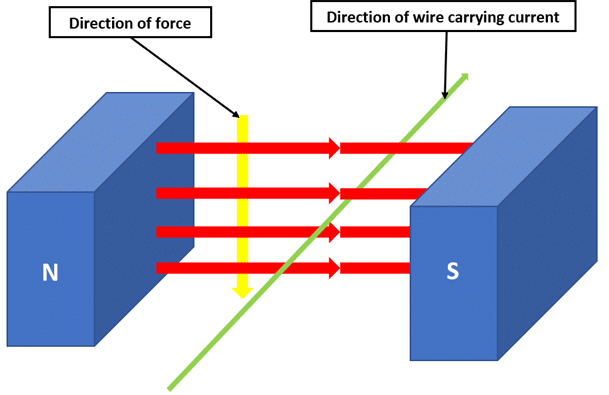
The interaction between the two magnetic fields will result in a force on the wire, pushing it out of the field. This force will be at a right angle to both the direction of the wire carrying current and the direction of the magnetic field.
However, to experience the full force, the wire has to be at exactly 90 degrees (right angle) to the magnetic field. This means that if the wire is at a different angle, it will experience less force. If the wire is going in the same direction as the field, then the wire will experience no force.
Note
Key Points To find the direction of the force, we need to know:
- The direction of the magnetic field
- The direction of the current in the wire