Circular Orbits (AQA GCSE Physics): Revision Notes
📚Revision Notes
8.1.6 Circular Orbits
Note
Planets orbit the sun in almost circular objects. Moons and artificial satellites orbit planets in almost circular objects. Orbits occur due to the force of gravity.
Note
Objects travelling at a constant speed in a circle are changing velocity (because velocity is speed and direction). The motion of the planet would cause it to fly off into space but the force of gravity is attracting the planet towards the sun. the combination of the momentum of the object and the force of gravity towards the centre of the circle means that the planet travels in a circular path around the sun. As there is no friction or air resistance in space, the planet continues at a constant speed in this orbit.
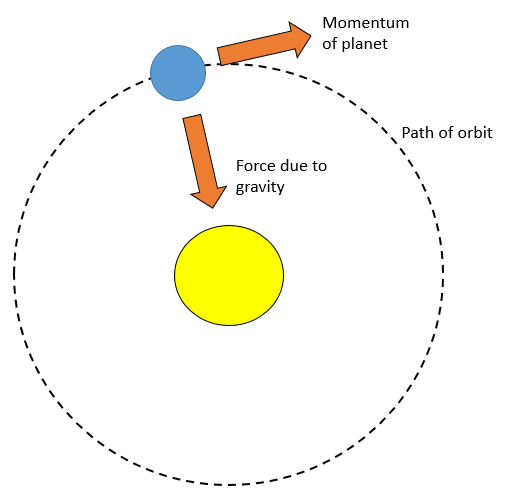
Note
The gravitational force is stronger, the closer you get to the star/planet. The stronger the force, the faster the orbiting object needs to travel to remain in orbit (rather than being pulled to the centre). If the speed of the object changes, the radius of the orbit will also change. The faster the object, the smaller the radius of the orbit.