Strata (AQA GCSE Statistics): Revision Notes
📚Revision Notes
Strata
What is a stratum?
A stratum is a distinct group within a population that shares common characteristics. When we use stratified sampling, we divide the entire population into these separate groups (called strata) based on important features like gender, age, class, or location.
The key principle behind strata is that each group in your sample must represent the same proportion of people as it does in the whole population. This ensures your sample accurately reflects the population you're studying.
Note
The word "strata" is the plural form of "stratum". So we talk about one stratum, but multiple strata when referring to several groups.
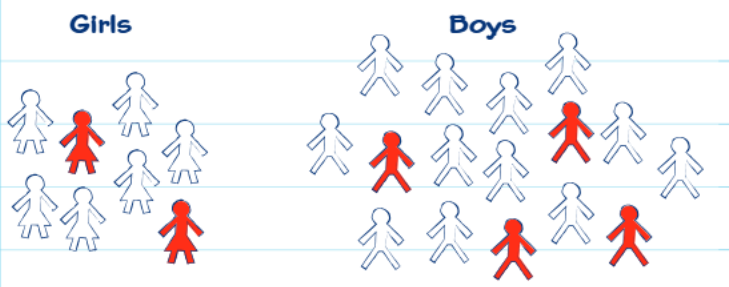
For example, if there are twice as many boys as girls in a school population, then your stratified sample must also contain twice as many boys as girls. This proportional representation is what makes stratified sampling more reliable than simple random sampling.
How to calculate sample sizes for each stratum
The formula for working out how many people to include from each stratum is:
Important
Formula for Stratified Sampling:
This formula ensures that each group is represented proportionally in your sample.
Worked example 1: Gender stratification
Let's look at a gym membership example to see how this works in practice.

Example
Worked Example: Gender Stratification at a Gym
A gym has 200 members in total: 120 males and 80 females. We want to take a stratified sample of 40 members based on gender.
Step 1: Calculate the proportion of males in the population Proportion of males =
Step 2: Apply this proportion to the sample size Number of males in sample =
Result: Our sample of 40 people should include 24 males and 16 females. This maintains the same 3:2 ratio that exists in the full population.
Worked example 2: Class stratification
Here's another example using school classes to demonstrate stratification with multiple groups:

Example
Worked Example: Class Stratification in Primary School
A primary school's Year 6 has three classes with different sizes:
- Class A: 34 children
- Class B: 28 children
- Class C: 18 children
- Total: 80 children
The headteacher wants a stratified sample of 20 children.
Step 1: Calculate the sample size for each class using the formula
For Class A: For Class B: For Class C:
Step 2: Round to whole numbers Since we can't have half a person, we need to round to the nearest whole number:
- Class A: 9 children
- Class B: 7 children
- Class C: 4 children

Important
Important Note About Rounding:
When your calculations give decimal numbers, always round to the nearest whole number. If the total doesn't exactly match your target sample size after rounding, adjust by reducing the largest stratum by one person.
Key points to remember
When working with strata, you need access to information about each group in your population before you can select your sample. This data about the characteristics of each population member is called the sampling frame.
Note
A sampling frame is essentially a list or database that contains information about every member of your population, including the characteristics you want to use for stratification (like gender, age, or class).
Each stratum must be represented in your sample in exactly the same proportion as it exists in the population. This is what makes stratified sampling more representative than simple random sampling, where some groups might be over or under-represented by chance.
The advantages of using stratified sampling include:
- Guaranteeing that all important groups are represented
- Ensuring proportional representation
- Often producing more accurate results than simple random sampling
Summary
Key Points to Remember:
- A stratum is a distinct group within the population that shares common characteristics
- The proportion of each group in your sample must match the proportion in the population
- Use the formula: to calculate how many from each group
- Always round decimal results to whole numbers, adjusting the total if necessary
- You need a sampling frame with information about population characteristics before you can create strata