Standardised scores (AQA GCSE Statistics): Revision Notes
📚Revision Notes
Standardised scores
What are standardised scores?
Standardised scores are a mathematical tool used to compare values from different frequency distributions. When students take different tests, it's not always fair to compare their raw marks directly because one test might be more difficult than another. This is where standardised scores become incredibly useful - they allow us to make fair comparisons between performances on different tests.
Think of it this way: if you scored 60 in English and 60 in Maths, which performance was better? Without knowing more about how everyone else performed, it's impossible to say. Standardised scores solve this problem by showing how far above or below the average each score is, relative to how spread out all the scores were.
Note
The power of standardised scores lies in their ability to convert raw scores into a common scale, making it possible to compare performance across completely different tests or assessments.

The diagram above shows two different test distributions. Even though both students scored 60, their relative performance compared to their classmates was quite different.
Understanding what standardised scores tell us
Standardised scores provide valuable information about a student's performance relative to their peers. Understanding how to interpret these scores is crucial for making meaningful comparisons.
Positive standardised scores occur when a mark is greater than the mean (average). This indicates above-average performance.
Negative standardised scores occur when a mark is lower than the mean. This indicates below-average performance.
Important
The key principle to remember is that the higher the standardised score, the better the student's performance on that particular test.
There's also an important relationship with standard deviation: bigger standard deviations result in lower standardised scores. This makes sense because when scores are more spread out, individual performances seem less exceptional relative to the group.
The standardised score formula
The mathematical foundation of standardised scores relies on a simple but powerful formula that measures how many standard deviations a score is away from the mean.
Important
Standardised Score Formula:
In mathematical notation:
Where:
- = the individual mark
- (mu) = the mean of all marks
- (sigma) = the standard deviation of all marks
This formula essentially tells us how many standard deviations away from the mean a particular score is. A score of 1.0 means the performance is exactly one standard deviation above average.
Step-by-step calculation process
Understanding the calculation process requires working through each component systematically. Let's examine how to calculate both the preliminary statistics and the final standardised score.
Example
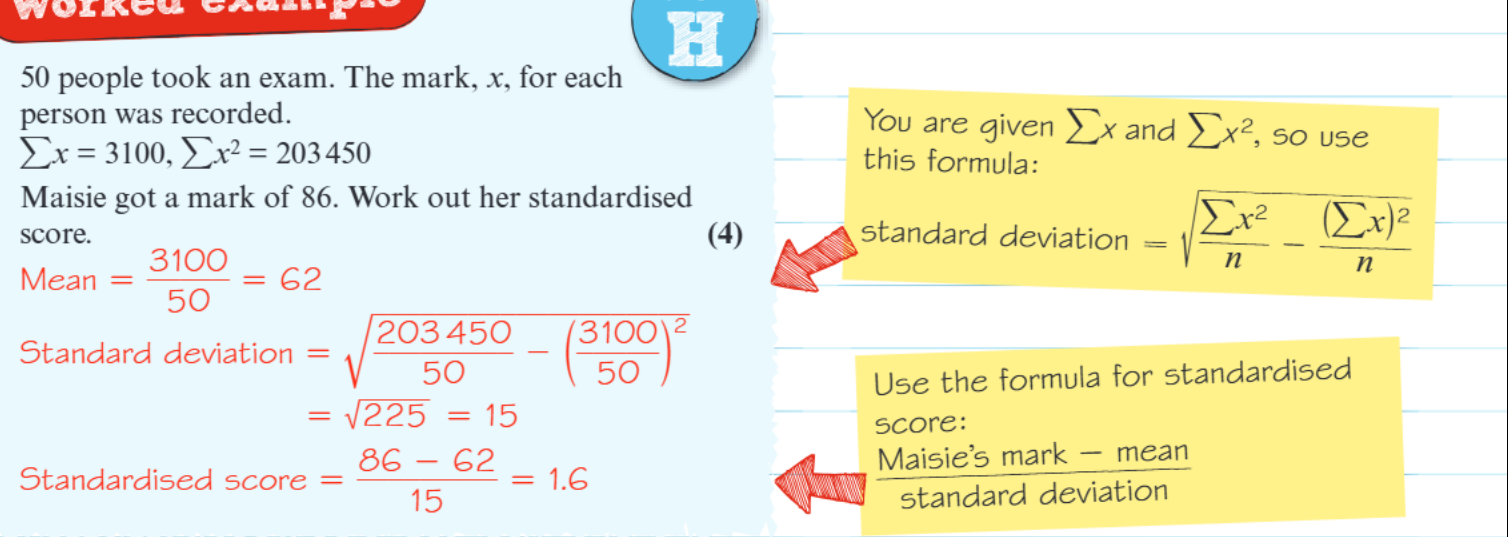
Worked Example: Calculating Standardised Scores
Given information:
- 50 people took an exam
- Sum of all scores () = 3100
- Sum of squares () = 203,450
- Maisie scored 86 marks
Step 1: Calculate the mean
Step 2: Calculate the standard deviation Using the formula:
Step 3: Calculate the standardised score
Interpretation: Maisie's standardised score of 1.6 means her performance was 1.6 standard deviations above the average, indicating very good performance.
Comparing different tests
The true power of standardised scores becomes apparent when comparing performance across different tests with different means and standard deviations. This application demonstrates why standardised scores are so valuable in educational assessment.
Example
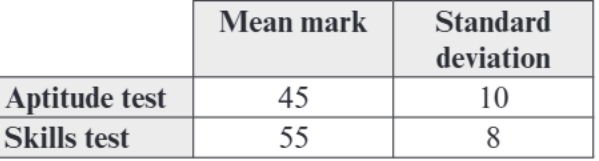
Worked Example: Comparing Test Performances
If a student scored 48 on the aptitude test and 64 on the skills test, we can calculate their standardised scores:
Aptitude test:
Skills test:
Conclusion: Even though the raw score was higher on the skills test (64 vs 48), the standardised scores reveal the student performed relatively better on the skills test (1.125) compared to the aptitude test (0.3).
Key exam tips
When working with standardised scores in examinations, following a systematic approach will help ensure accuracy and avoid common pitfalls.
Summary
Essential Exam Strategies:
- Always identify what you're given - Look for the mean, standard deviation, and the score you're analysing
- Check your arithmetic carefully - Small calculation errors can significantly affect your final answer
- Interpret your answer - A positive score means above average, negative means below average
- Use the correct formula - Remember it's , not the other way around
- Round appropriately - Usually to 2 or 3 significant figures unless specified otherwise
Summary
Key Points to Remember:
- Standardised scores allow fair comparison between different tests or distributions
- Positive scores indicate above-average performance, negative scores indicate below-average performance
- The formula is:
- Higher standardised scores always mean better relative performance
- You need both the mean and standard deviation of the entire group to calculate standardised scores