Decomposition and abstraction (Edexcel GCSE Computer Science): Revision Notes
📚Revision Notes
Decomposition and abstraction
What are decomposition and abstraction?
Computer scientists use computational thinking skills to define and analyse problems, design structured solutions, and translate these solutions into a form that computers can execute. Two of the most important computational thinking skills are decomposition and abstraction.
These skills work together to help you tackle complex programming problems by breaking them down and focusing on what really matters.
Note
Why these skills matter: Decomposition and abstraction form the foundation of effective problem-solving in computer science. They help transform overwhelming, complex problems into manageable, solvable pieces.
Understanding problem statements
When you're given a programming task, you'll often start with a problem statement. This tells you exactly what your programme needs to do. For example:
Example
Sample Problem Statement:
"A programme is needed to report the mean of a set of numbers entered by the user. Only positive numbers can be entered. The mean must be reported to two decimal places."
This might seem overwhelming at first, but decomposition and abstraction help you break it down into manageable pieces.
Decomposition - breaking it down
Decomposition is the first step where you read the problem statement carefully and break it down into smaller, more manageable parts.
Important
The IPO Approach
The best way to decompose a problem is to identify three key components:
- Input - What data does the programme need from the user?
- Processing - What calculations or operations need to happen?
- Output - What results need to be displayed?
Example
Worked Example: Decomposing the Mean Calculator
For our example problem:
- Input: Positive numbers from the user
- Processing: Calculating the mean (average) of the numbers
- Output: The mean displayed to two decimal places
This IPO approach (Input-Processing-Output) gives you a clear structure to work with.
Abstraction - focusing on what matters
Abstraction is the second step where you determine what you can ignore and what you need to know. This helps you focus on the essential parts of the problem.
Example
Worked Example: Applying Abstraction to Mean Calculator
For our mean calculation example:
- Need to know: How to check for negative numbers, how to format decimals to two places
- Can ignore: Any other data type inputs, complex error handling beyond basic validation
Abstraction helps prevent you from getting overwhelmed by unnecessary details that don't affect the core solution.
Implementing abstraction with comments
One of the best ways to express your solution abstraction is by using comments in your code. You can actually write these comments even before you write any actual code - this helps you plan your solution.
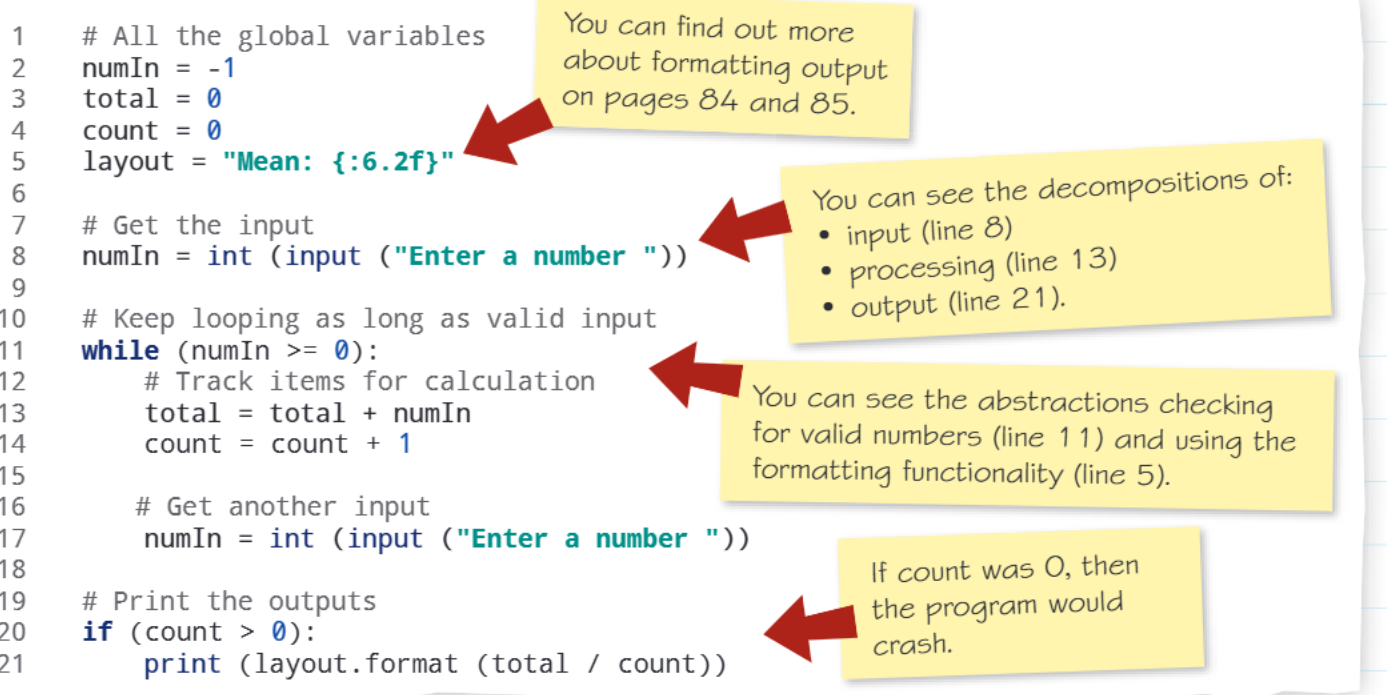
The code example above shows how decomposition and abstraction work in practice. Notice how:
- The programme is clearly decomposed into input (line 8), processing (line 13), and output (line 21)
- Abstraction is implemented through checking for valid numbers and using formatting functionality
- Comments explain each section, making the code easier to understand
Note
Planning with Comments: Writing comments before coding helps you think through your solution systematically. This approach ensures you've properly applied decomposition and abstraction before getting caught up in syntax details.
Key programming concepts in the example
The code demonstrates several important concepts:
- Variable initialisation: Setting up counters and totals at the start
- Input validation: Using a while loop to ensure only positive numbers are processed
- String formatting: Using
.format()to display the mean to two decimal places - Error prevention: Checking that count isn't zero before dividing (to avoid crashes)
Note
Best Practice: Always consider edge cases like division by zero. These defensive programming techniques prevent your programme from crashing unexpectedly.
Exam tips
When tackling decomposition and abstraction questions:
- Always start with IPO: Identify Input, Processing, and Output first
- Use comments: Write comments to show your thinking before coding
- Focus on requirements: Only include what the problem statement asks for
- Think step-by-step: Break complex problems into smaller, manageable chunks
- Check edge cases: Consider what could go wrong (like dividing by zero)
Summary
Key Points to Remember:
- Decomposition breaks problems into smaller parts using Input-Processing-Output
- Abstraction helps you focus on what's important and ignore unnecessary details
- Comments are an excellent way to express your abstraction before writing code
- IPO structure (Input-Processing-Output) provides a reliable framework for any programme
- Always consider edge cases and validation when implementing your solution