Macbeth: Context (Edexcel GCSE English Literature): Revision Notes
📚Revision Notes
Macbeth: Context
Context of Macbeth
Note
Historical Context: Macbeth was written in 1606, shortly after King James I came to the English throne. James was especially interested in witchcraft and the supernatural, which is why the play includes witches and prophecies. The play also honours King James by portraying his ancestor Banquo as a noble character.
Note
Social Context: In Shakespeare's time, people believed strongly in the "divine right of kings", meaning that a king was chosen by God and had a special place in the order of the world. When Macbeth kills King Duncan to take the throne, he disrupts this natural order, leading to chaos and disaster, which reflects the consequences of going against what was seen as God's will.
Timeline and Influence
Written around 1606 by William Shakespeare.
- During the reigns of Queen Elizabeth I (1558-1603) and King James I (1603-1625)
Themes and Political Context
- Focus on kingship, succession, and national health.
- Crisis of succession during Queen Elizabeth I's reign since she had no children.
- The play explores the qualities of a good and moral king versus the horrors of tyranny.
- Themes in Macbeth reflect issues at the time in 1606
- Power and politics
- Sacred power and the divine right of kings
- Nature of lawful succession
- England and Scotland's relationship
- Dangers of treason and sedition
Historical References - The Gunpowder Plot of 1605
The Gunpowder Plot of 1605 was a failed attempt by a group of English Catholics, led by Robert Catesby, to assassinate King James I and blow up the House of Lords during the State Opening of Parliament. The plot was discovered on November 5th, and the conspirators, including Guy Fawkes who was found guarding the explosives, were captured and later executed.
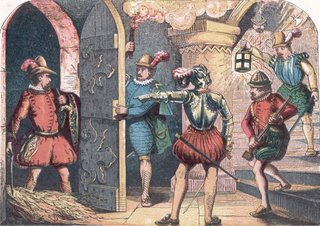
Macbeth connects to the Gunpowder Plot in several ways:
- Themes of Plot and Treachery
- Key themes of treason and regicide mirroring the Catholic conspirators.
- Macbeth's murder of King Duncan echoes the conspirators' plan to overthrow the monarchy.
- The play explores the consequences of betrayal and the moral and societal chaos that ensues from such acts, paralleling the fear and instability the Gunpowder Plot caused in England.
- The Role of Equivocation
- Equivocation is the use of ambiguous language to conceal the truth or mislead, a concept heavily featured in the play.
- Father Henry Garnet, a Jesuit priest associated with the plot, wrote about the "doctrine of equivocation," arguing that Catholics could use ambiguous language when being persecuted. He was tried and executed in 1606, and his defence of equivocation became well-known.
- The witches in Macbeth use equivocation to manipulate Macbeth, giving him prophecies that mislead him into a false sense of security.
- The Porter's Scene: in Act 2, Scene 3, the Porter's comic scene includes references to equivocation and treason.
- He pretends to be the gatekeeper of hell, humorously linking the castle to a place of eternal punishment, which could allude to the treachery of the plotters and the moral hell that Macbeth's castle becomes after Duncan's murder.
Witches and Witchcraft
Cultural Beliefs
- Witches were persecuted during Elizabeth I and James I's reigns
- Suspected witches were burned and examined for the "Devil's Mark"
- Beliefs about witches' powers included:
- Predicting the future and flying
- Causing storms and fog
- Killing animals and inducing nightmares
- Possessing others and cursing enemies
In Act 1, the First Witch describes creating a storm to destroy the captain of the Tiger.
- The Tiger was a real ship that set sail from England in 1604 and headed to Japan.
- The Tiger encountered disastrous storms during its voyage.
- The ship returned to England amid stormy seas, around the time Shakespeare was writing Macbeth.
James I and Witches
King James I was fascinated by witchcraft
- 1590: A witch group allegedly tried to kill him
- 1597: Published Daemonologie, a book on witchcraft
- 1604: An Act of Parliament mandated execution for witchcraft
Shakespeare's Reading and Inspirations
Source Material
- Derived Macbeth's plot and characters from Chronicles of England, Scotland, and Ireland by Raphael Holinshed
- Adapted to create a more dramatic and tragic narrative
Differences from Holinshed
- Holinshed's Duncan is ineffective; Shakespeare's Duncan is respected.
- Holinshed's Macbeth rules well for ten years; Shakespeare's Macbeth is immediately tyrannical.
- Lady Macbeth is a minor character in Holinshed but central in Shakespeare's play.
- Banquo is complicit in Duncan's murder in Holinshed; and innocent in Shakespeare's version.
Influence of Mediaeval Plays
- Draws from mystery and morality plays.
- The Harrowing of Hell may inspire the Porter scene.
- In the play, Hell is depicted as a castle with a gate guarded by a porter named Rybald.
- Christ descends to Hell and hammers on the gate, demanding that Satan release the good souls trapped inside.
- In Shakespeare's interpretation, Macduff serves as the Christ-like figure who knocks at the door of Macbeth's castle.
- Morality plays focused on choosing between vice and virtue, embodying the seven deadly sins.
- Heroes often fall but can find redemption, reflecting Christian teachings.
Tragedy Genre
- Tragedies were popular in Shakespearean England.
- Influenced by Roman playwright Seneca.
- Focused on the protagonist's downfall, often due to a fatal flaw.