A changing UK city (Edexcel GCSE Geography A): Revision Notes
📚Revision Notes
A changing UK city
Understanding urban transformation
UK cities are constantly evolving through the movement of people, changes in employment opportunities, and the development of services. To understand these changes, geographers study specific cities as case studies, examining how various processes reshape urban areas over time. Birmingham serves as an excellent example of how British cities have transformed through different stages of development and migration patterns.
Note
Geographers use case studies to examine real-world examples of urban change, allowing them to understand patterns and processes that can be applied to other similar cities across the UK and beyond.
Processes that change cities
Cities undergo transformation through four main processes that often occur in sequence, each bringing distinct changes to the urban landscape and population distribution.
Urbanisation
The first major process involves the growth of cities as people move from rural areas to urban centres. This transformation is heavily influenced by industrial development, particularly manufacturing industries such as jewellery production. During urbanisation, small housing developments are constructed specifically for workers migrating from the countryside, creating compact residential areas close to industrial sites.
Example
Worked Example: Urbanisation in Birmingham
Location: Small Heath area of Birmingham
- Cause: Manufacturing industries (jewellery production) attracted rural workers
- Effect: Construction of worker housing built close to industrial sites
- Result: Compact residential areas with high population density near employment
Suburbanisation
As urban population continues to grow, cities expand outwards in a process known as suburbanisation. This became particularly prominent during the 1920s when rising population numbers necessitated the construction of new housing developments on the outskirts of existing cities. These new residential areas, called estates, primarily consisted of semi-detached houses that offered more space and better living conditions than the cramped inner-city housing.
Note
Suburbanisation created the characteristic layout of many British cities today, with distinct inner-city areas surrounded by suburban residential zones featuring gardens and more spacious housing.
Counter-urbanisation
The third phase involves deliberate planning to redistribute urban populations. Five comprehensive development areas were established in inner city locations, while simultaneously relocating people from overcrowded urban centres to designated new towns such as Redditch. This process aimed to reduce population density in city centres while creating planned communities with better infrastructure and living conditions in previously less developed areas.
Re-urbanisation
The most recent transformation involves people choosing to return to city centres, attracted by proximity to employment and entertainment facilities. This process includes the modernisation of existing flat complexes and the construction of new apartment developments, often located near desirable features such as canals. Re-urbanisation reflects changing lifestyle preferences and the regeneration of urban cores.
Important
The four processes often occur in sequence: Urbanisation → Suburbanisation → Counter-urbanisation → Re-urbanisation. Understanding this sequence helps explain the development patterns seen in most UK cities today.
Migration patterns affecting UK cities
National migration
Within the UK, people move between different regions for various reasons, significantly impacting city demographics. In Birmingham, two main patterns of national migration are evident.
Firstly, older residents often relocate to retirement destinations in southern England, particularly to coastal areas like Bournemouth, seeking warmer climates and retirement-friendly environments. Secondly, younger people are attracted to Birmingham due to increased investment in the city's Central Business District (CBD), which has generated numerous employment opportunities in sectors such as finance, retail, and services.
International migration
International migration brings people from other countries to UK cities, contributing to cultural diversity and demographic change. Birmingham experiences international migration from multiple sources.
Currently, refugees and asylum seekers arrive from conflict-affected regions, particularly Afghanistan, Syria, and Ukraine, seeking safety and stability. Additionally, economic migrants have historically moved to Birmingham in response to active recruitment campaigns by the UK government, which encouraged immigration to fill essential job roles across various industries.
Note
The distinction between refugees/asylum seekers (forced migration) and economic migrants (voluntary migration) is important for understanding different migration motivations and their varying impacts on cities.
Impacts of migration on cities
Migration creates numerous effects on urban areas, transforming their demographic composition, cultural landscape, and infrastructure demands.
Demographic changes
Migration significantly affects the age structure of cities. Birmingham demonstrates this through its youthful population, with 43.8% of residents under 30 years old, compared to the English average of 35.7%. This younger demographic profile influences everything from school provision to entertainment venues and creates a dynamic, energetic urban atmosphere.
Example
Worked Example: Interpreting Population Data
Birmingham's age structure compared to England:
- Under 30 years: Birmingham vs England
- Difference: higher proportion of young people
- Largest single age group: 20-24 year olds
- Interpretation: Birmingham has a significantly younger population than the national average
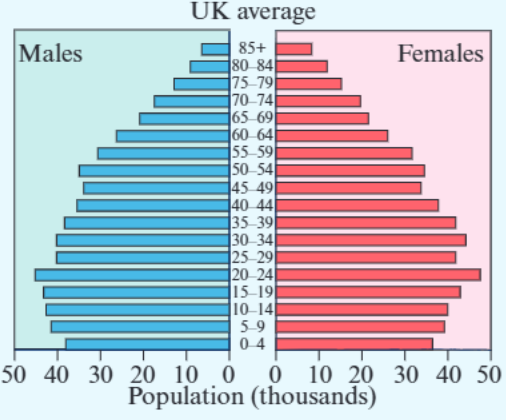
The population pyramid clearly illustrates Birmingham's distinctive age structure, showing higher proportions in the 15-34 age groups compared to national averages, with the largest single age group being 20-24 year olds.
Cultural transformation
International migration creates multicultural communities that enrich city life. In Birmingham, 51.4% of residents belong to ethnic groups other than white British, while 16% do not speak English as their primary language. This diversity brings varied cultural practices, cuisines, languages, and traditions that contribute to the city's vibrant character and global connections.
Important
Birmingham's cultural diversity statistics:
- of residents from non-white ethnic groups
- do not speak English as their first language These figures demonstrate how international migration has transformed the city's demographic composition.
Community development
Ethnic communities often establish distinct neighbourhoods with specialised services. During the 1970s, many migrants settled in areas like Sparkbrook and Sparkhill, where more affordable housing was available. Over time, these communities developed their own shops, restaurants, places of worship, and community centres, creating culturally rich districts that serve both residents and visitors.
Housing pressure
Population growth through migration increases demand for housing. Projections suggest Birmingham will require approximately 4,500 new homes annually for the next five years to accommodate population growth. This demand affects housing prices, rental markets, and urban planning decisions, requiring careful management to ensure adequate accommodation for all residents.
Important
Housing Challenge: Birmingham needs new homes per year for the next years. Total requirement: new homes by 2029. This represents a significant urban planning challenge requiring coordinated development strategies.
Service strain
Increased population puts additional pressure on public services and infrastructure. Healthcare systems, particularly GP surgeries, experience higher demand as more people require medical services. This necessitates expansion of service provision and careful resource allocation to maintain service quality for all residents.
Case study: Birmingham
Birmingham exemplifies how UK cities transform through migration and urban development processes. The city's evolution from an industrial centre to a diverse, modern urban area demonstrates the complex interplay between economic opportunities, demographic change, and cultural development.
Example
Case Study Summary: Birmingham's Transformation
Historical Development:
- Industrial past: Manufacturing and jewellery production
- Present day: Diverse, multicultural city with modern CBD
Key Statistics:
- of population under 30 (vs national average)
- from non-white ethnic groups
- speak languages other than English as first language
Migration Patterns:
- Outward: Older residents to coastal retirement areas (e.g., Bournemouth)
- Inward: Young people attracted by CBD employment opportunities
- International: Refugees from conflict zones, economic migrants
Its youthful population structure, multicultural composition, and ongoing regeneration projects make it an ideal case study for understanding contemporary urban change in the UK.
The city's experience with both national and international migration illustrates how global and local factors combine to reshape urban areas. From the outward movement of retirees to southern coastal areas to the inward movement of international migrants seeking economic opportunities or refugee status, Birmingham's population flows reflect broader patterns affecting cities across the UK.
Summary
Key Points to Remember:
- Cities change through four main processes: urbanisation, suburbanisation, counter-urbanisation, and re-urbanisation, often occurring in sequence over time
- Both national and international migration significantly impact UK cities, affecting demographics, culture, housing, and services
- Birmingham demonstrates typical patterns with a younger population ( under 30) and high cultural diversity ( from non-white ethnic groups)
- Migration creates both opportunities (cultural richness, economic growth) and challenges (housing demand, service pressure) for urban areas
- Population pyramids provide valuable insights into city demographics and help predict future planning needs