An urban world (Edexcel GCSE Geography A): Revision Notes
📚Revision Notes
An urban world
Understanding urbanisation
Urbanisation refers to the process where an increasing proportion of people move from rural areas to live in towns and cities. This has been a major global trend over the past 50 years, but it has happened at different speeds and in different ways across various types of countries, leading to diverse effects worldwide.
Today, more than half of the world's population lives in urban areas as a result of urbanisation. This represents a massive shift in how and where people live compared to previous centuries.
Important
Key Definition: Urbanisation
Urbanisation is the process of population shift from rural to urban areas, resulting in the growth of cities and towns. This demographic transformation has become one of the most significant global trends of the modern era.
Global urbanisation trends
The pace of urbanisation has been accelerating globally, and this trend is expected to continue well into the future. Current predictions suggest that the urban population could reach 5 billion people by 2030, representing a significant increase from current levels.
Note
About the Global Urbanisation Graph
The graph referenced here shows urbanisation trends from 1950 onwards across different world regions. It demonstrates how urbanisation levels have increased consistently over time, with projections extending to 2050. Notice how different regions started at different baseline levels but all show upward trends.
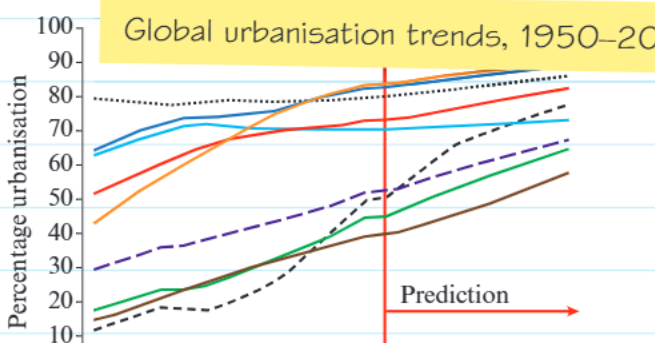
The global urbanisation trends from 1950 onwards show a clear upward trajectory across all regions of the world. While some regions started with higher levels of urbanisation than others, all areas are experiencing growth in their urban populations. The graph demonstrates that this trend is predicted to continue through to 2050, though at varying rates depending on the region.
Variations in urbanisation patterns
The causes of urbanisation differ significantly between developed countries and emerging or developing countries, reflecting their different stages of economic and social development.
Developed countries
In developed countries, the primary driver of urbanisation has been industrialisation. A clear example of this can be seen in the United Kingdom during the 18th and 19th centuries.
Example
Historical Example: UK Industrial Revolution
During the 18th and 19th centuries in the United Kingdom:
Step 1: Mechanisation of farming reduced the need for rural workers
Step 2: Factory jobs emerged in cities, creating new employment opportunities
Step 3: People migrated from rural areas to urban centres seeking work
Result: Rapid urbanisation as the economy shifted from agricultural to industrial
During this period, the mechanisation of farming meant fewer workers were needed in rural areas, while the rise of factory jobs created employment opportunities in cities. This economic shift encouraged people to move from rural areas to urban centres where work was available.
Emerging and developing countries
In emerging and developing countries, recent rapid urbanisation has been driven by two main factors:
Rural to urban migration occurs when people move from countryside areas seeking better quality of life and opportunities in cities. Urban areas often offer better access to services, employment, and education.
Natural increase happens when birth rates in these countries remain higher than death rates, leading to population growth that is often concentrated in urban areas where most people already live.
Note
Understanding the Two-Factor Model
In emerging and developing countries, urbanisation results from both population movement (migration) and population growth (natural increase). This dual mechanism often leads to more rapid urban growth than was experienced historically in developed countries.
Effects of urbanisation
As urbanisation increases and cities grow larger, several important effects emerge that can be both positive and negative.
Challenges of rapid urbanisation
In developing countries, rapid urban growth often leads to the development of shanty towns. These informal settlements emerge because there isn't enough permanent housing available for people migrating to urban areas. These settlements typically lack basic services and infrastructure.
Environmental problems also increase with urbanisation. Air pollution, noise pollution, and water pollution all tend to worsen as cities grow larger and more industrialised.
The gap between rich and poor often widens in rapidly growing cities. This inequality is frequently more pronounced in emerging and developing countries where urban growth outpaces economic development and service provision.
Important
Critical Challenge: Urban Inequality
The inequality gap in rapidly urbanising cities can become severe, creating stark contrasts between wealthy areas with full services and poor areas lacking basic infrastructure. This is a common challenge that requires careful urban planning to address.
Benefits of urbanisation
Despite the challenges, urbanisation also brings positive effects. Investment increases in urban areas, leading to greater economic opportunities for residents. Cities become centres of economic activity, innovation, and job creation, which can improve living standards over time.
Note
The Economic Benefits
Urban areas typically attract more investment because of their concentrated populations and infrastructure. This creates a positive cycle where investment leads to more jobs, which attracts more people, which in turn attracts more investment.
The world's largest cities
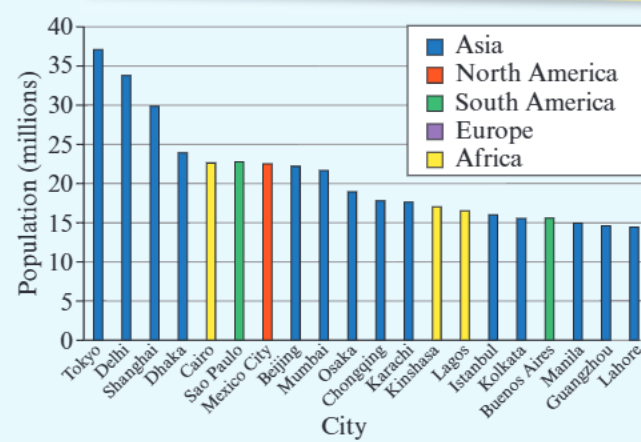
Asian cities dominate the list of the world's most populous urban areas. Tokyo leads as the largest city globally, followed by other major Asian centres like Delhi, Shanghai, and Dhaka. This reflects the rapid urbanisation occurring across Asia, particularly in countries like China, India, and Japan.
The distribution of large cities across continents shows that while Asia has the most megacities, other continents also host major urban centres. Cities from North America, South America, Europe, and Africa all feature among the world's largest, though generally with smaller populations than the Asian giants.
Example
Population Comparison Calculation
Comparing Tokyo and Mexico City:
From the data shown:
- Tokyo (largest city): approximately 37.4 million people
- Mexico City: approximately 22.8 million people
Calculation: Population difference = Tokyo population - Mexico City population Population difference = 37.4 - 22.8 = 14.6 million people
This demonstrates the enormous scale difference even among the world's largest cities.
For example, when comparing Tokyo (the world's largest city) with Mexico City, the population difference is approximately million people, highlighting the enormous scale of the world's largest urban areas.
Summary
Key Points to Remember:
-
More than half the world's population now lives in urban areas, with predictions suggesting this will reach 5 billion by 2030
-
Different countries experience urbanisation for different reasons - industrialisation in developed countries versus rural migration and natural increase in emerging and developing countries
-
Urbanisation creates both challenges and opportunities - problems like shanty towns and pollution alongside benefits like increased investment and economic growth
-
Asian cities dominate the world's largest urban areas, reflecting rapid urbanisation across the continent
-
The trend towards urbanisation is global and continuing, affecting all regions of the world though at different rates and with different impacts