Context and structure - Birmingham (Edexcel GCSE Geography A): Revision Notes
📚Revision Notes
Birmingham case study - context and structure

Birmingham serves as an excellent example of how UK cities have developed and changed over time. Understanding its location, characteristics, and internal structure helps explain urban patterns across Britain.
Birmingham's context
Location and physical setting
Birmingham developed in a strategically important location within the Midlands region of England. The city originated as a small settlement on the Birmingham plateau, taking advantage of a dry elevated site on a south-facing sandstone ridge. This physical geography provided several advantages for early settlement, including good drainage and defensive positions.
The city's central position within England has made it a natural hub for transport and communication networks. This connectivity has been crucial to Birmingham's growth and development as a major urban centre.
Transport connectivity
Birmingham benefits from exceptional transport links that connect it at multiple scales. The city serves as a major transport hub with Birmingham International Airport providing air connections, while Birmingham New Street railway station offers rail links across the country.
Note
The motorway network is particularly important, with the M5, M6, and M42 motorways providing easy access to other parts of the West Midlands and beyond. These transport connections have supported Birmingham's role as a regional economic centre and continue to influence its development patterns.
Cultural characteristics
Birmingham has become increasingly diverse, reflecting broader patterns of migration and settlement in UK cities.
Important
Cultural Diversity Statistics: Census data from 2011 revealed that approximately one quarter of the population was born outside the UK, with significant communities from:
- Pakistan: 17.1% of residents
- India: 6% of residents
This cultural diversity has influenced the city's development, creating distinct neighbourhoods and contributing to Birmingham's identity as a cosmopolitan urban centre.
Environmental features
Despite being a major industrial city, Birmingham has maintained significant green spaces.
Note
Birmingham's Green Credentials: The city contains an impressive 571 parks covering approximately 3,500 hectares, demonstrating how urban areas can balance development with environmental conservation. In 2010, Birmingham was recognised as the 14th most sustainable city in the UK, highlighting its efforts to manage environmental challenges.
City structure model
Birmingham's internal structure follows a clear pattern that reflects different periods of urban development and varying social and economic functions. This structure can be understood through four distinct zones, each with characteristic features.
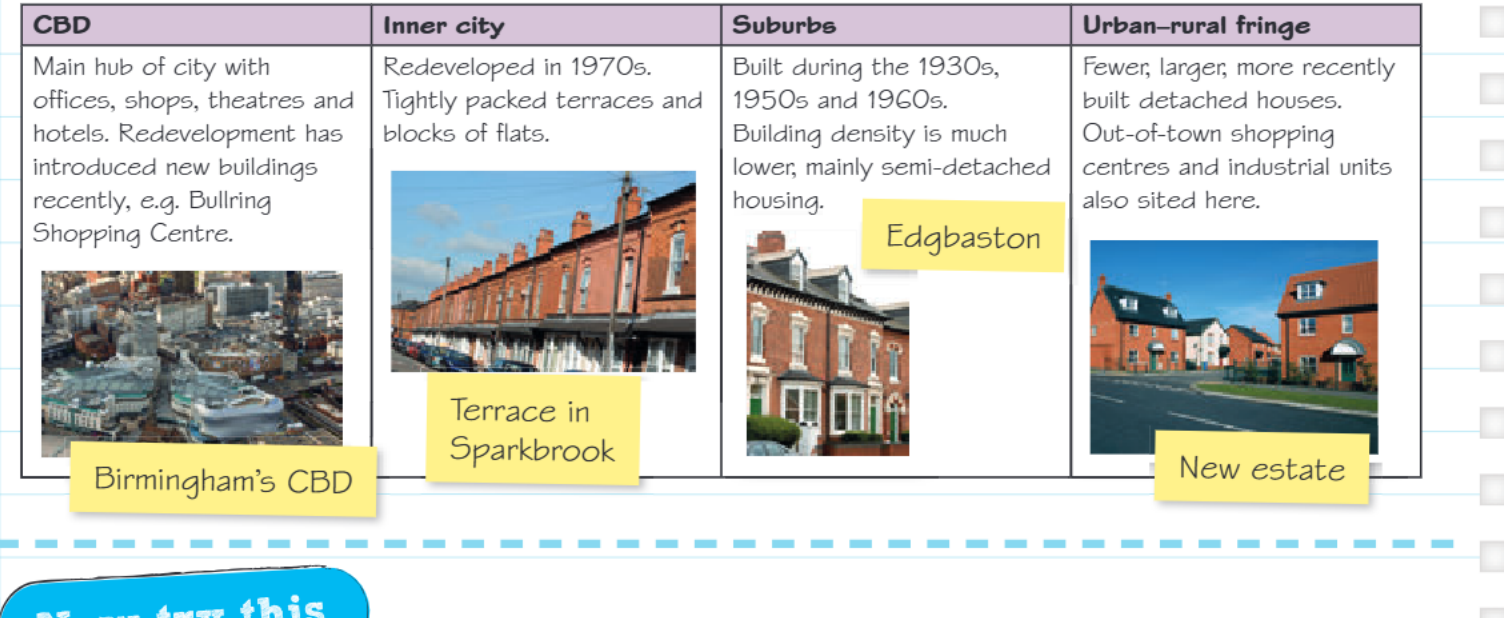
Central business district (CBD)
The heart of Birmingham functions as the main commercial and administrative centre. This area contains the highest concentration of offices, shops, theatres, and hotels, serving both local residents and the wider region. The CBD represents the most accessible part of the city, with excellent transport connections.
Recent decades have seen significant redevelopment within the CBD, with projects like the Bullring Shopping Centre transforming the urban landscape. These developments aim to maintain Birmingham's competitiveness as a retail and business destination while improving the area's appeal to visitors and workers.
Inner city areas
Surrounding the CBD, inner city neighbourhoods typically contain older housing stock that reflects Birmingham's industrial heritage. Many of these areas underwent major redevelopment during the 1970s, replacing some original Victorian terraced housing with modern alternatives.
Example
Case Study: Sparkbrook Sparkbrook exemplifies this inner city character, featuring:
- Tightly packed terraced housing
- Blocks of flats
- Diverse communities
- Challenges related to housing quality and employment opportunities
Suburban zones
The suburbs developed primarily between the 1930s and 1960s, reflecting the expansion of Birmingham during periods of economic growth and increased car ownership. These areas feature much lower building density compared to inner city zones, with predominantly semi-detached housing and more green space.
Edgbaston represents this suburban character well, showing how residential areas developed to provide better living conditions for middle-class families seeking to escape the more crowded inner city areas.
Urban-rural fringe
At Birmingham's outer edges, the urban-rural fringe contains the most recent residential developments. These newer areas feature larger, detached houses built on modern estates, often with better access to green space and more car-dependent lifestyles.
The urban-rural fringe also accommodates out-of-town shopping centres and industrial units, reflecting how cities continue to expand outward and how different land uses locate according to accessibility and land costs.
Summary
Key Points to Remember:
- Birmingham's central location in England and excellent transport links have made it a major regional hub
- The city demonstrates significant cultural diversity, with about 24% of residents born outside the UK
- Birmingham's structure follows a clear pattern from CBD through inner city, suburbs, to urban-rural fringe
- Each zone has distinctive housing types reflecting different development periods - from CBD offices to suburban semi-detached homes to modern detached houses
- The city combines urban development with significant green space, maintaining 571 parks across 3,500 hectares