Globalisation and economic change (Edexcel GCSE Geography A): Revision Notes
📚Revision Notes
Globalisation and economic change
What is deindustrialisation?
Deindustrialisation refers to the decline of industries in a particular area. This process has significantly affected many UK cities, transforming their economic landscapes and creating both challenges and opportunities for urban development.
Note
The impact of deindustrialisation extends far beyond just economic changes - it affects social structures, community identity, and the physical landscape of urban areas. Understanding these interconnected effects is crucial for effective urban planning and regeneration strategies.
Understanding the causes and impacts of deindustrialisation is essential for examining how globalisation has reshaped Britain's urban areas, particularly in former industrial centres like Birmingham.

Birmingham as a case study
Birmingham serves as an excellent example of how deindustrialisation has affected a major UK city. By examining Birmingham's experience, we can understand the broader patterns of economic change affecting urban areas across Britain.
Note
Case studies like Birmingham allow geographers to examine complex processes in detail, providing specific evidence that can be applied to understand similar situations in other locations.
Population characteristics of Birmingham
Birmingham has experienced significant demographic changes in recent decades. In 2021, the city had approximately 1.14 million residents, representing a 6.7% increase since 2011. This growth demonstrates that despite economic challenges, the city continues to attract people.
The city maintains a notably youthful population structure. In 2021, 43.8% of Birmingham's residents were under 30 years old, compared to just 35.7% across England as a whole. This young demographic profile suggests the city continues to draw young people seeking opportunities.
However, Birmingham has also seen a 9% increase in people of pensionable age compared with 2011. This ageing trend reflects broader national demographic patterns and has important implications for city planning and service provision.
Note
Key demographic drivers include:
- Increased birth rates among younger populations
- Rising international migration, particularly from Commonwealth countries
- Declining death rates due to improved healthcare services and living conditions
Several factors explain Birmingham's population growth, including increased birth rates, rising international migration, and declining death rates due to improved healthcare services.
Causes of deindustrialisation in Birmingham
Multiple interconnected factors contributed to Birmingham's industrial decline. These causes demonstrate how global economic forces, technological changes, and government policies combined to transform the city's economic base.
Important
Understanding that deindustrialisation results from multiple interconnected factors is crucial - it's rarely caused by a single issue but rather by the complex interaction of global and local processes.
Transport developments
The construction of new transport infrastructure, particularly the M6 motorway in the 1970s, had unintended consequences for Birmingham's industrial areas. When the ring road was built, some factories were removed to make way for the new route. This disrupted established industrial areas and forced businesses to relocate or close entirely.
Globalisation impacts
Global economic integration significantly affected Birmingham's manufacturing sector. Increased imports of foreign cars reduced demand for vehicles produced in Birmingham's automotive plants. International competition meant local manufacturers struggled to compete with cheaper products from overseas, leading to factory closures and job losses.
Note
The automotive industry was particularly vulnerable to globalisation as countries like Japan and South Korea could produce cars more cheaply due to lower labour costs and more efficient production methods.
Decentralisation policies
Government policies encouraged the movement of industries away from inner city areas. Empty factory units became eyesores and contributed to urban decay. Inner city areas were redeveloped, with old factories demolished to make way for new housing developments. This decentralisation process fundamentally changed the urban landscape.
Technological advances
Rapid technological progress created both opportunities and challenges. Some industries became less competitive than higher-tech rivals and were forced to close down. However, the slow adoption of new technologies by some Birmingham-based companies meant they fell behind more innovative competitors, accelerating industrial decline.
Demographic projections for Birmingham
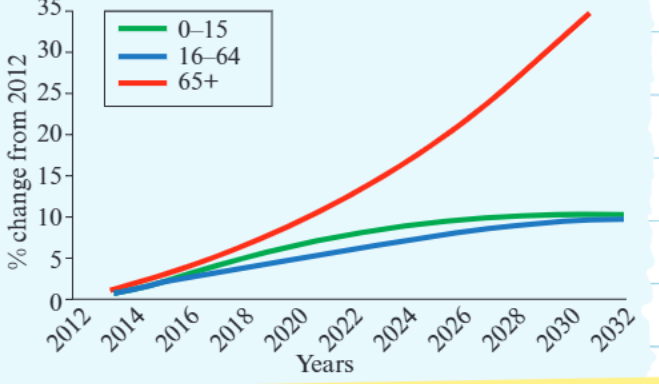
The graph shows projected demographic changes in Birmingham from 2012 to 2032, illustrating significant shifts in the city's age structure. These projections reveal important trends that will shape Birmingham's future development.
The most striking trend is the dramatic increase in the 65+ population, which is projected to grow by approximately 35% by 2032. This represents a steep upward trajectory that reflects the ageing of the baby boomer generation and increased life expectancy.
In contrast, both younger age groups show much more modest growth. The 0-15 age group and the 16-64 working-age population are each projected to increase by only about 10% over the same period. This creates an important demographic challenge for the city.
Important
The Dependency Ratio Challenge
These demographic shifts create a significant economic challenge: a smaller working-age population will need to support a much larger elderly population. This affects tax revenue, healthcare costs, and overall economic productivity.
These demographic shifts have significant implications for Birmingham's economic development, as a smaller working-age population will need to support a much larger elderly population. This trend affects everything from housing demand to healthcare provision and economic productivity.
Key skills for analysing demographic data
Important
Essential Analytical Techniques:
When examining graphs showing demographic change, focus on:
- Identifying the general pattern and noting any anomalies or particularly significant trends
- Always referring to specific evidence from the data in your responses
- Using precise figures and time periods to support your analysis
- Looking for the steepest changes in trend lines
- Comparing different groups' growth rates
- Considering what these patterns might mean for urban planning and economic development
Look for the steepest changes in trend lines, compare different groups' growth rates, and consider what these patterns might mean for urban planning and economic development in the future.
Summary
Key Points to Remember:
- Deindustrialisation is the decline of industries in an area, caused by multiple interconnected global and local factors
- Birmingham's population is growing and becoming more diverse, with a particularly youthful demographic profile compared to national averages
- Four main causes of deindustrialisation include transport developments, globalisation, decentralisation policies, and technological advances
- Demographic projections show Birmingham faces significant ageing, with the 65+ population growing much faster than younger groups
- Case study analysis requires specific examples and data to demonstrate understanding of processes and their impacts