Impact of rapid development (Edexcel GCSE Geography A): Revision Notes
📚Revision Notes
Impact of rapid development
Understanding rapid development impacts
When countries experience rapid economic growth and development, this creates a complex mix of consequences that affect both people and the environment. These impacts can be beneficial in some ways while creating significant challenges in others. For developing and emerging nations, understanding and managing these effects is crucial for sustainable progress.
Note
The complexity of rapid development means that the same processes that bring economic benefits often simultaneously create environmental and social challenges. This dual nature requires careful management and planning.
The impacts of rapid development fall into three main categories: environmental, social, and economic. Each category contains both positive outcomes that improve conditions and negative consequences that create new problems.
Environmental impacts
Positive environmental effects
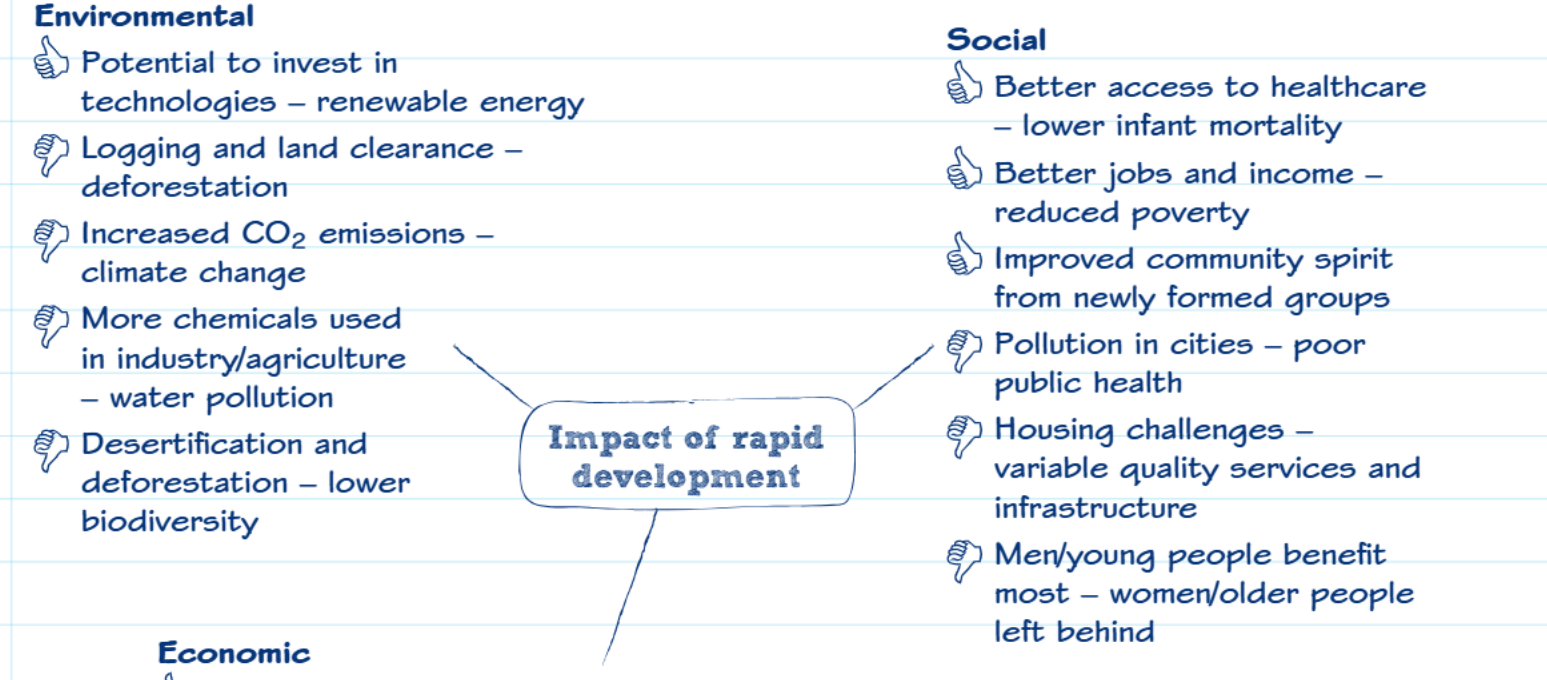
Rapid development can create opportunities for environmental improvements, particularly through investment in cleaner technologies. Countries experiencing economic growth often have more resources available to invest in renewable energy sources such as solar and wind power. This shift towards sustainable energy can help reduce long-term environmental damage and create a foundation for cleaner industrial development.
Negative environmental consequences
However, the environmental costs of rapid development are often severe and immediate. Large-scale deforestation occurs as countries clear land for agriculture, urban expansion, and resource extraction. This logging and land clearance destroys natural habitats and reduces the Earth's capacity to absorb carbon dioxide.
The increased industrial activity and energy consumption that accompany rapid development lead to higher CO2 emissions, contributing to climate change. Manufacturing processes and intensive agriculture also result in greater use of chemicals, which often pollute water sources and harm ecosystems.
Important
Critical Environmental Challenge
Desertification can occur when rapid agricultural expansion and poor land management practices degrade soil quality. This process further reduces biodiversity as natural habitats are destroyed or become unable to support wildlife.
Social impacts
Positive social changes
Rapid development brings several important social benefits. Improved economic conditions typically lead to better access to healthcare services, which helps reduce infant mortality rates and improves overall public health. The creation of new jobs and increased income opportunities helps lift people out of poverty, providing families with better living standards.
Development also fosters improved community spirit as new social groups form around shared economic opportunities and urban growth brings people together in different ways.
Negative social consequences
Despite these benefits, rapid development creates significant social challenges. Urban areas often experience increased pollution that harms public health, creating respiratory problems and other health issues for city residents.
Housing becomes a major challenge as rapid population growth in urban areas outpaces the development of adequate accommodation and infrastructure. This leads to variable quality services and inadequate basic facilities for many residents.
Important
Inequality Warning
Perhaps most concerning is the unequal distribution of development benefits. Men and younger people typically gain more from new opportunities, while women and older people are often left behind. This creates or worsens social inequalities within communities.
Economic impacts
Economic benefits
Rapid development generates substantial economic advantages. A rise in consumerism indicates a strengthening economy as people have more disposable income to spend on goods and services. The growth in tourism provides additional jobs and brings foreign currency into the country, further boosting economic performance.
The expansion of the workforce means more people are employed and contributing to economic growth, creating a positive cycle of development.
Economic costs and challenges
However, managing rapid development requires significant investment. Governments must spend heavily on installing new infrastructure such as roads, utilities, and public transport systems to support growing populations and industries.
There are also ongoing costs associated with addressing the environmental and social challenges that development creates. Providing adequate services to growing populations puts pressure on government budgets and resources.
Managing rapid development impacts

Countries experiencing rapid development must actively manage these impacts to improve their global standing and ensure sustainable progress. India provides an excellent example of how governments can address the negative consequences of rapid development.
As the world's third-largest emitter of greenhouse gases, India faces significant environmental challenges largely caused by its rapid economic growth. The country is responsible for approximately 7.4% of global greenhouse gas emissions, highlighting the scale of the environmental impact.
Example
Worked Example: India's Climate Strategy
The Challenge: India produces 7.4% of global greenhouse gas emissions due to rapid development
The Solution: Two-pronged approach
- Renewable Energy Development: Focus on solar power installations through the Intended Nationally Determined Contribution (INDC)
- Carbon Absorption: Commitment to plant more forests to absorb CO2 from the atmosphere
The Result: A practical framework for managing environmental impacts while maintaining economic growth
To address these issues, the Indian government has committed to developing renewable energy resources as part of its climate change strategy. The Intended Nationally Determined Contribution (INDC) focuses specifically on clean energy solutions such as solar power installations.
Additionally, India has pledged to plant more forests to help absorb carbon emissions from the atmosphere. This dual approach of reducing emissions through cleaner energy while increasing carbon absorption through reforestation demonstrates how countries can take practical steps to manage the environmental impacts of their development.
Summary
Key Points to Remember:
-
Rapid development creates both positive and negative impacts across environmental, social, and economic dimensions - countries must actively manage these mixed effects
-
Environmental consequences include opportunities for renewable energy investment but also serious problems like deforestation, increased emissions, and biodiversity loss
-
Social impacts bring benefits such as better healthcare and job opportunities, but also create challenges including urban pollution and inequality between different groups
-
Economic growth generates consumerism, tourism, and employment opportunities, but requires substantial investment in infrastructure and services
-
Countries like India show how governments can address negative impacts through renewable energy development and environmental restoration programmes