The world's natural resources (Edexcel GCSE Geography A): Revision Notes
📚Revision Notes
The world's natural resources
Natural resources are materials and energy sources that occur naturally in the environment and can be used by humans for various purposes. These resources face increasing threats from human activities and exploitation, making their sustainable management crucial for our future.
Understanding the four types of natural resources
Natural resources can be organised into four main categories, each with distinct characteristics and sources. Understanding these differences helps us appreciate how we obtain and use various materials and energy sources.
Note
The classification of natural resources into these four categories helps scientists and policymakers understand how different resources should be managed and protected for future generations.
Biotic resources

Biotic resources are sourced from living organisms and ecosystems within the biosphere. These resources have the important characteristic of being able to reproduce naturally, which means they can potentially regenerate if managed sustainably. Common examples include animals such as livestock and wildlife, birds that provide food and materials, and plants that give us timber, food crops, and medicinal compounds. The key advantage of biotic resources is their capacity for natural reproduction, though this requires careful management to prevent overexploitation.
Abiotic resources

Abiotic resources come from non-living components of our planet, specifically from the lithosphere (Earth's crust), atmosphere (air around us), and hydrosphere (water systems). These resources include minerals extracted from rocks and soil, sunlight that provides energy, and fresh water essential for life. Unlike biotic resources, abiotic resources don't reproduce, but some like sunlight and wind are continuously available, while others like minerals exist in finite quantities.
Non-renewable resources
Non-renewable resources are materials that cannot be replaced or recreated once consumed. These resources formed through geological processes that required millions of years to complete, making them essentially finite on human timescales. Key examples include coal formed from ancient plant matter, oil created from prehistoric marine organisms, uranium used in nuclear power, and natural gas trapped in rock formations.
Important
The critical challenge with these resources is that once we use them, they're gone forever, making conservation and alternative energy sources increasingly important.
Renewable resources
Renewable resources offer hope for sustainable resource management because they can be naturally replenished over relatively short time periods. These resources are potentially inexhaustible if used responsibly and not consumed faster than they can regenerate. Wind energy harnesses air movement, solar power captures sunlight, and hydro-electric power (HEP) uses flowing water to generate electricity. The advantage of renewable resources is their sustainability, though they often require significant initial investment in technology and infrastructure.
Case studies: environmental exploitation and consequences
The following case studies demonstrate the real-world impacts of unsustainable resource extraction and management practices across different industries and regions.
Oil extraction in Ecuador
Example
Case Study: Environmental Impact of Oil Extraction in Ecuador
Background: During the 1960s, Texaco discovered significant oil deposits in the Oriente region and constructed 350 oil wells to extract this valuable resource.
Environmental Consequences:
- Over 1000 unlined waste pits filled with toxic sludge
- Approximately 18 billion gallons of toxic water dumped directly into local rivers
- Drastically reduced water quality throughout the region
Social Impact: Devastating effects on indigenous communities who depend on these rivers for drinking water, cooking, bathing, and fishing activities.
Health Consequences: Polluted river water linked to increased reports of miscarriages and birth defects among local populations.
This case study illustrates how short-term economic gains from resource extraction can create long-term environmental and social costs that affect communities for generations.
Overfishing in the North Sea
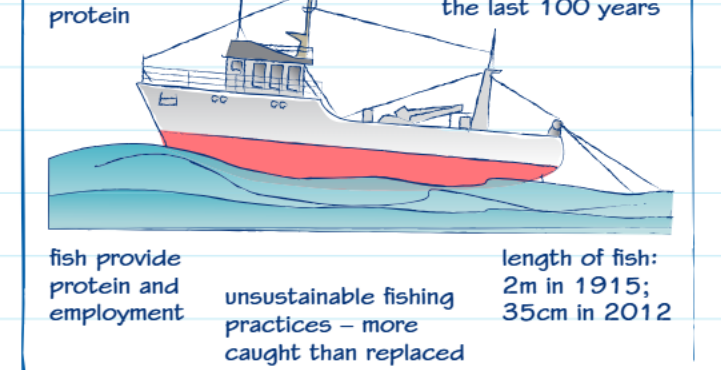
The North Sea fishing industry provides an excellent example of how overexploitation can lead to dramatic resource depletion. While fishing provides essential employment opportunities and fish remain in high demand as a protein source, unsustainable practices have created serious problems for marine ecosystems.
Example
Case Study: Overfishing Impact in the North Sea
Key Evidence: The most striking evidence of overfishing appears in the dramatic reduction in fish sizes over the past century.
Data Comparison:
- 1915: Cod averaged 2 metres in length
- 2012: Average length had shrunk to just 35 centimetres
Core Problem: Unsustainable fishing methods where more fish are caught than can be naturally replaced through reproduction.
Result: Cod numbers have been decimated over the last 100 years, showing how quickly marine resources can be depleted when extraction exceeds natural regeneration rates.
This situation threatens both the long-term viability of the fishing industry and the marine ecosystems that depend on balanced fish populations.
Deforestation in Cameroon
Cameroon's rainforests showcase the devastating impact of deforestation on biodiversity and ecosystem stability. These tropical rainforests represent some of Earth's most biodiverse environments, supporting over 600 species of trees and bushes along with countless animal species that depend on forest habitats for survival.
Example
Case Study: Deforestation Impact in Cameroon
Scale of Destruction: Large-scale deforestation has affected approximately 70,000 hectares of forest, much cleared for palm oil plantations.
Environmental Consequences:
- Extensive soil erosion as tree roots that held soil in place are removed
- Reduced ability to absorb rainfall, leading to increased flooding
- Further soil degradation
Biodiversity Impact: These forests contain some of the oldest woodland ecosystems on Earth. When destroyed, countless species lose their homes and many face extinction.
Ecosystem Effects: The interconnected nature of forest ecosystems means losing one species can have cascading effects throughout the entire ecosystem.
Important
Deforestation represents a threat to global biodiversity because it eliminates some of Earth's most ancient ecosystems and the countless species they support.
Remember!
Summary
Key Points to Remember:
-
Four resource types: Biotic (from living things), abiotic (from non-living environment), renewable (can be replenished), and non-renewable (finite once used)
-
Exploitation consequences: Resource extraction often creates long-term environmental damage that affects local communities for generations, as seen in Ecuador's oil pollution
-
Overfishing impacts: Unsustainable fishing practices can dramatically reduce both fish populations and individual fish sizes, threatening marine ecosystems and fishing industries
-
Deforestation threats: Clearing forests for agriculture destroys biodiversity, causes soil erosion, and eliminates some of Earth's most ancient ecosystems
-
Sustainability challenge: Balancing human resource needs with environmental protection requires careful management to ensure resources remain available for future generations