Paper 3 (i) (Edexcel GCSE Geography A): Revision Notes
📚Revision Notes
Paper 3 extended writing questions

Understanding paper 3 structure
Paper 3 is focused on fieldwork investigations and UK challenges, making it quite different from other geography papers. This paper contains three distinct sections that you need to understand before sitting the exam.
Note
Paper 3 Structure Overview:
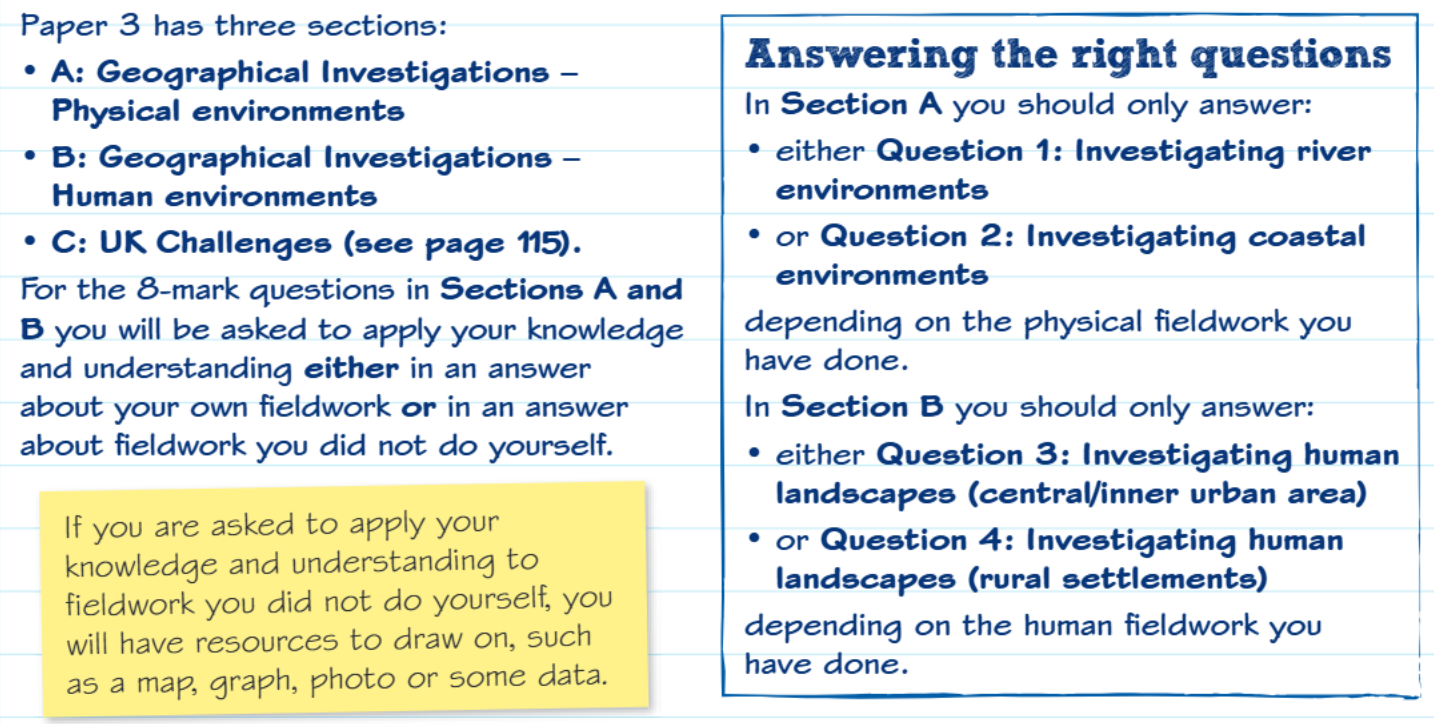
The paper is divided into three key sections:
- Section A: Geographical Investigations - Physical environments
- Section B: Geographical Investigations - Human environments
- Section C: UK Challenges
Each of the first two sections contains extended writing questions worth 8 marks, whilst Section C features a more substantial 12-mark extended writing question.
Choosing the right questions
One of the most important aspects of Paper 3 is knowing which questions to answer in Sections A and B. Your choice depends entirely on the type of fieldwork you completed during your course.
Important
Critical Decision Points for Question Selection:
Section A - Choose based on your physical fieldwork:
- Question 1: Investigating river environments
- Question 2: Investigating coastal environments
Section B - Choose based on your human fieldwork:
- Question 3: Investigating human landscapes in central/inner urban areas
- Question 4: Investigating human landscapes in rural settlements
Your choice should align exactly with the fieldwork you actually conducted during your studies. Never attempt questions on fieldwork you didn't complete yourself.
Command words and assessment objectives
The extended writing questions in Paper 3 use specific command words that signal what type of response is required. The most common command words you'll encounter are "assess" and "evaluate". These questions may or may not provide additional resources such as maps, graphs, photographs, or data sets to support your answer.
Note
Assessment Objectives Breakdown:
Each 8-mark question in Paper 3 tests Assessment Objectives 3 and 4, with each objective worth 4 marks. This means you need to demonstrate:
- AO3: Apply knowledge and understanding to analyse and evaluate
- AO4: Use a variety of skills and techniques to investigate questions and issues
Answering questions about your own fieldwork
When questions focus on fieldwork you conducted yourself, you need to demonstrate thorough knowledge of your investigations. You should carefully revise both of your fieldwork investigations before the exam, ensuring you're prepared to discuss challenging aspects such as how you used secondary data and the reliability of your conclusions.
Note
Preparing for Reliability Questions:
For questions about reliability, you must discuss the different types of data collection methods you used during your fieldwork. Consider both the advantages and disadvantages of each method, and how these factors might have affected the reliability of your data and conclusions.
Handling unfamiliar fieldwork scenarios
Sometimes you may be asked to apply your knowledge and understanding to fieldwork scenarios you didn't experience personally. In these cases, you'll have access to resources such as maps, graphs, photographs, or data sets to help you formulate your response.
Note
Strategy for Unfamiliar Scenarios:
- Read the provided information very carefully
- Identify key details that might be important for your answer, such as specific sampling techniques mentioned
- Examine all resources thoroughly
- Incorporate information from these materials into your response
Example question analysis
Example
Worked Example: Analysing an 8-Mark Question
Question: "You have studied a coastal or river landscape as part of your own fieldwork. Evaluate the reliability of the methods you used to collect your data."
Analysis:
- Command word: "Evaluate" - requires critical analysis of strengths and limitations
- Focus: Reliability aspect of data collection methods specifically
- Required content:
- Various methods you used during fieldwork
- Strengths and limitations of each method
- How these factors affected overall reliability of conclusions
- Assessment: AO3 and AO4 (4 marks each)
Summary
Key Points to Remember:
- Paper 3 has three sections - choose your questions in Sections A and B based on your actual fieldwork experience
- 8-mark questions test Assessment Objectives 3 and 4, worth 4 marks each
- "Assess" and "evaluate" are key command words that require critical analysis, not just description
- Always revise both your physical and human fieldwork investigations thoroughly before the exam
- When answering questions about unfamiliar fieldwork, make full use of all provided resources and incorporate them into your response