Edward the Confessor (Edexcel GCSE History): Revision Notes
📚Revision Notes
Edward the Confessor's final years (1064-1066)
The last years of Edward the Confessor's reign were marked by increasing political tension and events that would shape the Norman Conquest. Edward died on 5 January 1066, but the crucial developments in his final years set the stage for the succession crisis that followed.
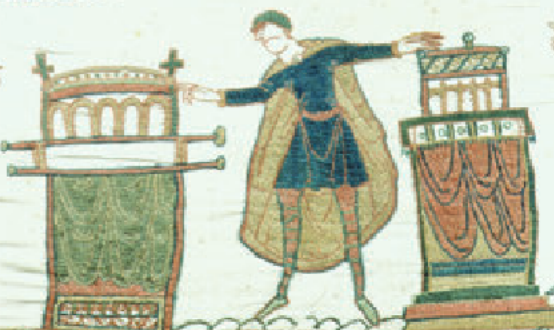
Harold's embassy to Normandy (1064-1065)
One of the most controversial events of Edward's final years was Harold Godwinson's diplomatic mission to Normandy. This embassy would later become central to William of Normandy's claim to the English throne, though the exact details remain disputed between Norman and English sources.
Important
The embassy to Normandy became one of the most politically significant and controversial diplomatic missions in English history, as it would later be used to justify the Norman invasion of England.
What happened during the embassy
The embassy involved several key events that would have lasting consequences:
Harold was sent to Normandy by Edward the Confessor, though historians debate what message he was supposed to deliver to William, Duke of Normandy. During his journey, Harold was captured by Count Guy of Ponthieu but was rescued by William, who rewarded Harold with gifts of weapons and armour for his service in military campaigns.
The most significant and controversial aspect of the embassy was that Harold swore a solemn oath. However, the exact nature and content of this promise remains unclear and would later become a source of major political dispute.
Why the embassy was important
The embassy held different meanings depending on the source, and these conflicting interpretations would have major political consequences:
From the Norman perspective: Norman sources claimed that Harold swore allegiance to William and promised to support William's claim to succeed Edward as king of England. They argued this embassy proved that Edward had chosen William as his heir and that Harold had agreed to this arrangement.
From the English perspective: English sources suggested the embassy was simply about recovering hostages from Normandy and that any oath Harold made was meaningless regarding the succession. They maintained that Harold was acting under duress and that the oath had no legal standing.
Note
The Normans would later use this embassy to justify their invasion of England, claiming that Harold had broken his sacred oath when he took the crown himself after Edward's death.
The rising against Earl Tostig (1065)
In October 1065, a major rebellion erupted in Northumbria against Earl Tostig, Harold Godwinson's brother. This uprising created a serious political crisis that Edward was forced to resolve in his final months.
Background to the rebellion
Tostig had been Earl of Northumbria but had become increasingly unpopular with his subjects. The Northumbrian thegns (nobles) rose up against him, demanding his removal from power. Edward initially ordered his earls to suppress the rebellion, but they refused to act.
Note
The refusal of Edward's earls to suppress the rebellion showed how weak the king's authority had become in his final year, and how even his own nobles were unwilling to act against popular sentiment.
Reasons for Tostig's unpopularity
The rebellion against Tostig arose from multiple grievances that had built up over time:
Tostig had implemented harsh crackdowns on lawlessness in Northumbria, going too far in his methods and alienating the local population. He abused his power by threatening rivals and seizing land and money from his enemies for personal gain. Tostig also had several Northumbrian rivals assassinated to eliminate opposition to his rule.
His failure to defend Northumbria against Scottish attacks, particularly because of his friendly relationship with Malcolm III of Scotland, angered the locals who expected protection. The heavy taxes he imposed on Northumbria caused widespread resentment among the population. Finally, many Northumbrians felt resentful about being governed by a southerner rather than a local leader who understood their customs and needs.
Harold's response and consequences
Harold faced a difficult choice between supporting his brother and maintaining political stability. Rather than defending Tostig, Harold may have calculated that Edward was unlikely to live much longer and that he needed to demonstrate his ability to act in England's best interests rather than just his family's interests.
Important
By November 1065, Tostig had been exiled and replaced with Morcar, brother of Edwin, Earl of Mercia. This decision showed Harold's political pragmatism but also created a dangerous enemy who would later ally with Harold's opponents during the succession crisis.
Timeline of key events
- 1064 (or possibly 1065): Harold's embassy to Normandy and the controversial oath
- October 1065: Northumbrian rebellion begins against Earl Tostig
- November 1065: Tostig is exiled and replaced by Morcar
- 5 January 1066: Edward the Confessor dies
Key terms
Note
Embassy: A diplomatic mission where representatives travel to meet with the ruler of another country to conduct official business or negotiations.
Oath: A solemn, sacred promise to do something, often made before God and considered binding on the person's honour and soul.
Summary
Key Points to Remember:
- Edward the Confessor died on 5 January 1066, triggering the succession crisis that led to the Norman Conquest
- Harold's embassy to Normandy became a major source of controversy, with Norman sources claiming he promised to support William's claim to the throne
- The different interpretations of Harold's oath show how the same events could be used by opposing sides to justify their actions
- The rebellion against Earl Tostig in 1065 demonstrated the political challenges facing Edward's government and Harold's pragmatic approach to maintaining stability
- These events in Edward's final years created the conditions that would lead directly to the battles of 1066 and the Norman Conquest of England