The extent of change (Edexcel GCSE History): Revision Notes
📚Revision Notes
The extent of change under Norman rule
Introduction
When William became King of England after 1066, he needed to establish strong control over his new kingdom. Rather than completely replacing the Anglo-Saxon system of government, William chose a clever approach. He took control of the existing Anglo-Saxon governmental structures and modified them to give himself much greater power as monarch than Edward the Confessor had enjoyed, and more authority than he had possessed as Duke of Normandy.
Note
William's strategy of adapting existing systems rather than completely replacing them proved highly effective. This pragmatic approach allowed him to maintain stability while dramatically increasing royal power - a key factor in the successful Norman consolidation of England.
How William centralised power in Norman England
William used multiple strategies to concentrate power in his hands and ensure his control over England. These methods worked together to create a highly centralised system of royal authority.
The feudal system and knight service
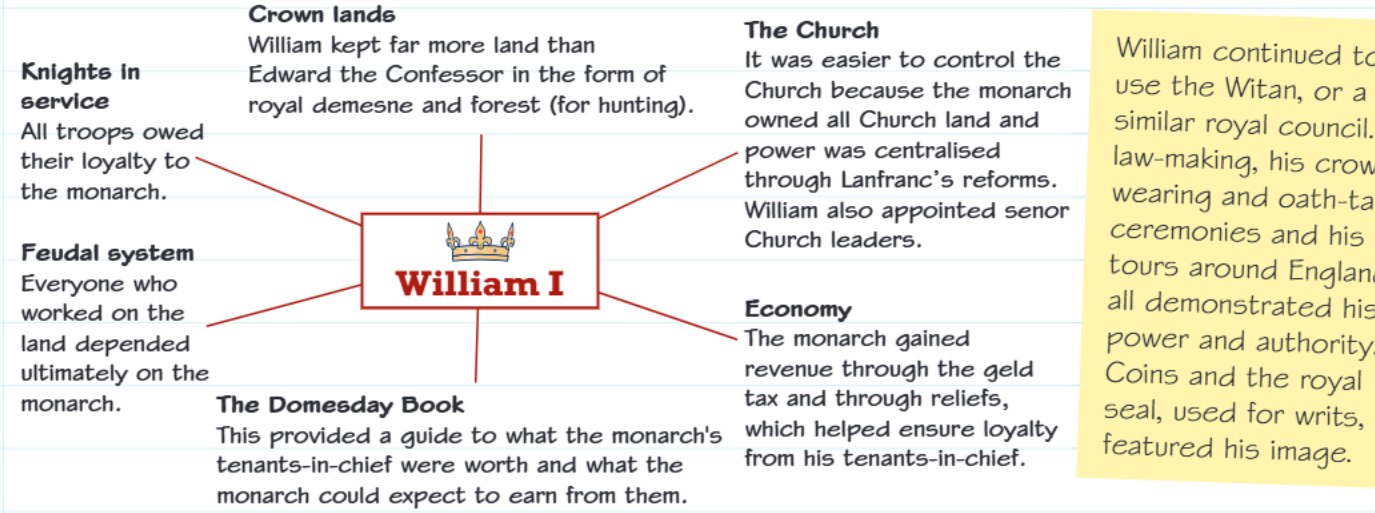
William introduced a feudal system where everyone who worked on the land ultimately depended on the monarch. All troops owed their loyalty directly to the king, creating a clear chain of command. This system meant that military power was centralised under royal control, preventing any single lord from becoming too independent or powerful.
Note
The feudal system was revolutionary in England because it replaced the more decentralised Anglo-Saxon military arrangements with a system that gave the king direct control over all military forces.
Crown lands and royal wealth
William kept far more land than Edward the Confessor had controlled, taking royal demesne and forest lands for hunting. This provided the king with a much larger source of direct income and resources, making him less dependent on his nobles for financial support.
Control of the Church
William found it easier to control the Church because the monarch owned all Church land and held power over senior Church appointments. He centralised religious authority through Lanfranc's reforms and personally appointed senior Church leaders. This gave him influence over both spiritual and temporal matters throughout England.
Economic control
The monarch gained revenue through the geld tax and through tithes, which helped ensure loyalty from his tenants-in-chief. By controlling the major sources of income, William could reward loyal followers and punish those who opposed him.
The Domesday Book
Example
Historical Example: The Domesday Book as a Tool of Control
Completed around 1086, this comprehensive survey provided William with:
- A detailed guide to what the monarch's tenants-in-chief were worth
- Information about what the monarch could expect to earn from them
- Unprecedented knowledge of his kingdom's resources
- A powerful tool for managing royal wealth more effectively
The Domesday Book represented the most thorough administrative survey of any mediaeval kingdom, demonstrating the extent of Norman organisational capabilities.
Continuity with Anglo-Saxon traditions
Importantly, William continued to use some Anglo-Saxon governmental structures, including the Witan (or a similar royal council). His law-making, crown-wearing ceremonies, and royal tours around England all demonstrated his power and authority. Coins and the royal seal, used for official documents, featured his image, reinforcing his position as legitimate ruler.
The role of earls
William recognised that England's earls could potentially challenge his authority, as they had previously done in Normandy. To prevent this, he systematically reduced their power through several key strategies.
Important
Earl power had to be carefully managed because these nobles controlled large territories and could potentially unite against Norman rule. William's systematic approach to reducing their influence was crucial for maintaining royal supremacy.
Reducing earl power
William made earldoms smaller, which reduced the land controlled by individual earls and therefore reduced their power. He also decreased the number of earldoms by phasing out positions like Wessex and Mercia. The king increased the power of sheriffs, who answered directly to the monarch rather than to local earls.
Additionally, William used knight service requirements to ensure only the monarch maintained a large army. He used his powers over tenants-in-chief to make sure his earls depended on him for keeping their lands and to be able to pass them on to their heirs.
The Revolt of the Earls (1075)
Example
Historical Example: The Revolt of the Earls (1075)
This rebellion demonstrated several key points about Norman rule:
- William's reduction of earl power was resented by some English nobility
- The revolt showed ongoing tensions between Norman rule and established English earls
- The rebels deliberately timed their revolt for when William was away in Normandy
- The revolt's failure proved the effectiveness of William's centralised control system
- Lanfranc's successful management as regent showed the importance of reliable deputies
The role of regents
Because William served as both England's monarch and Duke of Normandy, he faced the challenging task of governing two territories. He spent up to three-quarters of his time away from England during the last ten years of his life, making the appointment of reliable regents crucial.
Early regents and their problems
Important
Poor Regency Can Undermine Royal Authority
Odo of Bayeux and William FitzOsbern appear to have performed poorly as the first regents in 1067. They seem to have undone much of William's diplomatic approach towards the Anglo-Saxon nobility and contributed to provoking Anglo-Saxon resistance through their harsh rule.
This demonstrates how the wrong choice of regent could threaten the stability that William had worked so hard to establish.
More successful regents
Lanfranc proved much more reliable as a regent. In 1075, he successfully managed to contain the Revolt of the Earls until William could return from Normandy. The fact that the rebel earls had timed their revolt for a period when William was away demonstrates how important his personal presence was to maintaining central control of England.
Matilda of Flanders, William's wife, served as his most trusted regent in Normandy when William was in England. She was very influential and acted as regent many times, showing that William was willing to delegate significant authority to those he completely trusted.
Timeline of key events
- 1066: William becomes King of England
- 1067: Odo of Bayeux and William FitzOsbern serve as regents
- 1075: The Revolt of the Earls occurs while William is in Normandy
- 1075: Lanfranc successfully manages the revolt as regent
- 1086: Domesday Book completed
Remember!
Summary
Key Points to Remember:
- William centralised power by adapting Anglo-Saxon institutions rather than completely replacing them, giving him greater control than previous English kings
- The feudal system, crown lands, church control, and the Domesday Book all worked together to concentrate authority in royal hands
- William systematically reduced the power of earls through smaller earldoms, fewer appointments, and stronger sheriffs to prevent challenges to his rule
- The need for regents to govern while William was in Normandy created both opportunities and risks - effective regents like Lanfranc maintained stability, while poor regents could provoke resistance
- The extent of change was significant but built upon existing structures, showing William's pragmatic approach to conquest and control