The Norman aristocracy (Edexcel GCSE History): Revision Notes
📚Revision Notes
The Norman aristocracy: Bishop Odo
Introduction to Bishop Odo
Bishop Odo represents a prime example of how the Norman aristocracy gained and exercised power in England after 1066. As William the Conqueror's half-brother, Odo demonstrated both the opportunities and dangers that came with being part of the Norman elite.
Odo held the position of Bishop of Bayeux in Normandy, but his appointment was controversial due to his poor reputation. Despite this, William trusted him because family loyalty was crucial in Norman politics - William had few people he could truly rely on outside his immediate family circle.
Note
The Norman aristocracy often combined religious and secular power. Odo's dual role as both bishop and earl was typical of how Norman elites accumulated multiple sources of authority and wealth.
Following the successful invasion of England, William rewarded Odo's support by granting him the earldom of Kent. This made Odo one of the wealthiest and most powerful men in both England and Normandy, controlling vast estates and significant resources.
Timeline of Bishop Odo's career and significance
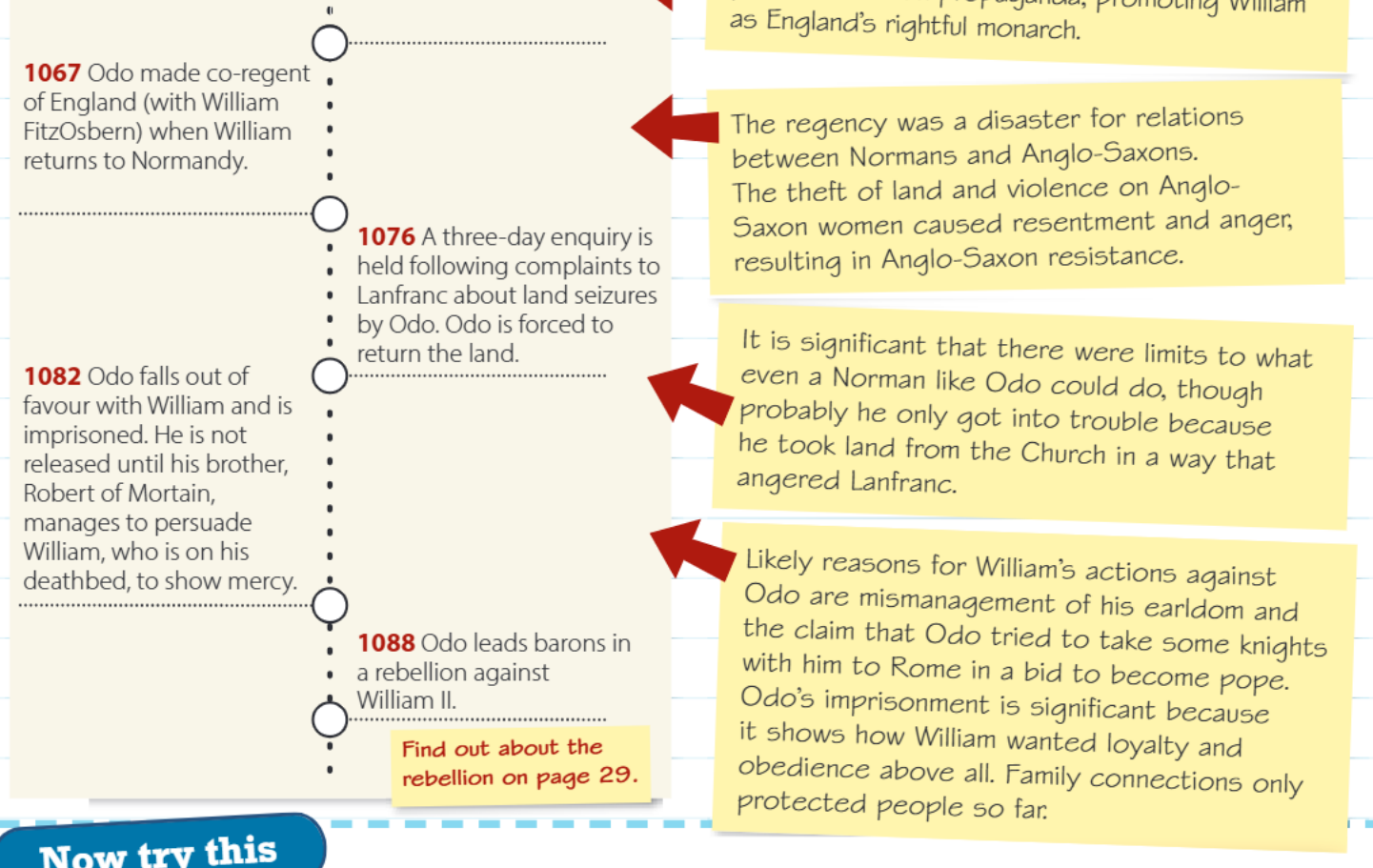
The timeline of Odo's life reveals the complex relationship between the Norman aristocracy and royal power. Born around 1036, Odo shared the same mother (Herleva) as William, creating a strong family bond that would prove both beneficial and problematic.
Important
Key Appointment (c1049): William's decision to make Odo Bishop of Bayeux despite his bad reputation demonstrates how family connections trumped other considerations in Norman society. This pattern of nepotism was central to Norman aristocratic power structures.
Odo's contribution of 100 ships to William's invasion fleet in 1066 illustrates how the Norman aristocracy supported the conquest through substantial financial and military commitments. His participation in the Battle of Hastings, later depicted in the Bayeux Tapestry, shows how bishops could also serve as military leaders - a common feature of Norman aristocratic culture.
The regency and its consequences
In 1067, William appointed Odo as co-regent of England alongside William FitzOsbern when the king returned to Normandy. This decision reveals how William relied on his most trusted Norman aristocrats to govern England in his absence.
Important
The Disastrous Regency: Odo's regency became a disaster for Norman-Anglo-Saxon relations. His seizure of lands and violence towards Anglo-Saxon women created widespread resentment and resistance, demonstrating how the behaviour of Norman aristocrats could undermine William's efforts to establish stable rule.
The three-day enquiry held in 1076 following complaints from Lanfranc about Odo's land seizures shows that even powerful Norman aristocrats faced limits. William was forced to intervene when Odo's actions threatened royal authority and church relations.
The limits of aristocratic power
Odo's imprisonment in 1082 represents a crucial moment in understanding Norman aristocracy. When Odo attempted to recruit knights for a journey to Rome - possibly seeking to become Pope - William saw this as a direct challenge to his authority. The king's willingness to imprison his own half-brother demonstrates that royal power ultimately superseded family loyalty.
Note
William kept Odo imprisoned until his deathbed, showing how seriously the king viewed attempts by aristocrats to act independently. This harsh treatment sent a clear message to other Norman elites about the boundaries of acceptable behaviour.
Odo's final rebellion in 1088 against William II proves that even after harsh punishment, some Norman aristocrats continued to challenge royal power. This rebellion highlights the ongoing tensions within the Norman elite and their willingness to resort to violence when their interests conflicted with those of the monarchy.
Summary
Key Points to Remember:
-
Family connections were crucial - Odo's relationship as William's half-brother gave him enormous opportunities but also created expectations of absolute loyalty
-
Norman aristocrats held multiple roles - Odo combined religious, military, and political positions, showing how the Norman elite concentrated different types of power
-
Royal authority had limits but ultimate supremacy - While William tolerated Odo's land seizures for years, he drew the line at independent foreign policy
-
Aristocratic behaviour affected Norman rule - Odo's harsh treatment of Anglo-Saxons during his regency damaged Norman efforts to establish legitimate authority
-
Power struggles continued beyond 1066 - The rebellion of 1088 shows that tensions within the Norman aristocracy persisted well after the initial conquest