Features and effects of the Revolt (Edexcel GCSE History): Revision Notes
📚Revision Notes
The feudal hierarchy: William's system for securing England
How William I established control through feudalism
After William conquered England in 1066, he needed a reliable system to maintain control over his new kingdom and prevent future rebellions. His solution was to establish a feudal hierarchy that would ensure loyalty from his subjects while providing him with military support when needed.
William declared himself the owner of all English land. He then granted large portions of this land to his most trusted supporters, who became known as tenants-in-chief. This created a chain of loyalty and obligation that helped William secure his kingdom against potential revolts.
Important
The feudal system was not just about land ownership - it was William's strategic method for preventing rebellions by making loyalty profitable and disloyalty costly.
Understanding feudal vocabulary
Several important terms help us understand how this system worked:
Hierarchy refers to how Norman society was organised into different levels of importance, with each level owing obedience to those above them. This created a clear chain of command from the king down to ordinary peasants.
Tenants-in-chief were the powerful nobles who received their land grants directly from William himself. These included lords, bishops, and abbots who formed the top tier of Norman society below the king.
Vassals were people who held land from someone higher up in the feudal system. They could be under-tenants who received land from tenants-in-chief, or even tenants-in-chief themselves when considering their relationship to the king.
A fief (also called a feud) was the actual piece of land granted to a vassal in exchange for their service and loyalty. The term "feudalism" comes from this word.
Note
The ceremony of homage was crucial to the feudal system. This formal ceremony where a vassal publicly pledged their allegiance to their lord created a binding relationship between the two parties. It wasn't just a symbolic gesture - breaking this oath had serious legal and social consequences.
A barony consisted of the lands held by a baron, who was typically a major landowner and often a tenant-in-chief.
The structure of feudal society
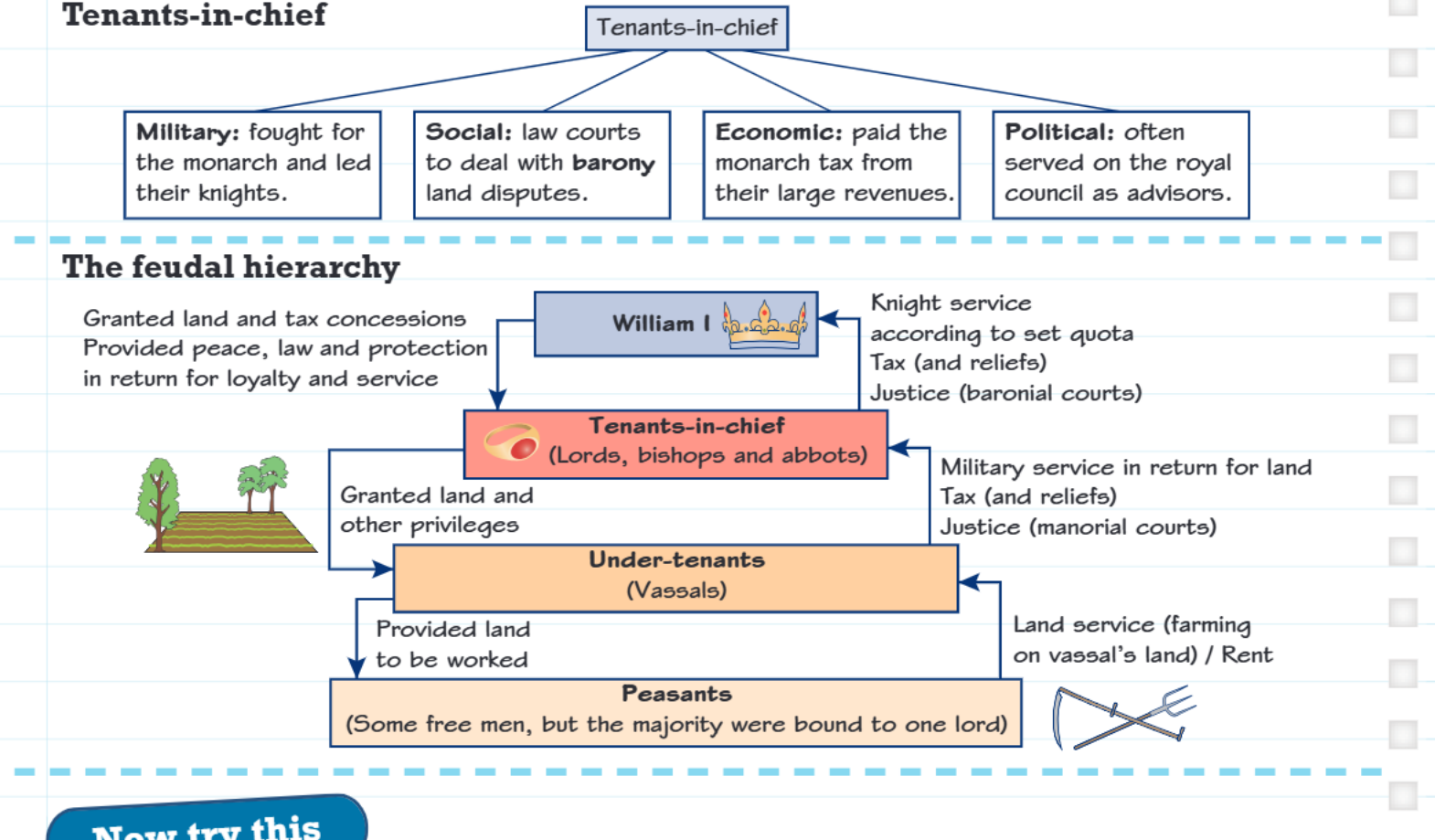
The feudal system created a pyramid-like structure of society. At the very top sat William I as king and ultimate owner of all land. Below him were the tenants-in-chief, who received large grants of land directly from the crown. These powerful nobles then granted portions of their land to under-tenants (vassals), who in turn might grant smaller portions to others. At the bottom of this hierarchy were the peasants, who worked the land but owned very little.
This system worked through mutual obligations flowing both up and down the hierarchy. Those higher up provided land and protection, while those below provided service, loyalty, and various forms of payment or labour.
Note
Think of the feudal system as a series of contracts. Each level received something valuable (usually land or protection) and gave something valuable in return (usually service, loyalty, or payment). This created a web of interdependence that made the system stable and self-reinforcing.
Knight service: the military foundation
One of the most important aspects of the feudal system was knight service. This was the obligation for nobles to provide trained knights to fight for the monarch when required. Typically, a knight was expected to serve for up to 40 days per year, though some had arrangements to serve for longer periods.
The knight service system meant that William could quickly raise an army from his tenants-in-chief whenever he faced threats to his rule. Some knights received enough land to live comfortably, while others were less wealthy and closer to peasants in their standard of living. However, all knights were expected to be properly equipped and ready for military service when called upon.
Important
Knight service was the backbone of William's military security. Unlike hired mercenaries who might switch sides for better pay, knights had a personal stake in the kingdom's stability because their land holdings depended on William's continued rule.
This military obligation was crucial for William's security. Rather than relying solely on hired soldiers, he could count on a network of loyal knights who had a personal stake in defending the kingdom because they held land from him.
The four key roles of tenants-in-chief
William's tenants-in-chief had multiple responsibilities that helped him govern England effectively:
Military role: They were required to fight for the monarch and lead their own knights into battle. This ensured William had military support from across the kingdom.
Social role: They managed law courts to deal with disputes over land ownership and other baronial matters. This helped maintain order at a local level.
Economic role: They paid taxes to the monarch from their large revenues. This provided William with the income needed to run his government and fund military campaigns.
Political role: Many tenants-in-chief served as advisors on the royal council, helping William make important decisions about governing England.
These multiple roles meant that tenants-in-chief were not just landowners, but key partners in William's system of government. Their loyalty was essential for maintaining control over England.
How feudalism secured William's kingdom
The feudal hierarchy was William's answer to the challenge of controlling a conquered kingdom. By making land ownership dependent on personal loyalty to him, he created powerful incentives for his supporters to remain faithful. If a tenant-in-chief rebelled, they risked losing everything.
The system also helped William respond quickly to threats. Through knight service, he could mobilise military forces from across England without maintaining a large standing army. The network of personal relationships meant that news of potential revolts would travel quickly up the hierarchy to the king.
Furthermore, by granting land to his Norman followers, William displaced Anglo-Saxon nobles who might have organised resistance. This both rewarded his supporters and removed potential leaders of rebellion.
Note
Timeline of William's consolidation
- 1066: William defeats Harold at Hastings and claims the English throne
- 1066-70: William establishes the feudal hierarchy, granting land to Norman followers
- 1069-70: William crushes major rebellions in the North, demonstrating the effectiveness of his system
- 1086: Domesday Book compiled, recording William's complete control over English landholding
Summary
Key Points to Remember:
-
The feudal hierarchy was William's key method for securing control - by making land ownership dependent on loyalty, he created a system that discouraged rebellion
-
Knight service provided military security - tenants-in-chief had to provide trained knights for up to 40 days per year, giving William a reliable army
-
Tenants-in-chief had four main roles - military, social, economic, and political responsibilities that helped William govern effectively
-
The system displaced Anglo-Saxon nobles - by granting land to Norman followers, William removed potential leaders of resistance
-
Personal relationships were the foundation - the bonds between lord and vassal, sealed by homage ceremonies, created a network of loyalty extending from peasants to the king