Diplomatic Negotiations (Edexcel GCSE History): Revision Notes
📚Revision Notes
Diplomatic Negotiations
The Significance of the Oil Crisis and the involvement of US and USSR
US ACTIONS AND THE CRISIS
CAUSES
- President Nixon's removal of the US from the gold standard, which resulted in a decrease in the value of the Dollar, as well as OPEC's revenue for its oil.
- The United States' support for Israel through emergency military aid during the Yom Kippur War in 1973, which amounted to $2.2 million.
THE OIL CRISIS OF 1973
- The Organisation of Petroleum Exporting Countries decided to impose an oil embargo against the US on October 19, 1973, as a result of their actions.
- An oil embargo meant that OPEC stopped exporting oil to the United States and allies that supported Israel during the Yom Kippur War.
- Egypt, Syria, and Israel declared a truce on October 25, 1973, with the intervention of the United States but OPEC continued implementing the embargo until March 1974.
EFFECTS AND SIGNIFICANCE
EFFECTS ON INDUSTRIALISED NATIONS: The oil embargo exacerbated economic problems facing Western industrialised countries, which experienced stagflation. In addition, the oil crisis led them to curb energy use and shift to industries that did not require oil (i.e. Japanese electronics).
SIGNIFICANCE OF THE 1973 OIL CRISIS:
The 1973 oil crisis changed the face of the international economy. Industrialised nations shifted their policies towards investment in diversifying energy sources, for example. This also brought about a change in economic policies to better address inflation.
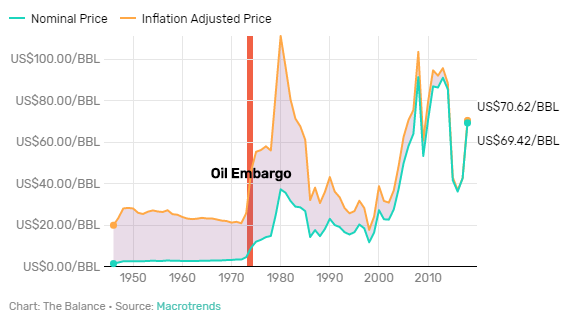 GRAPH 1: Crude Oil Price per barrel since 1946. Since OPEC imposed the oil embargo, oil prices began to rise from 11.65 per barrel at the end of March 1974.
(Chart from The Balance; Data from Macrotrends)
USSR AND THE OIL CRISIS
SOVIET'S SUPPORT FOR THE ARAB OIL EMBARGOES: The Soviet Union did not directly impose oil embargoes against the West but it has encouraged Arab states to do so. They took advantage of oil embargoes by increasing their oil exports and production against other top oil-producing countries.
EFFECTS OF THE SOVIET UNION'S ACTIONS
The Soviet Union acted as a proxy to the Arabs in terms of exporting oil products. In addition, they took advantage of the rising oil prices on the global arena. In fact, in 1974, they were able to earn around $3 million in oil exports compared to $1.2 million in 1973.
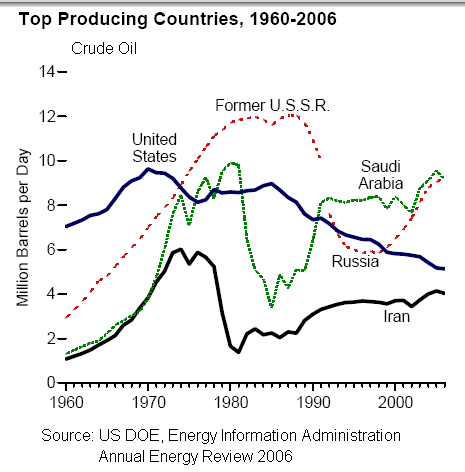 GRAPH 2: Production of oil per day in million barrels by Saudi Arabia, Iran, the US and the USSR. It can be seen that after the imposition of the oil embargo, the USSR's oil production rose. (Data from US DOE, Energy Information Administration)
Henry Kissinger's Rise to Diplomatic Prominence in the United States
Henry A. Kissinger came to prominence as a powerful and controversial diplomat in the history of the United States. He became the national security adviser to President Richard Nixon in 1969 and secretary of state in 1973, serving both Nixon and President Ford.
Before being appointed to various government posts, he escaped from Nazi Germany as a German Jewish refugee and went to the United States to pursue his education. He
Read his bachelor's, master's, and doctoral degrees at Harvard University. In the 1950s and 1960s, he served the same university as a professor of government.
As a diplomat, he engaged in secret negotiations with the Soviet Union, North Vietnam, and China, which bore the 1973 Paris Agreement that ended the involvement of US in the Vietnam War. His efforts led him to receive the Nobel Peace Prize in 1973 for this landmark work.
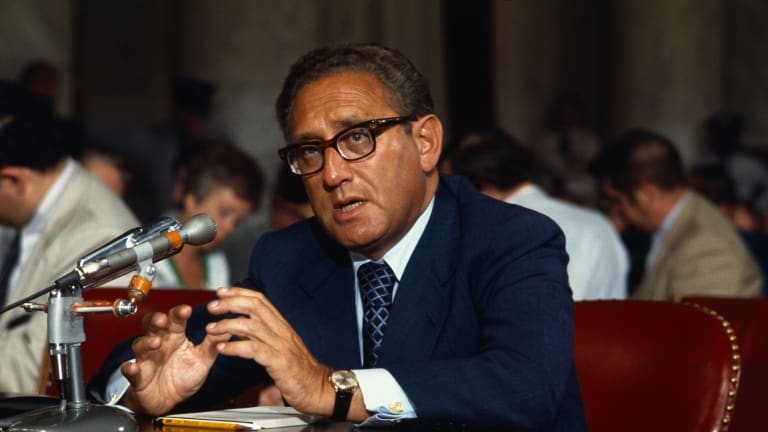 US Secretary of State Henry Kissinger
Kissinger and his "Shuttle Diplomacy"
Shuttle diplomacy is a term used in the field of diplomacy and international relations, which refers to the action of a third party to serve as a mediator between or among parties in dispute.
The process usually involves travelling back and forth ("shuttling") by the mediator from one location to another. This term was coined to describe the actions of Henry Kissinger in 1973.
KISSINGER'S SHUTTLE ENGAGEMENT IN THE MIDDLE EAST
- JANUARY 1974: He went back and forth to Egypt and Israel to negotiate proposals for disengagement. Discussions included redeployment of Egyptian and Israeli forces and reopening the Suez Canal.
- MAY 1974: Kissinger went back and forth to Syria and Israel for a month for negotiations. Discussions mostly focused on Quneitra, and the Syrians' demand for Israel to return it to them.
- 1975: Sadat asked Kissinger and Ford to push for another agreement between Egypt and Israel. AUGUST 1975: Finalised the Sinai Interim Agreement after several months of negotiations.
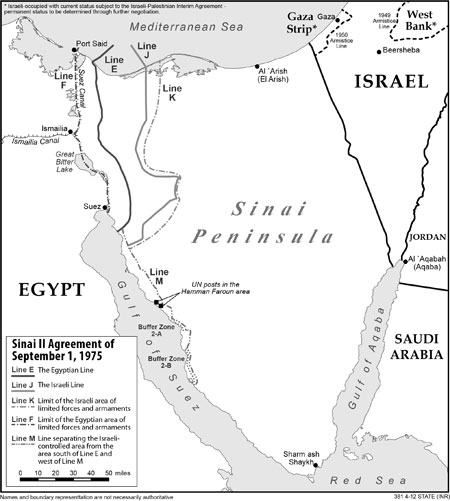 Map of Second Disengagement Agreement between Egypt and Israel, 1975 (Photo from the Office of the Geographer)
AGREEMENTS FROM KISSINGER'S SHUTTLE DIPLOMACY
- Egypt-Israel Disengagement Agreement (January 18, 1974) Redeployment of Egypt's forces to the West of the Suez Canal, while Israeli forces moved to the east with a buffer zone.
- Israel-Syria Disengagement Agreement (May 31, 1974) Israel's withdrawal of forces from territories it held in the 1967 war, and the establishment of a buffer zone.
- Egypt-Israel Sinai Interim Agreement (Sept. 4, 1975) Peace settlement based on UN Resolution 338, withdrawal in Sinai, and a UN buffer zone.
The Reopening of the Suez Canal
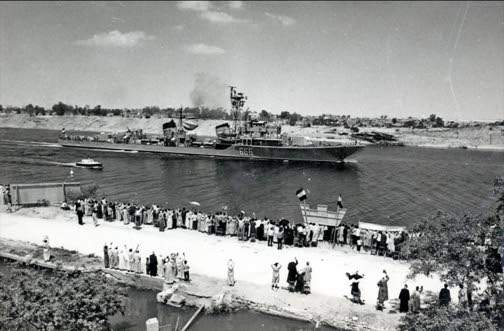 An Egyptian naval ship passes through the Suez Canal at Port Said after its reopening on June 5, 1975
Egyptian President Anwar al-Sadat announced on March 29, 1975, that Egypt would re-open the Suez Canal to international shipping on June 5, 1975. This was in line with the 8th anniversary of the outbreak of the Six Day War in 1967.
The canal closed after the war in 1967. After negotiations with Israel and the intervention of Henry Kissinger, Sadat decided to re-open it to generate more trade revenue.
Sadat's visit to Israel (1977)
REASONS
- Sadat realised that force was not successful in gaining back territories lost to Israel during the 1967 War.
- Introduce Egypt to the world by establishing good relations with the US, and to boost its popularity with the West.
SADAT'S VISIT TO ISRAEL (1977)
- President Sadat went to Israel on November 19, 1977, to discuss peace negotiations with Prime Minister Menachem Begin.
- After meeting with Begin, he addressed the Knesset (Israel's Parliament) on his desire to end decades of conflict in the region.
- While Sadat's visit was well- received by Israel and his supporters, the Arab world expressed its outrage.
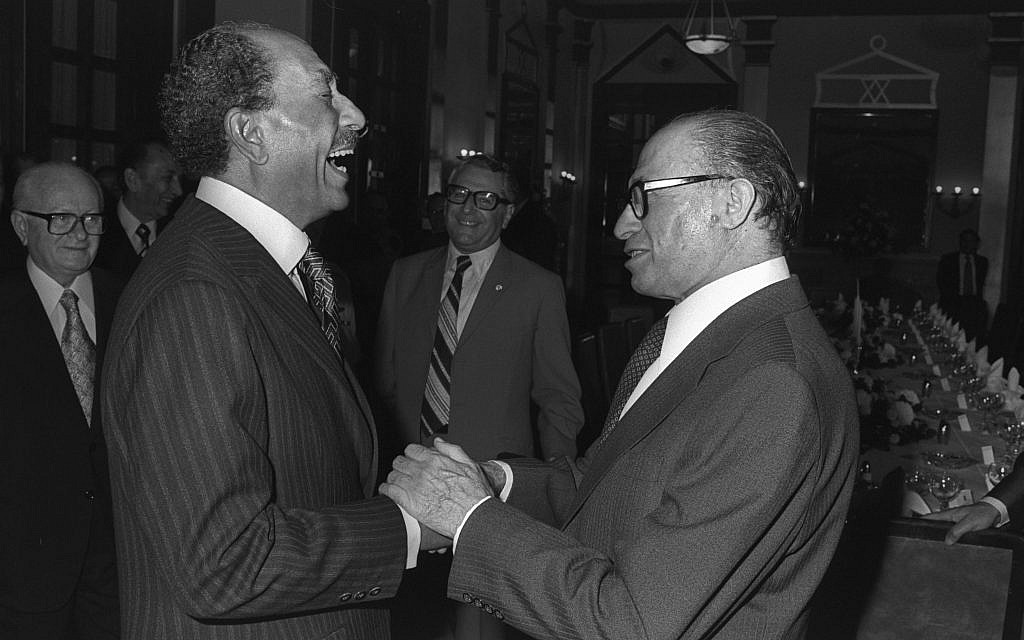 Israel Prime Minister Begin welcomes Egypt President Sadat to the country (Photo: Ya'akov Sa'ar/GPO archive)
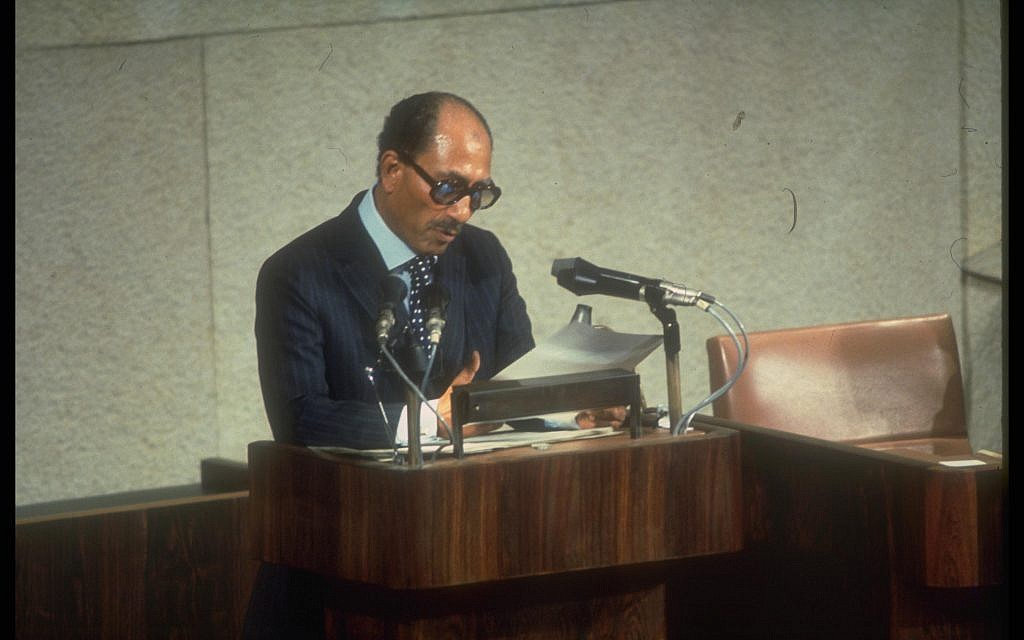 Egypt President Sadat addresses the Knesset (Israel's Parliament) (Photo: Ya'akov Sa'ar/GPO archive)
Begin's visit to Egypt (1977)
A month after Sadat's Jerusalem visit, he welcomed Israeli Prime Minister Begin to Cairo during the Ismailia Summit on December 25 to 26, 1977. While it presented an opportunity for the two leaders to negotiate peace agreements, there was no actual progress that occurred. The summit was able to come up with an agreement to convene joint military and political committees to advance negotiations. On the last day of the summit, the two leaders held a press conference, issued statements and answered questions.
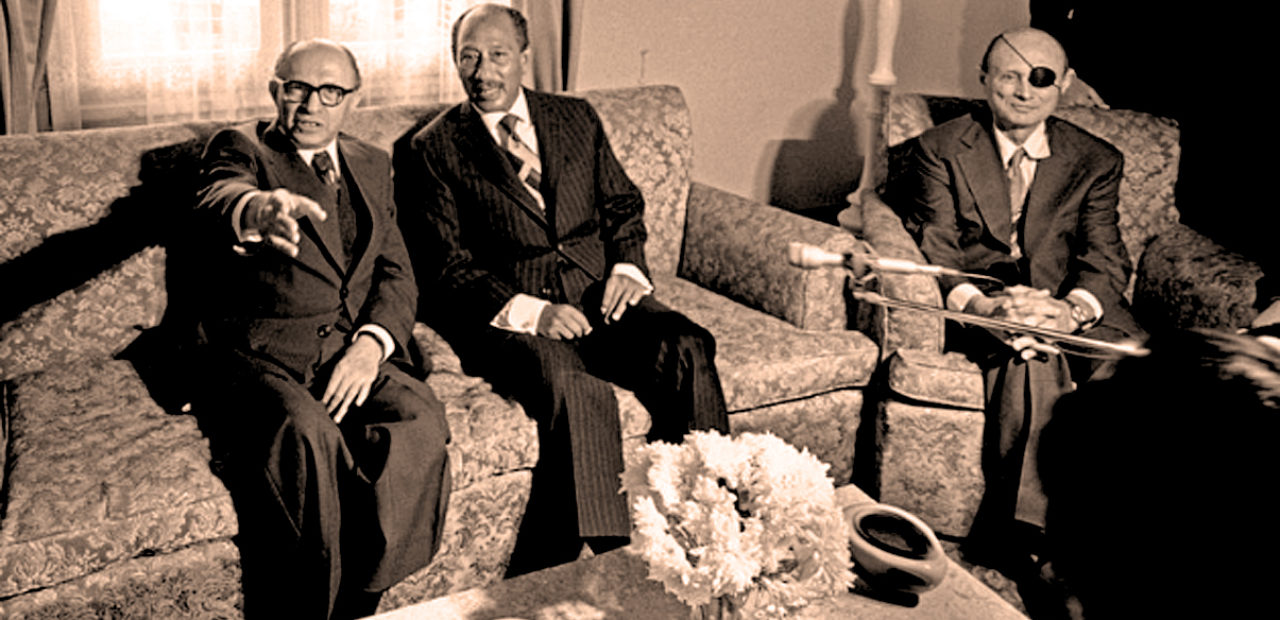 Israel Prime Minister Begin (Left) and Egypt President Sadat (Right) during the Ismailia Summit in 1977
US President Carter and the Camp David Accords (1978)
THE AGENDA
September 5, 1978: Arrival at Camp David for a twelve-day negotiation marathon with the following items on the agenda:
- Issues on the West Bank, Palestinian homeland, and self-government.
- Israel's settlement of the occupied territories during the 1967 war.
- Egypt's demand for Israel to withdraw from territorial borders stipulated in UN Resolutions 242 and 336.
EVENTS AT THE CAMP DAVID
- Slow progress was made due to the ongoing animosity between Begin and Sadat. Because of his frustration with the progress of the talks, Sadat and his delegation went back to Washington.
- US President Jimmy Carter resumed the peace talks after a brief encounter with Sadat and Begin. Two days later, President Carter confirmed the deal with his announcement.
- On September 17, 1978, the Camp David Accords between Israel and Egypt was signed at the White House, which outlines two major agreements.
US President Carter and the Camp David Accords (1978)
The Camp David Accords (1978)
- Agreement 1: Framework for Peace in the Middle East The agreement included resolving issues in the West Bank, Gaza, Palestine, as well as implementing UN resolutions. It did not include provisions on dealing with Jerusalem, however, which was a highly contested territory.
- Agreement 2: Framework for Conclusion of a Peace Treaty between Israel and Egypt This agreement led to the withdrawal of Israel from Sinai, the restoration of diplomatic relations with Egypt, and the security of southern borders of Egypt, all of which Israel agreed to.
THE EFFECT:
The Camp David Accords signed in 1978 led to the signing of the peace treaty in Washington in 1979, which closed a significant chapter on the conflict between the Arabs and the Israelis. This also "saved" Carter's diplomatic reputation.
The Treaty of Washington (1979)
- March 26, 1979: Egypt and Israel concluded its decades-long conflict through a peace treaty at the White House, in Washington D.C.
- This was signed by Egyptian President Sadat and Israeli Prime Minister Begin in the presence of US President Jimmy Carter.
- The treaty served as a culmination of several negotiations between the two countries - from Sadat's visit to Israel, to the signing of the Camp David Accords in 1978.
- Restoration of diplomatic and trade relations between Israel and Egypt was one of the provisions of the treaty. Others included Israel's withdrawal of all military and civilian forces from Sinai, which they seized during the Six Day War in 1967.
- For its part, Egypt agreed to turn the Sinai Peninsula into a demilitarised zone, with the exception of limited police presence. Israeli ships could pass through the Suez Canal.
- Israel completed the withdrawal of its forces in 1982, as well as its evacuation of its settlements in Ofira and Yamit, all of which were established after the Six Day War in 1967.
Note
Glossary of terms
OIL EMBARGO: This refers to the economic situation that involves the limited transportation of oil products from one area to another. It's often used as political strong-arming.
CAMP DAVID ACCORDS: These were the agreements entered into by Israel and Egypt, which they signed on September 17, 1978, at Camp David. It served as the framework towards the peace treaty.
STAGFLATION: It refers to the economic condition that sees slow economic growth coupled with a rise in unemployment rates and inflation.
SHUTTLE DIPLOMACY: Refers to the action taken by an outside party to serve as a mediator between or among parties engaged in a dispute without any contact between them. This involves travelling back and forth (shuttling) to several locations.