The Palestinian Issue (Edexcel GCSE History): Revision Notes
📚Revision Notes
The Palestinian Issue
Arafat's speech to the United Nations (1974)
Despite the backlash for the lack of action against the violence inflicted by the PFLP and Fatah, the PLO was recognised as the "sole representative of the Palestinian people" by the Arab League. On the 13 November 1974, PLO Chairman Yasser Arafat appeared before the General Assembly to deliver a historic speech after being granted observer status by the United Nations. Here, he asked the UN for help to regain freedom for the Palestinian people, as well as for the lands lost during conflict with Israel. This event bolstered the PLO and Arafat in advancing their interests in the region.
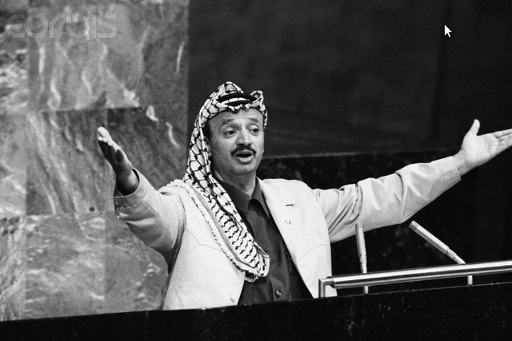 PLO Chairman Yasser Arafat delivering his speech to the UN General Assembly in 1974
The significance of the PLO Activities in Lebanon in the 1970s
EXPULSION FROM JORDAN
Following the Jordanian Civil War in 1970, a ceasefire agreement was signed by the PLO and King Hussein, which was mediated by the Arab states. The following year, they were expelled by the King of Jordan and transferred to Lebanon.
ACTIVITIES IN LEBANON
The PLO seized certain areas in the country, which were transformed into camps mainly occupied by Palestinian refugees. They were recruited by several PLO factions. It also established an "autonomous state" within a state, having its own army.
REACTIONS AND SIGNIFICANCE
The PLO's existence in Lebanon was a significant one for political gain and international recognition. Their presence brought about violence, displacement, and economic downturns, however. As such, Lebanese citizens feared their presence.
Israeli reprisals, the invasion of Lebanon (1982) and the results
CAUSE/ROOT
The PLO and other militant groups launched several violent attacks, raids, kidnappings, and aeroplane hijackings targeting Israelis and Jews, as well as Israel's institutions across the globe. Since the 1970s, the Palestinian insurgency has been prevalent in South Lebanon.
Israel's Reprisals against PLO
- April 9-10, 1973: Operation Spring of Youth (part of Operation Wrath of God) commenced when Israeli forces attacked the PLO in Beirut and Sidon in retaliation for the Munich massacre.
- March 14-21, 1978: Israel's Defence Forces (IDF) carried out another invasion of Lebanon in response to the massacre that happened along Israel's Coastal Highway.
- July 1981: After the PLO launched rocket attacks on Israeli settlements in the north, Israel bombed PLO encampments in the southern part of Lebanon.
ISRAEL'S LAST STRAW
- A Palestinian terrorist group led by Abu Nidal attempted to assassinate Shlomo Argov, Ambassador of Israel to Britain.
- The assassination attempt happened in June 1982. On June 4-5, 1982, the IDF attacked Lebanon in retaliation for the PLO's actions.
- In return, the people of Galilee were attacked by the PLO. On June 6, the IDF invaded Lebanon to commence Operation Peace for Galilee.
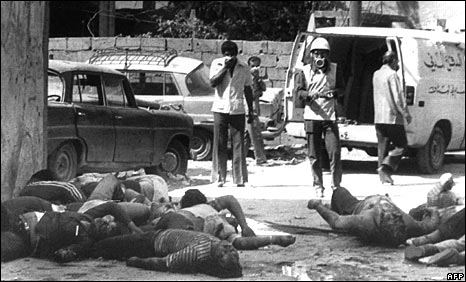 Bodies of Palestinians seen at the Sabra refugee camp after being killed during the 1982 Lebanon invasion
Israeli reprisals, the invasion of Lebanon (1982) and the results
MOVEMENTS AND EVENTS
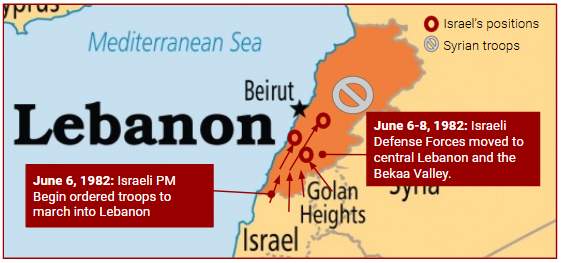 MAP OF SYRIA, ISRAEL AND LEBANON
Israeli reprisals, the invasion of Lebanon (1982) and the results
MOVEMENTS AND EVENTS
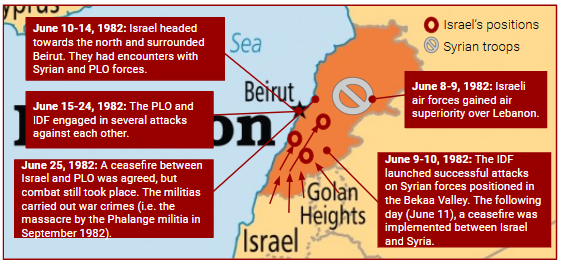 MAP OF SYRIA, ISRAEL AND LEBANON
Aftermath of the 1982 Invasion of Lebanon
- August 30, 1982: The PLO was forced to depart to Tunisia. Israel began to withdraw from Lebanon (January to June 1985) and established a security zone at the northern part of its border.
- Lebanon entered a new phase of the civil war with isolated Christian groups, which is considered to be the bloodiest. As a result, about 850,000 Christians fled Lebanon.
- The PLO's withdrawal from Lebanon resulted in a power vacuum. This was later on filled by Hezbollah. It was supported by Iran in the pursuit of launching attacks against Israel.
The Israeli occupied territories, revisited
Issues over territory were contested by Israel and Palestine. After the 1967 war, Israel occupied Golan Heights from Syria, the Sinai Peninsula and the Gaza Strip from Egypt, and the West Bank and East Jerusalem from Jordan. In 1978 and 1982, Israel seized southern Lebanon. With these occupations, settlements were built. These continued even though Israel had withdrawn from Egypt and Lebanon.
The international community questioned Israel's occupation of these territories as it was not provided for by international law. The UN Charter did not allow for acquisition of territory by means of war.
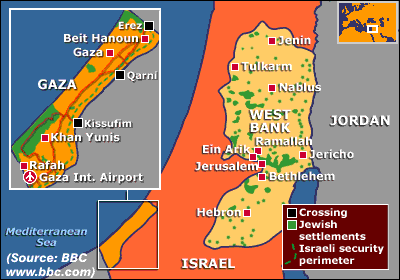 Occupied territories of Israel since the Six Day War in 1967, along with lines of demarcation
The First Palestinian Intifada (1987-1993)
Causes
- In Gaza, Palestinian workers were involved in an accident that saw an Israeli truck crash into a car.
- Four people were killed, while 10 were wounded. Palestinians saw this incident as retaliation for the killing of a Jewish person prior.
The Palestinian Intifada (1987-93)
- The Palestinian intifada ("shaking off" in Arabic) took place in the Gaza Strip, an Israeli-occupied territory since the 1967 war.
- Street protests, burning tyres, and throwing rocks at Israeli forces by Palestinians took place and signalled for riots to begin.
- Israel's paratroopers went to Gaza to neutralise the violence but the riots spread to the West Bank.
The First Palestinian Intifada (1987-1993)
The events during the first Intifada (1987-1993)
- December 9, 1987: Riots began in Gaza Strip. Despair among the Palestinians prevailed during the intifada. The uprising came under the control of Palestinian leaders. Wealthy Palestinians and women joined the protests.
- July 1988: King Hussein of Jordan declared his abandonment of responsibility over the West Bank. With this decision, Palestinian influence became more prevalent in the Israeli-occupied territory.
- November 1988: The PLO decided to put to a vote the establishment of an independent Palestinian state. The small-scale riots and violence continued, where 300 Palestinians were killed, and more than 11,000 people were wounded.
- Towards the end of 1988, PLO Chairman Yasser Arafat called to put an end to terrorism and to recognise the existence of Israel as a state. He also proclaimed that it was time to begin negotiations with Israel.
- 1992: Yitzhak Rabin was elected as Israel's Prime Minister. He ordered a halt to building new settlements in the Israeli- occupied territories.
- After five years, the intifada ended.
- 1993: There was a secret negotiation going on between Israel and Palestine in Oslo, Norway. As a result, on September 13, 1993, the historic Declaration of Principles on Interim Self-Government Arrangements was signed in Washington DC.
Note
Glossary of terms
INTIFADA: It is an Arabic word, which means "shaking off", and refers to a legitimate resistance or uprising against oppression.
TERRITORIAL OCCUPATION: It refers to the invasion of territory by a belligerent state, with the goal of occupying it temporarily.
OBSERVER STATUS: It is a privilege granted by a certain organisation (i.e. United Nations) to non- members to participate in the activities conducted by the organisation.
INSURGENCY: The term is used to refer to active revolt or uprisings against the existing authority.