Aftermath of the 1948-49 War (Edexcel GCSE History): Revision Notes
📚Revision Notes
Aftermath of the 1948-49 War
The Impact of the 1948-49 Arab-Israeli Conflict: Territorial Changes
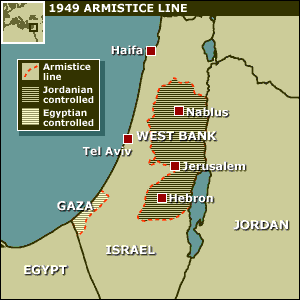
During the Arab-Israeli War, Israel was able to gain control of West Jerusalem, while East Jerusalem, including the old walled city, was conquered by Jordan. This was incorporated in the armistice agreements, signed in 1949.
In the agreements, the Armistice Demarcation Lines were drawn, which saw Israel controlling more than one-third of what was assigned to them by the United Nations in the Partition Plan in 1947. Egypt was able to gain a hold of the Gaza strip. It was seen that the West Bank and the Gaza Strip became distinct geographical areas as a result of the 1949 armistice agreements.
 Jewish refugees from Arab countries
The United Nations Truce Supervision Organisation and Mixed Armistice Commissions were established to maintain peace and order in the region and to monitor and supervise armistice and ceasefire agreements.
The Impact of the 1948-49 Arab-Israeli Conflict: State Relations and Geopolitical Power Shifts
In 1945, the Arab League was founded with a focus on economic development, political cooperation, and coordination. The founding members of the league were Egypt, Iraq, Saudi Arabia, Transjordan (now Jordan), Lebanon, and Syria.
The league had voiced its support of the Arabs in Palestine, especially during the first Arab-Israeli conflict from 1948-1949.
 The Arab League Emblem
However, in a turn of events, the Arabs were not able to conquer territories under Israeli control. This led to a split in the league, between Egypt, Syria, and Iraq, that blamed each other for failures during the war. The United Kingdom's influence further weakened after its withdrawal from Palestine and, soon, the United States rose to power in the region.
The Palestinian Diaspora and the Role of the United Nations
A sudden turn of events happened in 1947 after the United Nations General Assembly approved the Palestine Partition Plan. With over one million Palestinians living in the region in 1949, more than three-quarters (66%) of them fled their homes to escape violence as a result of the Arab-Israeli war. The diaspora was seen not only as a human tragedy but it further escalated the Arab-Israeli conflict. There were many debates and stances on whether the refugee crisis was a deliberate policy by Israelis or a product of the conflicts brought about by the Arabs' wish to control Israeli territories in Palestine. Whatever the reasons, the crisis greatly affected Palestinian Arabs.
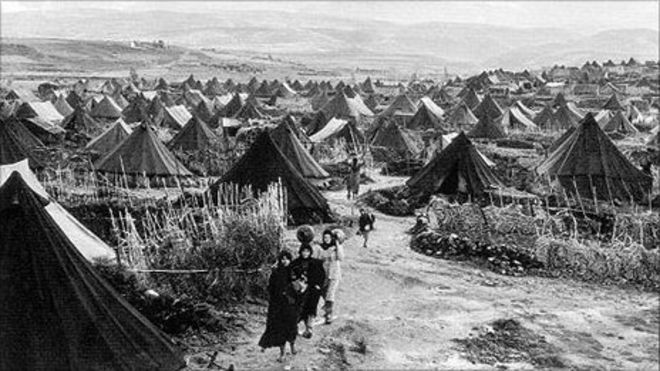 A Palestinian refugee camp, 1948 (Photo from BBC News)
Palestinians sought refuge in neighbouring countries. As their numbers increased, it became a problem since the available resources could not support them.
Based on the figures from the United Nations Relief and Works Agency (UNWRA), there were more than 1.5 million refugees living in 58 recognised refugee camps in Jordan, Lebanon, the Syrian Arab Republic, the Gaza Strip and the West Bank, including East Jerusalem. At the end of 1948, UN Resolution 194 was passed to allow Palestinian Arab refugees to return to Israel and compensation to be given to those who did not want to.
 The UNRWA Logo
Since 1950, the UNWRA helped 35% of the refugees to irrigate and develop land that they had occupied in the camps. In addition, the UN allocated budget for improving the refugees' livelihood, education, and healthcare. Other refugees sought refugee status in Arab countries such as Egypt, Syria, Lebanon, Jordan, Saudi Arabia, and Gulf States, as well as in the United States and Europe.
The location of Jewish refugees since 1948
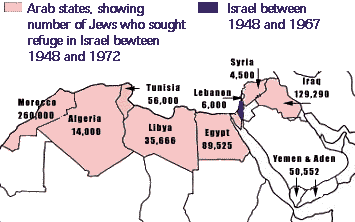 Diagram from The Pedagogic Centre, The Department for Jewish Zionist Education,****** The Jewish Agency for Israel (1997, 1998, 1999, 2000)
The Creation of the Israeli Defence Forces (IDF)
After Israel's independence in 1948, Prime Minister David Ben-Gurion, who also served as defence minister, ordered the creation of the Israeli Defence Forces on May 26, which served as the armed forces of Israel. The IDF was formed out of the paramilitary group Haganah, and militant groups Irgun and Lehi after being disbanded by the Israeli government over terrorist attacks in Palestine in 1945.
The IDF was primarily responsible for the country's military operations, including those during the Arab-Israeli war in 1948. Much of these operations were successful in gaining territories under Arab control.
Due to their experiences in these conflicts, the IDF was regarded by Global Security as one of the world's most battle-trained military forces.
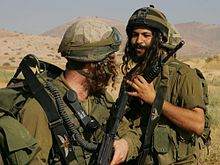 Israeli Defence Force (IDF) Soldiers
The Law of Return and the US Aid's Impact on Israel's Economic Development
Following the end of the Arab-Israeli war in 1949, Israel's government faced numerous issues regarding their people who were displaced by conflict in Palestine. To address this, laws were proposed to enable the refugees to claim land and property in the region.
In 1950 and 1952, the Knesset (Israel's unicameral parliament) passed two landmark laws: Law of Return (1950) and the Law of Citizenship (1952) that granted all Jews their rights to settlement and citizenship, including immigrants.
 The Knesset Plenum and Visitor's Gallery (1950)
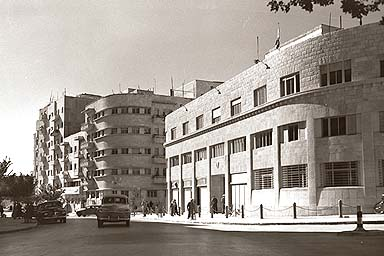 The old Knesset building in Jerusalem
With the passage of these laws, more Jews were encouraged to settle in Israel to have a brighter future. It served as a turning point in Israel becoming an economic powerhouse in the Middle East in the subsequent 30 years.
In the forty years that have passed since its independence, Israel has changed dramatically. The immigration of Jews to Israel (known as aliyah) increased with over
500,000 arriving from Eastern Europe (called Ashkenazim), Spain and Portugal (also known as Sephardim), and Arab States like Yemen, Iraq, Iran, and Morocco (also known as the Oriental Jews).
With increasing Jewish immigration to Israel, some cultural problems emerged. However, the different cultures worked together to integrate and avoid conflict.
"Every Jew has the right to come to this country as an oleh [immigrant]." (Section 1, Law of Return 1950)
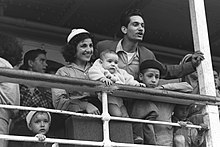 Moroccan Jewish immigrants arrive in Israel (1954)
The United States enters the Middle East affairs
Despite the promise of a better future in Israel, economic and political problems continued to trouble the newly-established state. With few natural resources, the government relied on importation to survive. Worst, both oil and water were contested resources between Israel and its neighbouring states.
Israel's need for outside help was met by the United States through loans, then later from West Germany. Jewish businessmen also gave donations. This financial assistance helped boost Israel's economy, with developments in agriculture, transport, housing, infrastructure, and healthcare for its citizens.
Bilateral relations between Israel and the United States started with the latter's sympathy and support for the creation of a Jewish state. The US policy in the Middle East is based on supporting the independence of Arab states, providing aid to oil-producing countries, and preventing the USSR from taking control of Turkey, Greece, and Iran.
The Relations between Israel and Egypt
 The Flags of Egypt and Israel
Towards the end of the Arab-Israeli war, Israel and Egypt began talks on an armistice at the island of Rhodes in Greece on January 12, 1949. After the talks, Israel agreed to release a besieged Egyptian unit in Fallujah but later reneged on the agreement. After a month, talks did not prosper. Israel soon demanded Egypt withdraw all its military forces from territories under the Palestine Mandate.
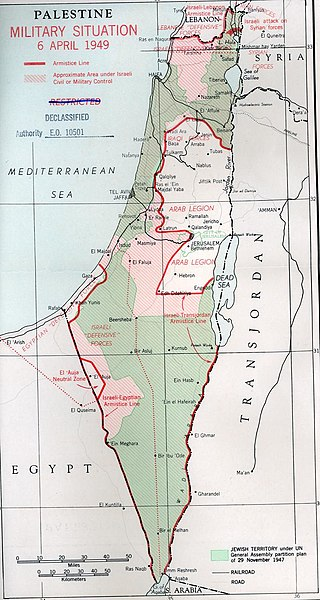 Palestine Military Situation (1949) from Truman Papers
The 1949 Israel-Egypt Armistice Agreement
Egypt, on the other hand, insisted that Arab military forces withdraw from their respective positions held on October 14, 1948, based on the resolution of the UN Security Council on November 14, 1948. Israel had to withdraw theirs to positions on the northern part of the Majdal-Hebron road.
The deadlock flared on February 12, 1949, with the murder of the leader of Islamic group Muslim Brotherhood, Hassan al-Banna. Israel attempted to withdraw from the talks but the United States requested both parties conclude an armistice agreement.
On February 24, 1949, the agreement was signed by Israel and Egypt, which stipulated the delineation of Egypt's territories (Gaza Strip), as well as the declaration of the borders around 'Uja al-Hafeez as a demilitarised zone. Lastly, Egyptian forces who were besieged in Fallujah were allowed to return to Egypt on the condition that the area be surrendered to the Israeli military.
The armistice agreement did not end the state of war but was a declaration of a truce between the two states. A few years after the agreements were signed, there were numerous incidents that violated the truce. On February 1954, Egypt complained that Israeli forces launched attacks on the Egyptian army guarding the borders of the demarcation line. This was followed by significant incidents.
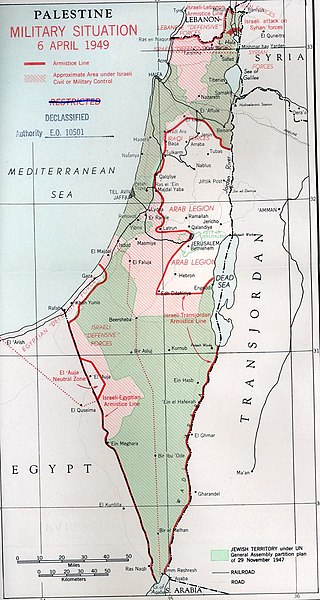 Palestine Military Situation (1949) from Truman Papers
Note
Glossary of terms
DIASPORA: Dispersion, scattering or forced exile from a certain territory.
ALIYAH: A Hebrew word for 'ascent', which refers to the immigration of Jews to Palestine.
AL-NAKBA: A coined term that refers to the diaspora of Palestinian Arabs from Palestine.
REFUGEE: A person who has been forced to leave their home territory to avoid conflict and/or persecution.
KNESSET: The unicameral legislature of Israel.