Aftermath of the 1967 War (Edexcel GCSE History): Revision Notes
📚Revision Notes
Aftermath of the 1967 War
The United Nations Resolution 242
The crisis in the Middle East continued to escalate despite multiple armistices and third party agreements made at the end of previous wars. The world had been trying to put an end to the conflict between the Arab world and the Jewish state. For the international community, one way to end the animosity was through peace settlements.
In November 1967, after disagreements to resolve the conflict, US Ambassador to the United Nations, Arthur Goldberg, went to the Security Council and
proposed that a peace agreement must involve the following:
- Withdrawal of Israeli troops from the territories they gained control of during the conflict; and
- Recognition by all states that their respective territorial boundaries were secured and recognised.
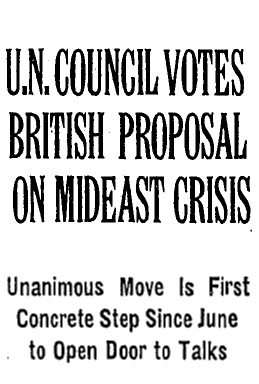 A New York Times headline on UN Resolution 242 (Nov. 23, 1967)
Goldberg's pronouncements served as the basis for the language that was successfully used in the resolution by British Ambassador Lord Caradon.
THE APPROVAL
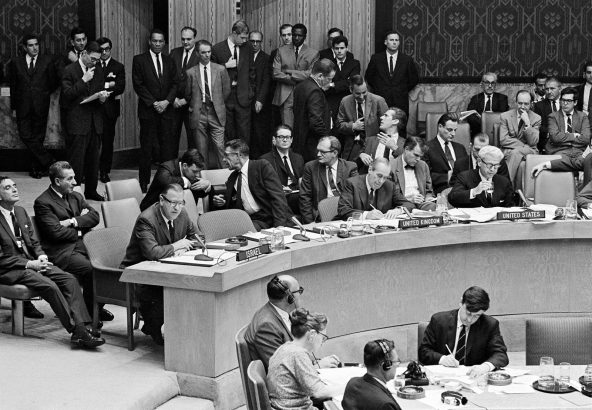
The UN Security Council Meeting in 1967 (Photo from the United Nations by Teddy Chen)
On November 22, 1967, the UN Security Council unanimously approved Resolution 242.
Looking into the resolution, it was built around two main provisions: (1) Withdrawal of Israeli forces from territories they occupied; and (2) Giving recognition to Israel's right to legitimacy and security. The language used by the British Ambassador Lord Caradon played a vital role in passing the resolution.
While the text appeared to be substantive, the provisions were actually vague. Both parties could have interpreted it as they saw fit based on their own interests. The resolution affirmed the need to resolve these problems but it failed to specify how to do it.
The resolution was accepted by Egypt, Israel, and Jordan. However, it took another war in 1973 for Egypt and Israel to implement the provisions of the resolution.
The Continued Disputes over the Suez Canal
THE CANAL'S CLOSURE AND ITS IMPACT
The Suez Canal was seen as an important waterway that connects the Mediterranean and Red Seas. Since it was opened in November 1869, the canal offers a direct route from the North Atlantic to the northern Indian Oceans, increasing trade activity between the countries within these bodies of water.
At the height of the Six Day War in June 1967, Nasser ordered the closure of the Canal to prevent all ships from Israel from entering the area. The closure caused 15 cargo ships, known as the "Yellow Fleet" to be trapped in the Canal until 1975. At the end of the war, both forces from Egypt and Israel were on either side of the Suez Canal, which made its reopening very uncertain.
The Suez Canal accounts for 7.5% of the world's trade. Its closure caused trade volumes to fall at an average of over 20% (Feyrer, 2009).
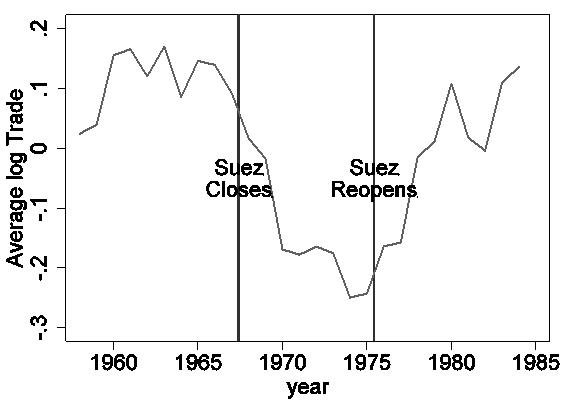 The trade volume in the Suez Canal from 1959 to 1984 (Photo from Feyrer, 2009)
The Palestinian Refugees after the Six Day War (1967)
THE WORSENING CONDITIONS
After the Six Day War, there were around 280,000 to 325,000 Palestinians driven out of the territories under Israel's control. An estimated 145,000 of the total number of Palestinian refugees in 1967 also sought refuge at the height of the Arab-Israeli conflict in Palestine in 1948.
The refugees suffered worsening conditions after the 1967 war, such as facing threats of demolition of their homes and refugee camps.
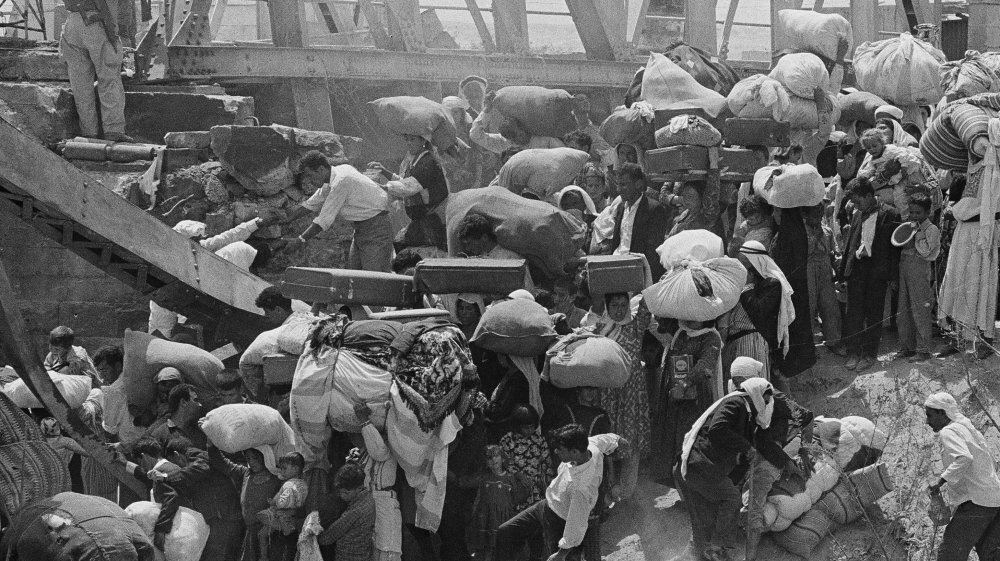 Palestinian refugees carry their belongings as they cross the Jordan River via Allenby Bridge from West Bank (Photo by AP)
EVENTS
- A UN Special Committee investigated allegations of demolition of over 400 Arab villages, which was deliberately done by Israeli forces.
- 245,000 fled from the West Bank to Jordan; 11,000 from the Gaza Strip to Egypt; and 116,000 Palestinians and Syrians fled from Golan Heights
- Until 1967, the majority of Palestinians sought refuge outside the Palestine territory.
The significance of Israel's occupied territories after the 1967 war
GOLAN HEIGHTS
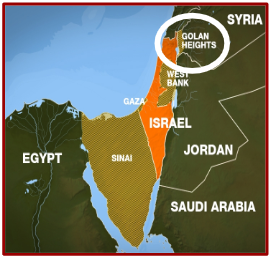 Territories gained by Israel after the 1967 War (ENCIRCLED TERRITORY: Golan Heights)
Significance of Golan Heights to Israel
PHYSICAL GEOGRAPHY: Golan Heights possess fertile land, and volcanic soil, ideal for cultivating vineyards, orchards, as well as for raising cattle.
MILITARY STRATEGY:
Southern Syria and Damascus could easily monitor movements by Syrian forces. It provides a natural buffer against attacks from Syria.
SOURCE OF WATER:
Rainwater from Golan Heights' catchment flows to the Jordan River.
GAZA STRIP
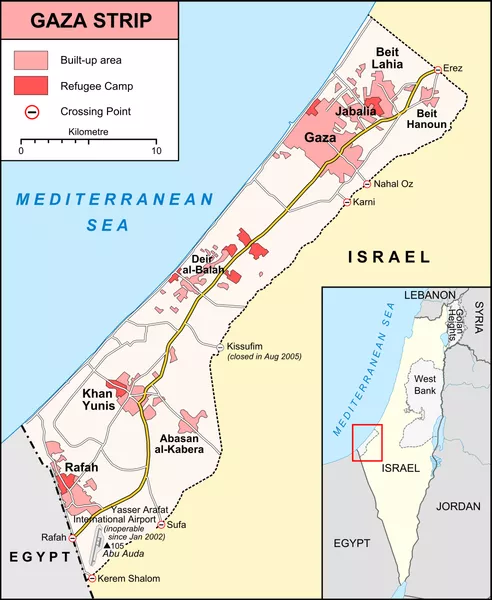 The Gaza Strip Map (by Gringer/Lencer, 2008/2009)
Significance of Gaza Strip
- The Gaza Strip has been part of decades-long conflict between the Arabs and the Israelis. It was used to assert Israel's right to existence.
- Gaza has played a significant role in history as a prosperous trade centre. Economic activities such as textile manufacturing, fishing, and tourism thrive in this area.
- Palestinians left or were driven out of their homes. Some had moved to Gaza as refugees.
Significance of West Bank to Israel
- It was considered by Jews as the heartland of the ancient Jewish state, and home to many Jewish holy sites.
- After the capture of the West Bank by Israeli forces in 1967, it was subjected to military rule. Palestinians lived under Israeli military authority during this time.
- International laws have viewed Israel as a belligerent occupant, as a result of controlling the West Bank in 1967.
Significance of Sinai Peninsula
- The area is spiritually significant for Christians, Jews, and Muslims, especially Gebel Musa (Mountain of Moses).
- Historically, Sinai has been the centre of conflict between Egypt and the rest of the states within the Mediterranean region. This is mainly due to its strategic geopolitical location, economic, and cultural convergences. Most trading activities take place here since the Suez Canal is in the western portion of the peninsula.
EAST JERUSALEM
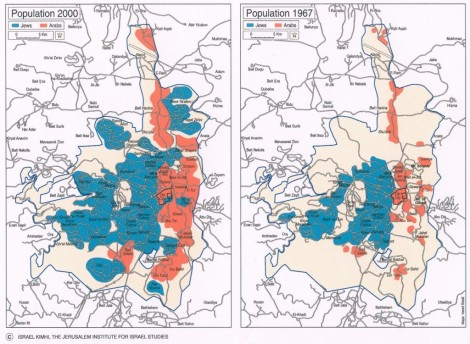
Population of Arabs and Jews in East Jerusalem (Map by Israel Kimhl)
Significance of East Jerusalem Annexation
- After the 1967 war, the reunification of Jerusalem took place when Israel annexed East Jerusalem.
- These administrative measures appeared to be pragmatic to address the situation in East Jerusalem (Rempel, 1997).
- Knesset (Israel's Parliament) passed two landmark laws: the annexation of East Jerusalem and the expansion of municipal borders of Jerusalem to legitimise reunification.
The use of terrorism, Israel's response and international attitudes towards Palestine issue
PFLP PLANE HIJACKS (SEPTEMBER 1970)
On September 6, 1970, a terrorist group known as the Popular Front for the Liberation of Palestine (PFLP) launched simultaneous hijacks of jetliners after they took off from European airports en route to the United States. PFLP hijackers seized a total of five planes and three jets were blown up on September 12.
The hijackings took place as a result of the ceasefire agreement between Jordan, Egypt, and Israel, which ended the War of Attrition in July 1970. PFLP leader George Habash opposed any peace settlements with Israel, claiming that it would "turn the Middle East into hell."
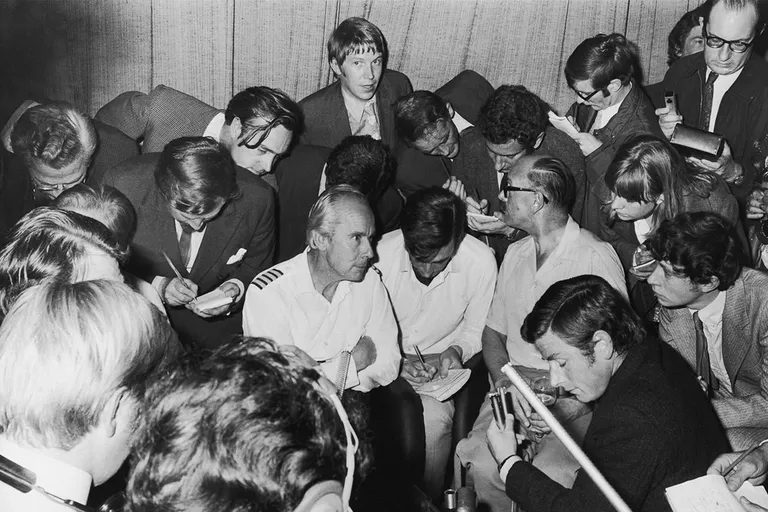 Captain Cyril Goulborn, the pilot of an airliner hijacked by Palestinian terrorists, was interviewed upon arriving at Heathrow Airport (Photo by J. Wilds/Hulton Archive/Getty Images)
The use of terrorism, Israel's response and international attitudes towards Palestine issue
THE RISE OF BLACK SEPTEMBER (1970)
The Black September organisation was born after the 1970 conflict that took place in Jordan between the Jordanian Armed Forces under the leadership of King Hussein, and the Palestine Liberation Organization led by Yasser Arafat. When Hussein subjected Jordan to military rule, he ordered the expulsion of thousands of Palestinian fighters. Some of them were murdered.
The organisation retaliated with the assassination of Prime Minister Wasfi al-Tal of Jordan, and the attempted assassination of Zaid al-Rifai, ambassador of Jordan to London. They were known for and suspected of several terrorist attacks such as the German electrical plant sabotage, Belgian aircraft hijack to Israel, and others.
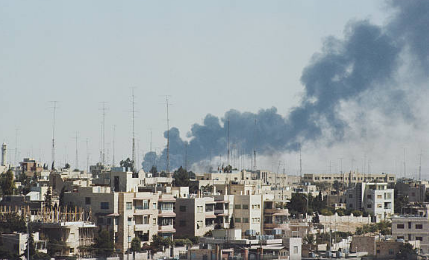 Amman, Jordan during the Black September conflict in 1970 (Photo by Jordanian Archives)
THE MUNICH OLYMPICS MASSACRE
The Munich Olympics massacre was considered to be the most notorious terrorist attack by the Black September group. It took place on September 5, 1972, when 11 people were kidnapped and killed.
Israel's weightlifting coach, Moshe Weinberg, and weightlifter Yossef Romano were the first victims as they attempted to fight the members of Black September. With nine other athletes held hostage, Black September demanded the release of 234 Palestinians who were imprisoned in Israel as well as German Red Army Faction leaders Andreas Baader and Ulrike Meinhof. Israel ignored the demands.
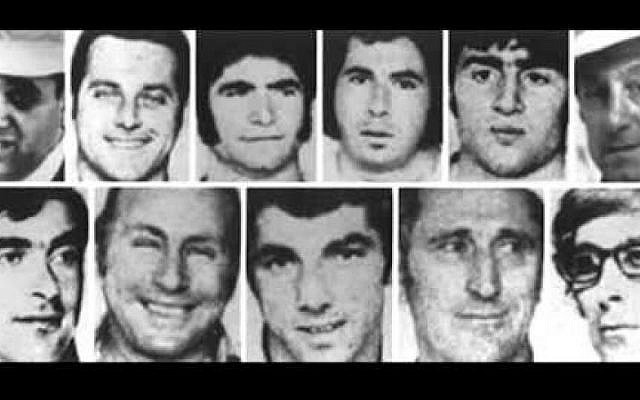 The 11 Israeli athletes and coaches who were killed during the Munich Olympics Massacre
The terrorist group then demanded to be brought to a local airport, which the hostage negotiators immediately arranged.
A helicopter was chartered to bring the kidnappers and their hostages to Fürstenfeldbruck Air Base. There was a plan by German police to ambush the terrorists but it failed. Realising that they had been trapped, the terrorist group began to shoot the hostages. Chaos ensued, which led to a brutal shootout that left all hostages, one German police officer, and five Black September members dead. On September 6, 1972, the Olympic Games were postponed for 24 hours.
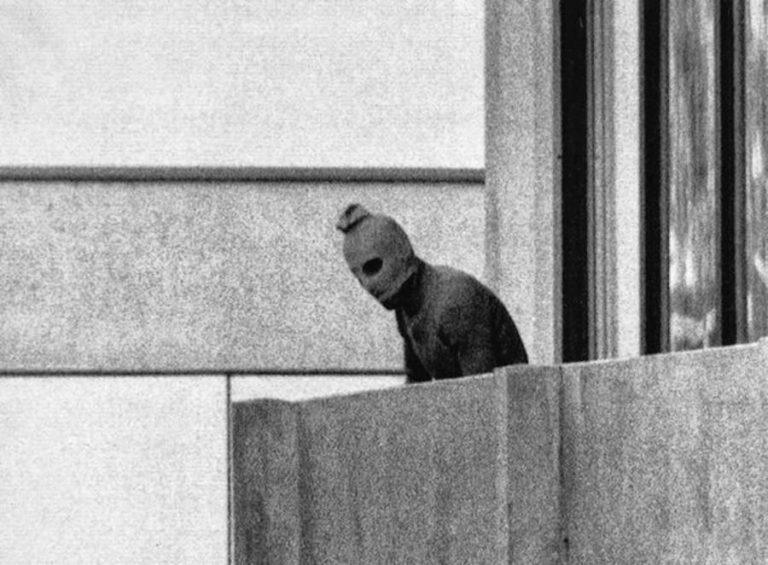 A member of the Black September group at the apartment balcony where athletes stayed (Photo from AP/Kurt Strumpf, 1972)
The Expulsion of the Palestinian Liberation Organisation from Jordan
With the ceasefire between Jordan, Egypt, and Israel taking place, both PFLP leader George Habash and PLO chairman Yasser Arafat claimed to have liberated Palestine.
The pronouncement led to the Jordanian Civil War in September 1970, known also as Black September in the Arab World. Both the PFLP and the PLO attempted to seize control of Jordan and topple Hussein.
After the war, up to 15,000 Palestinian were killed, including militants and civilians. The PLO's leadership was decimated. Jordan's military, under the leadership of Hussein, claimed a victory.
On September 25, 1970, a ceasefire was signed by the PLO and Jordan's King Hussein, which was mediated by the Arab states. By early 1971, Arafat and PLO members were expelled from Jordan.
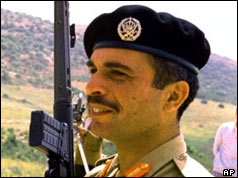 Photo of Hussein of Jordan (Photo from AP)
Note
Glossary of terms
WAR OF ATTRITION: It refers to a military strategy, which consists of belligerent attempts to wear down the enemy to the point of its collapse through continuous losses in personnel and material.
MARTIAL LAW: The term refers to the imposition of direct military control of normal civilian functions to respond to emergency situations such as invasion or major disaster events.
POPULAR FRONT FOR THE LIBERATION OF PALESTINE: It was a revolutionary socialist party and movement that was co-founded in 1967 by George Habash, Nayef Hawatmeh, and Ahmad Jibril, with the aim of removing Western imperialism and capitalism from the Middle East, and subscribing to Marxist- Leninist ideology, and Arab nationalism.