The Six Day War (1967) (Edexcel GCSE History): Revision Notes
📚Revision Notes
The Six Day War (1967)
The Cairo Conference in 1964
The Arab League Summit (Cairo Conference) took place in Cairo, Egypt, from January 13-16, 1964. There were thirteen Arab states that participated in the conference: Egypt, Iraq, Lebanon, Syria, Jordan, Saudi Arabia, Yemen, Libya, Sudan, Tunisia, Kuwait, Morocco, and Algeria.
Among the things discussed at the summit was the resolution of conflicts within Arab states, and the adoption of common principles on how to deal with the "aggressive policies" of Israel and imperialism. Egypt was accused by Syria of being reluctant towards military aggression against Israel. In response, Egypt's President Gamal Abdel Nasser crafted the Headwater Diversion Plan, which aimed to divert two sources of the Jordan River to prevent Israel from using the water for their National Water Carrier project.
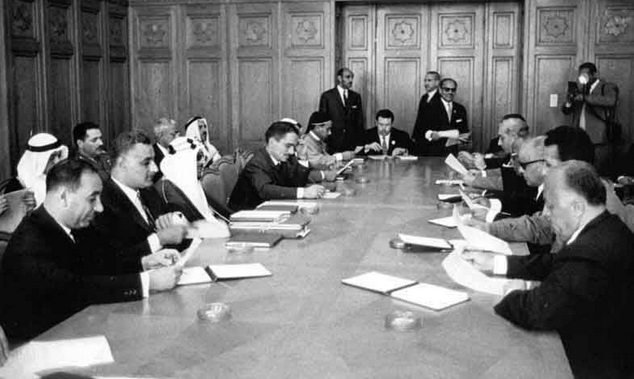 A special meeting of kings and leaders of Arab states during the Arab Summit Conference in Cairo (January 14, 1964)
Resolutions during the Cairo Conference (Arab League Summit)
- The Arab League had given Palestinian diplomat Ahmad al-Shukairi a mandate to negotiate the establishment of a Palestinian entity, which would be known as the Palestinian Liberation Organization (PLO).
- Member states of the Arab League agreed to establish a unified military command, known as the United Arab Command, led by Ali Ali Amer, Egypt's lieutenant general and its headquarters would be in Cairo.
- All Arab League member states had to unanimously approve Nasser's water diversion plan. He also declared that there would be no military aggression and provocation of Israel.
Escalating tensions between Israel, Syria, and Jordan
SYRIA'S SUPPORT FOR FATAH
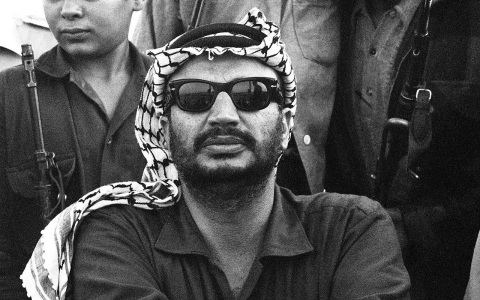
Palestinian Leader Yasser Arafat was seen as a symbol for his people's independence (Photo Courtesy of AFP/Getty Images)
The Palestinian Liberation Organisation (PLO) was established in 1964 by virtue of the resolutions passed by the Arab League during the first summit in Cairo. The sudden emergence of this Palestinian entity was met with great opposition by one of the Palestinian nationalist groups, known as Fatah. Led by Yasser Arafat, the group was previously involved in revolutionary struggles for independence of the Palestine region.
Fatah responded to the PLO formation by asserting their military aggression against Israel and launching terrorist attacks in the country. Syria's ongoing conflicts with Israel led them to express their support and endorsement of Fatah. In January 1965, they conducted several terrorist operations against Israeli forces in Jordan, Gaza (occupied by Egypt at that time), and Lebanon, with the backing of Syria.
ISRAEL'S RAID IN SAMU
CAUSES
- Fatah's military aggression against Israeli forces resulted from PLO's formation.
- Terrorist raids of Fatah supported by Syria in Lebanon, Gaza, and Jordan.
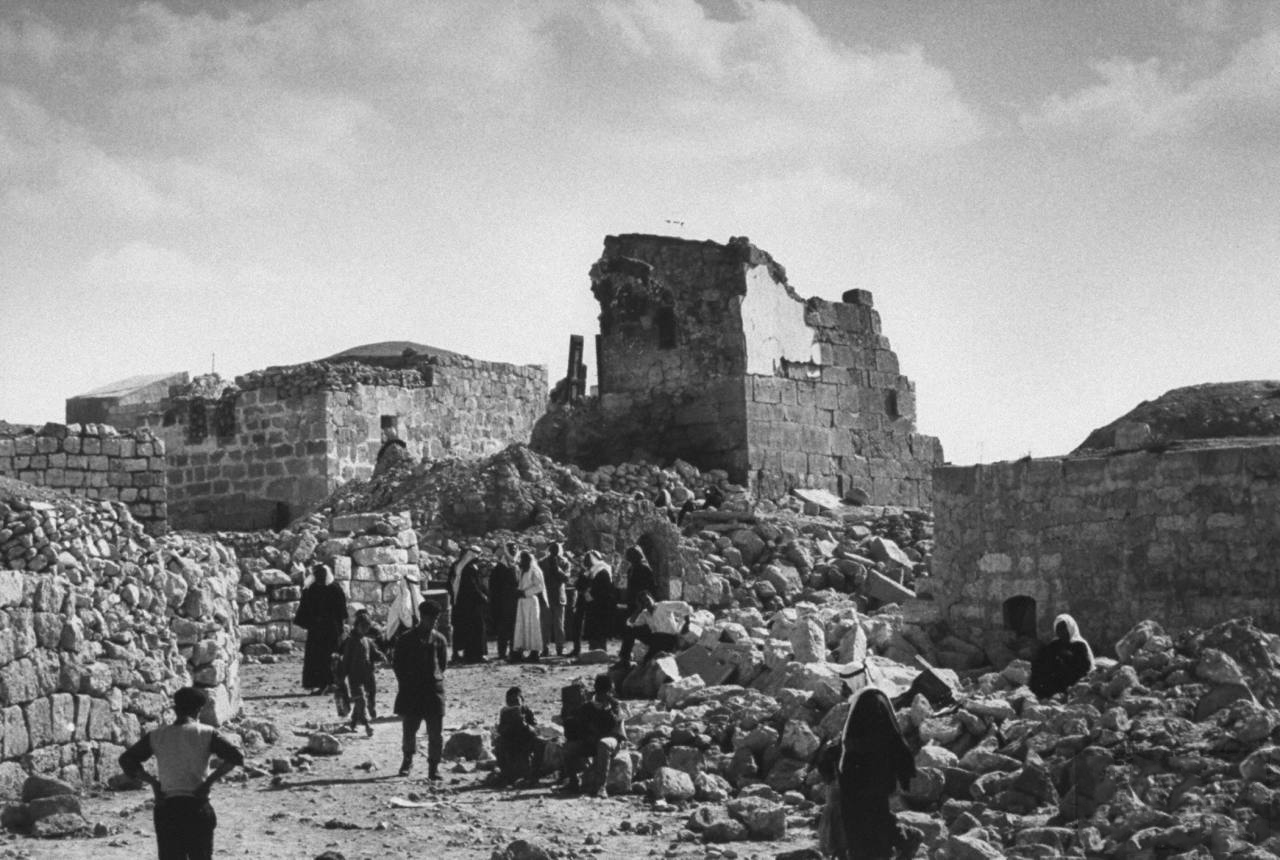 The ruins from the Samu incident as a result of Israel's raid on the area (Photo from Aletheia)
EVENTS
- November 16, 1966: Israel attacked the West Bank border village of Samu, destroying villager's houses.
- Armed forces from Jordan tried to fire back but they were immediately stopped by the superior firepower of Israel's forces.
- Riots ensued in major cities in Jordan as heard through radio broadcasts in Egypt, Syria and Iraq.
EVENTS OF APRIL 7, 1967
- Both Israel and Syria launched attacks on one another as a result of the latter's military aggression against the former.
- Unarmoured Israeli tractors were attacked in the demilitarised zone. Israelis fired back and engaged in air attacks using 130 planes.
- Israeli Mirage fighter jets were able to gain control by attacking six Syrian MIG jets cruising over Damascus, Syria.
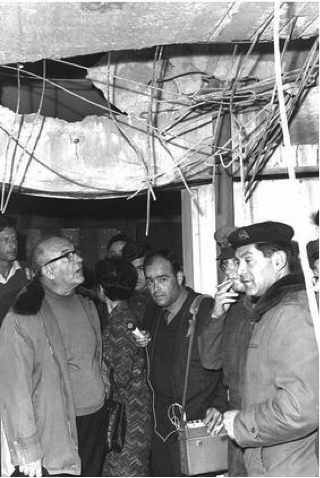 A house damaged during the April 7th, 1967, battle (Photo by Centre for Israel Education)
The actions of the USSR, Nasser, and the United States leading to the Six Day War
THE USSR
The USSR had been taking much interest in the Arab-Israeli conflict since 1955, when it started to provide military equipment to Egypt. In May 1967, the USSR provided false intelligence to the Arabs that Israel had begun to mobilise forces on Syria's border.
EGYPT'S NASSER
For Egyptian President Nasser's part, after receiving the intelligence from the USSR, he acted swiftly by ordering the withdrawal of UN forces from Sinai on May 16, and the closure of the Straits of Titan on May 22. The withdrawal caused the removal of the buffer provided by UN forces, which led to direct contact between Israel and Egypt.
UNITED STATES
For its part, the US maintained its stance of not getting involved in any aggression in the Middle East and to pursue diplomatic solutions. President Eisenhower pressured Israel to withdraw its forces from Sharm el-Sheikh and promised to grant the right of passage to the Straits of Titan. The US did not grant military aid to Israel despite its requests.
Key Events during the Six Day War (1967)
TIMELINE OF THE EVENTS DURING THE WAR
JUNE 5, 1967:
- Israel launched a surprise attack, which eliminated Egyptian air force in one blow.
- Syria, Jordan, and Iraq launched air strikes on Haifa, Netanya, and other Israeli targets (done by Jordan).
- Jordanian and Iraqi air forces attacked Tel Aviv.
JUNE 6, 1967:
- Syria began to strengthen its border with Israel, artillery fire soon began.
- Israel was able to capture the following: Gaza, Ras al Naqeeb, Jebel Libni, Northeast Jerusalem, Ammunition Hill, and Talpiot.
- Jordan's military forces retreated from the West Bank.
JUNE 7, 1967:
- A ceasefire was crafted by the UN Security Council and presented to Nasser but he turned down.
- Israel was able to gain control of Bir el-Hasna and Al Qazima in Egypt.
- Jordan's forces were once again ordered to retreat.
- Syria and Israel continued to wage war on the border of Golan.
JUNE 8, 1967:
- A ceasefire was accepted by Egypt.
- Israeli forces were able to capture Hebron.
- On the border of Golan, fighting continued between Israel and Syria.
JUNE 9, 1967:
- There was an order to attack Golan Heights.
- Israel gained control of the Golan Heights from Syria.
- Nasser resigned as Egyptian President. He announced it through television and radio broadcasts. However, the legislators did not accept his resignation.
JUNE 10, 1967:
- The war ended as Syria and Israel agreed to a ceasefire initiated by the United Nations.
- The Golan Heights was taken by Israel, as well as the town of Kuneitra in Syria.
- Israel gained control of the Gaza Strip, West Bank, and Sinai Peninsula leading to the Suez Canal.
THE EFFECTS OF THE SIX DAY WAR (JUNE 1967)
- Israel became the strongest military power in the Middle East region. It also found itself an ally in the United States, who was not in favour of military aggression in the region in the early years of the Arab-Israeli conflict.
- Egypt suffered huge losses with 15,000 troops killed during the war. It was seen a humiliation and prompted Nasser to attempt to resign.
- Among the Arab states, the war in 1967 created humiliation and domestic discontent, as citizens criticise their weak leaders. Fundamentalism among Palestinian and Muslims grew.
- The Six Day War in 1967 displaced Palestinian Arabs in the region. The population of refugees continued to increase. Resentment emerged among the Arabs over their loss against Israel and fundamentalism emerged.
- The Soviet Union's prestige was called into question amidst the ongoing Cold War with the West, since their allies started to be defeated in wars.
- The United Nations (UN) served as a peace negotiator at the height of the Arab-Israeli conflict, which later on would conclude into a landmark resolution in November 1967.
- The state of Jordan suffered greatly from the war. There were more than 300,000 displaced Palestinian Arabs who went to Jordan.
- The economy of Jordan was affected since 70% of its agricultural land was located in the West Bank. This land produced 60-65% of its fruit and vegetables. The tourism industry was also affected since Jordan lost Jerusalem and other religious sites.
- Jordan's industrial establishments were also located in the West Bank, which accounted for 38% of the country's GNP. These were occupied by Israel as a result of the raid.
Note
Glossary of terms
FATAH: A Palestinian nationalist political party, which later on became part of the Palestine Liberation Organisation (PLO), which led several revolutionary struggles in its quest for Palestinian independence.
DEMILITARIZED ZONE: It refers to an area along an established border in which treaties or agreements between parties do not allow military activities to take place, nor military equipment or personnel to be present.
PALESTINE LIBERATION ORGANIZATION: An organisation founded in 1964 by virtue of the resolution made during the first Arab League Summit, which aimed to liberate the Palestine region through armed struggle.