The Revolt of the Northern Earls (Edexcel GCSE History): Revision Notes
📚Revision Notes
The revolt of the Northern Earls, 1569-70
The Revolt of the Northern Earls (1569-70) represented a critical challenge to Elizabeth I's early reign. This Catholic uprising in northern England tested the queen's authority and highlighted the religious divisions that continued to threaten Tudor stability.
Background and causes
Several interconnected factors led to this significant rebellion during Elizabeth's first decade as monarch.
Religious tensions
The revolt stemmed primarily from Catholic resistance to Elizabeth's Protestant religious settlement. The northern earls and their supporters sought to restore Catholicism as England's official religion. They particularly opposed Elizabeth's appointment of James Pilkington, a committed Protestant, as Bishop of Durham in 1561. This appointment demonstrated Elizabeth's determination to enforce Protestant control even in traditionally Catholic regions.
Note
The appointment of Protestant bishops to traditionally Catholic areas was a deliberate strategy by Elizabeth to consolidate religious control throughout England, even in regions where Catholic sentiment remained strong.
Loss of political influence
The traditional northern nobility found their power and influence at court dramatically reduced under Elizabeth's rule. Powerful Catholic families like the Percys and Nevilles had previously enjoyed significant status and wealth. However, Elizabeth's government increasingly favoured "new men" such as William Cecil, John Forster, and Robert Dudley - Protestant administrators who owed their positions to merit rather than birth.
Succession uncertainty
Elizabeth's continued refusal to name an heir or marry created dangerous political instability. The northern earls feared that a future Protestant succession would permanently exclude Catholics from power and influence. This uncertainty made the possibility of replacing Elizabeth with the Catholic Mary Queen of Scots increasingly attractive to disaffected nobles.
Important
The succession crisis was fundamental to understanding why the revolt occurred - without a clear Catholic heir, traditionalist nobles saw this as potentially their last opportunity to restore Catholic influence in England.
Key figures in the rebellion
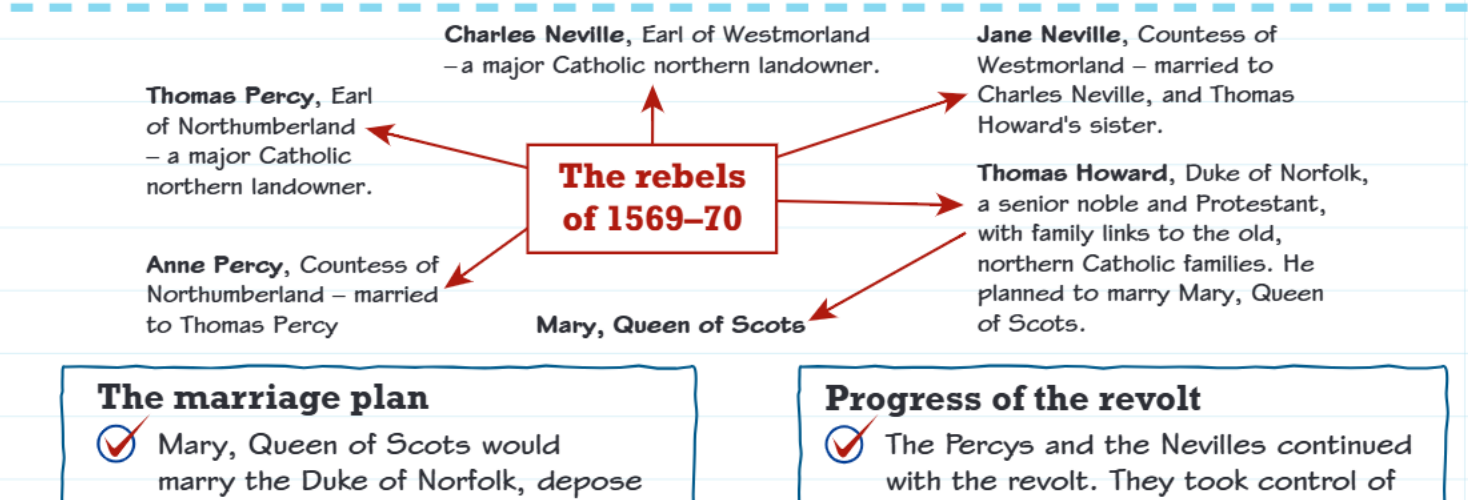
The revolt centred around several prominent Catholic nobles and their interconnected family relationships. Thomas Percy, Earl of Northumberland, and Charles Neville, Earl of Westmorland, emerged as the primary leaders. Both men controlled extensive lands in northern England and commanded significant local loyalty among Catholic communities.
Their wives played crucial supporting roles - Anne Percy, Countess of Northumberland, and Jane Neville, Countess of Westmorland, encouraged their husbands' participation and helped coordinate rebel activities. The involvement extended beyond the north through Thomas Howard, Duke of Norfolk, England's premier noble and a Protestant with Catholic sympathies who maintained family connections to the traditional Catholic aristocracy.
Most significantly, Mary Queen of Scots became the focal point of rebel hopes. Although imprisoned in England since 1568, Mary represented a legitimate Catholic alternative to Elizabeth's Protestant rule.
Note
The involvement of noble women in the conspiracy demonstrates how these family networks operated - the rebellion was not just a political plot but a coordinated effort involving entire aristocratic households and their extended relationships.
The marriage plot
Central to the rebellion was an ambitious plan to fundamentally alter England's political and religious landscape. The conspirators devised a scheme whereby Mary Queen of Scots would marry Thomas Howard, Duke of Norfolk. This union would provide Mary with the necessary aristocratic support to challenge Elizabeth's throne.
The plan involved several stages: first, the marriage would legitimise Mary's claim to the English succession; second, the couple would depose Elizabeth and assume control of the government; third, they would restore Catholic worship throughout England. Mary herself encouraged this plot, telling the Spanish Ambassador in 1569 that she expected "to be Queen of England in three months" and that "mass shall be said all over the country."
Important
The marriage plot was far more than a personal arrangement - it represented a comprehensive strategy to overthrow Elizabeth's government and fundamentally reverse the English Reformation. Mary's confident prediction reveals how seriously the conspirators believed their plan would succeed.
However, the conspiracy unravelled when Robert Dudley discovered the plot and informed Elizabeth. This intelligence led to Norfolk's immediate arrest and imprisonment in the Tower of London, removing a key figure before the northern rebellion could properly begin.
Progress of the revolt
The rebellion commenced in November 1569 when the Percy and Neville families took control of Durham Cathedral. The rebels celebrated Catholic mass there and in other northern churches, symbolically reclaiming these religious spaces for traditional worship. This religious demonstration attracted local Catholic support and signalled the rebels' determination to restore the old faith.
From Durham, the rebel forces began moving southward towards London, gathering supporters as they advanced. However, their progress remained limited and slow. Elizabeth responded decisively by ordering Mary Queen of Scots to be moved to Coventry, preventing any possibility of the rebels liberating their intended queen and rallying point.
Note
Elizabeth's quick decision to relocate Mary Queen of Scots demonstrated her acute understanding of the revolt's objectives - by securing Mary, she effectively removed the rebels' primary goal and symbolic leader.
Despite capturing Hartlepool and controlling significant territory in Northumberland and Durham, the rebels failed to gain the momentum necessary for success. Their forces remained relatively small, and expected support from other regions never materialised.
Reasons for failure
Multiple factors contributed to the revolt's ultimate collapse, revealing the limitations of Catholic opposition to Elizabeth's rule.
The most significant disappointment came from Spain's failure to provide promised military support. The rebels had counted on Spanish assistance, both financial and military, to sustain their campaign. However, King Philip II remained cautious about openly supporting rebellion against Elizabeth, preferring diplomatic pressure to military intervention.
Important
The lack of foreign support was crucial to the revolt's failure. Without Spanish backing, the northern earls lacked the resources and military strength necessary to challenge Elizabeth's government effectively.
Many northern landowners, despite their Catholic sympathies, chose to remain loyal to Elizabeth rather than risk their estates and positions. These nobles had gained considerable wealth from the dissolution of monasteries under Henry VIII and feared losing their properties if they supported a failed revolt. Their calculation proved shrewd - supporting rebellion risked everything they had gained from previous religious changes.
The limited geographical scope of the uprising also undermined its effectiveness. The rebellion remained confined primarily to Northumberland and Durham, failing to spread to other potentially sympathetic regions. Catholics in Lancashire, Cheshire, and other areas chose not to join the northern earls, leaving the rebels isolated and outnumbered.
Note
The economic self-interest of Catholic landowners proved stronger than their religious convictions - having benefited from Henry VIII's dissolution of monasteries, they were unwilling to risk their newly acquired wealth for an uncertain cause.
Significance and consequences
The revolt's failure had profound implications for both Catholic England and Elizabeth's government, strengthening the queen's position while weakening Catholic resistance.
Mary Queen of Scots' involvement proved particularly damaging to her cause. Rather than becoming England's Catholic queen, Mary remained imprisoned under even stricter conditions. Elizabeth and her counsellors now had clear evidence of Mary's willingness to plot against the English crown, making any future release impossible.
Important
Pope Pius V's response further escalated tensions between Catholic and Protestant England. In 1570, the Pope issued the bull "Regnans in Excelsis," formally excommunicating Elizabeth and calling upon loyal Catholics to depose her.
This papal pronouncement encouraged further Catholic plots against Elizabeth while simultaneously making all English Catholics suspect in the government's eyes.
The loyalty of England's Catholic population came under intense scrutiny following the revolt. The government now questioned whether Catholics could be trusted as loyal subjects, leading to harsher treatment and increased surveillance of Catholic families throughout Elizabeth's reign.
Finally, the revolt's failure actually strengthened Elizabeth's control over northern England. The queen could now justify placing more Protestant officials in key positions throughout the region, reducing Catholic influence and ensuring greater governmental control over traditionally independent areas.
Timeline of events
1568 - Mary Queen of Scots arrives in England as Elizabeth's prisoner
1569 - Duke of Norfolk and Mary Queen of Scots marriage plot discovered; Robert Dudley warns Elizabeth; Norfolk arrested and imprisoned in the Tower
November 1569 - Northern Earls begin revolt; rebels take control of Durham Cathedral and celebrate Catholic mass
December 1569 - Rebel forces move south; Elizabeth orders Mary moved to Coventry for security
Early 1570 - Revolt collapses as expected Spanish support fails to materialise; many rebels flee to Scotland
1570 - Pope Pius V excommunicates Elizabeth through the bull "Regnans in Excelsis"
Summary
Key Points to Remember:
-
The Revolt of the Northern Earls (1569-70) was primarily motivated by Catholic opposition to Elizabeth's Protestant settlement and the desire to restore Mary Queen of Scots to power through marriage to the Duke of Norfolk.
-
The rebellion failed due to lack of Spanish support, limited participation from Catholic landowners who feared losing their wealth, and Elizabeth's decisive action in securing Mary Queen of Scots.
-
The revolt's consequences actually strengthened Elizabeth's position - Mary remained imprisoned, the Pope's excommunication of Elizabeth made all Catholics suspect, and the government gained greater control over northern England.
-
Key figures included Thomas Percy (Earl of Northumberland), Charles Neville (Earl of Westmorland), their wives, and the Duke of Norfolk, all connected through family relationships and shared Catholic sympathies.
-
The rebellion demonstrated the ongoing religious divisions in Elizabethan England while proving that Catholic resistance lacked the widespread support necessary to challenge Protestant rule successfully.