The Throckmorton and Babington plots (Edexcel GCSE History): Revision Notes
📚Revision Notes
The Throckmorton and Babington plots
Introduction
During Elizabeth I's reign, Catholic conspirators organised several dangerous plots aimed at overthrowing the Protestant queen and replacing her with Mary, Queen of Scots. Two of the most significant were the Throckmorton plot of 1583 and the Babington plot of 1586. These conspiracies revealed the serious threat Elizabeth faced from both foreign Catholic powers and English Catholics at home.
Note
These plots occurred during a period of intense religious and political tension in Europe, where Catholic and Protestant powers competed for dominance. Elizabeth, as a Protestant ruler, was seen by many Catholics as illegitimate, making her particularly vulnerable to such conspiracies.
The Throckmorton plot, 1583
Background and planning
The Throckmorton plot represented a serious international Catholic conspiracy against Elizabeth's rule. The scheme was masterminded by the French Duke of Guise, who was a cousin of Mary, Queen of Scots. The Duke's ambitious plan involved launching a French invasion of England that would overthrow Elizabeth and establish Mary as the new Catholic queen.
Key figures in this conspiracy included Philip II of Spain, who offered financial backing for the rebellion, and the Pope, who gave his blessing to the entire enterprise. The plot also relied on Francis Throckmorton, a young English Catholic nobleman who served as a crucial link between the foreign conspirators and Mary, Queen of Scots. Throckmorton's role involved secretly passing letters between the plotters and Mary, coordinating the conspiracy from within England.
Discovery and failure
Elizabeth's government successfully uncovered the plot thanks to the excellent intelligence work of Sir Francis Walsingham, her Secretary of State and spymaster. In May 1583, Walsingham's extensive spy network discovered the conspiracy when his agents found incriminating papers at Throckmorton's house in November 1583.
The evidence clearly revealed Throckmorton's central role in the conspiracy. Under torture, he confessed to his involvement in the plot and was subsequently executed in May 1584. This swift action by Elizabeth's government effectively ended the immediate threat.
Significance and consequences
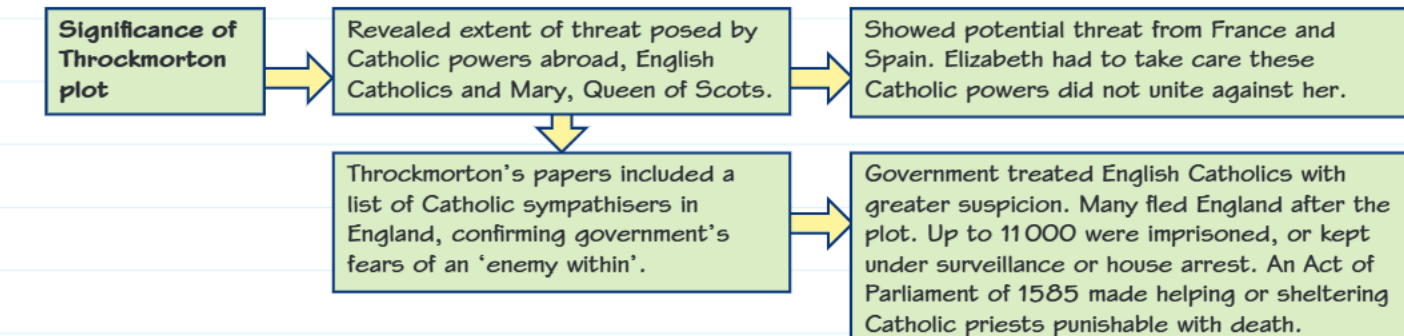
The Throckmorton plot had far-reaching consequences for Elizabeth's domestic and foreign policy. The conspiracy demonstrated the serious threat posed by Catholic powers abroad, including France and Spain, as well as the danger from English Catholics within the kingdom.
Important
Following the plot's discovery, Elizabeth's government implemented harsh measures against the Catholic community. The authorities imprisoned up to 11,000 suspected Catholic sympathisers or placed them under house arrest and surveillance. This massive crackdown reflected the government's deep concern about the loyalty of English Catholics.
The most significant legislative response came in 1585 when Parliament passed an Act making it a capital offence to assist Catholic priests. This law represented a major escalation in the persecution of Catholics and demonstrated how the Throckmorton plot had intensified religious tensions in England.
The Babington plot, 1586
Background and planning
The Babington plot emerged as an even more dangerous conspiracy than its predecessor. Once again, the Duke of Guise planned to invade England and assassinate Elizabeth, with the goal of placing Mary, Queen of Scots on the English throne. This plot involved Philip II of Spain and had papal support, making it another major international Catholic conspiracy.
The key English conspirator was Anthony Babington, a Catholic gentleman who wrote to Mary in July 1586 detailing the assassination plan. Babington's correspondence with Mary provided crucial evidence of her direct involvement in planning Elizabeth's murder.
Discovery and consequences
Sir Francis Walsingham's spy network once again proved its effectiveness by intercepting and reading Babington's letters to Mary. These communications provided clear proof of Mary's awareness of, support for, and active participation in the conspiracy to kill Elizabeth.
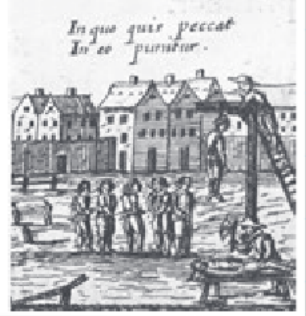
The government moved quickly to arrest Babington and his fellow conspirators. They were sentenced to death and executed using the brutal method of hanging, drawing, and quartering, which served as a stark warning to other potential plotters.
Important
The most significant consequence of the Babington plot was Elizabeth's decision regarding Mary, Queen of Scots. In October 1586, Mary was sentenced to death for her role in the conspiracy. Although Elizabeth initially hesitated, she eventually signed Mary's death warrant in February 1587, and Mary was beheaded shortly afterwards.
Why the Babington plot was so significant
The Babington plot marked a turning point in several important ways. Elizabeth's situation had become increasingly precarious compared to earlier plots, as the international Catholic threat had intensified. By 1585, England and Spain were effectively at war, creating a more dangerous international environment.
Note
The plot prompted Elizabeth's government to adopt an even more determined approach to crushing the Catholic threat within England. The persecution of Catholics reached new heights, with thirty-one priests executed across the country in 1586 alone.
Most importantly, the Babington plot resulted in the execution of Mary, Queen of Scots, which eliminated any realistic hope of replacing Elizabeth with a Catholic heir. This decisive action removed the focal point around which Catholic conspiracies had previously formed.
Timeline of major events
- 1583: Throckmorton plot discovered by Walsingham's spies
- May 1584: Francis Throckmorton executed
- 1585: Act of Parliament makes helping Catholic priests punishable by death
- July 1586: Anthony Babington writes to Mary about assassination plot
- 1586: Babington plot discovered and conspirators executed
- October 1586: Mary, Queen of Scots sentenced to death
- February 1587: Mary, Queen of Scots executed
Summary
Key Points to Remember:
- Both plots aimed to overthrow Elizabeth I and replace her with the Catholic Mary, Queen of Scots, with support from foreign Catholic powers
- Sir Francis Walsingham's spy network was crucial in discovering and stopping both conspiracies, demonstrating the effectiveness of Elizabeth's intelligence services
- The plots led to increasingly harsh persecution of English Catholics, including mass imprisonment and the 1585 Act making it a capital crime to help priests
- The Babington plot directly resulted in the execution of Mary, Queen of Scots in 1587, eliminating the main Catholic alternative to Elizabeth's rule
- These conspiracies showed how Elizabeth faced serious threats from both international Catholic powers and domestic Catholic sympathisers throughout her reign