Challenges abroad: France, Scotland and Spain (Edexcel GCSE History): Revision Notes
📚Revision Notes
Religious divisions in England and Europe, 1558
Elizabeth I inherits a divided nation
When Elizabeth I became queen in 1558, she faced a major challenge that would affect her relationships with foreign powers. As a Protestant monarch, she inherited a country that remained largely Catholic, creating internal tensions that had significant implications for England's foreign relations with Catholic France and Spain, as well as Protestant Scotland.
Important
The religious division Elizabeth inherited was not just a domestic issue - it directly threatened England's security and diplomatic relationships with major European powers who might exploit these internal religious conflicts.
The central role of religion in Elizabethan society
Religion was not simply a matter of personal belief in 16th century England - it shaped every aspect of daily life and had profound political consequences. Understanding why religion mattered so much helps explain the foreign challenges Elizabeth faced.
Religious teachings and practices formed the foundation of people's moral understanding and shaped their view of the world around them. Every major life event - from birth and marriage to death - was marked by religious ceremonies that gave meaning to people's existence.
Note
Many people believed that attending church services, going on pilgrimages, and confessing their sins would reduce their time suffering in purgatory before reaching heaven. This belief system meant that changing religious practices felt like risking one's eternal salvation.
The agricultural calendar revolved around religious festivals and holy days, such as St Swithin's Day on 15 July and Lammas Day on 2 August. These celebrations were considered essential for ensuring good harvests, linking religious observance directly to economic survival.
The European religious landscape
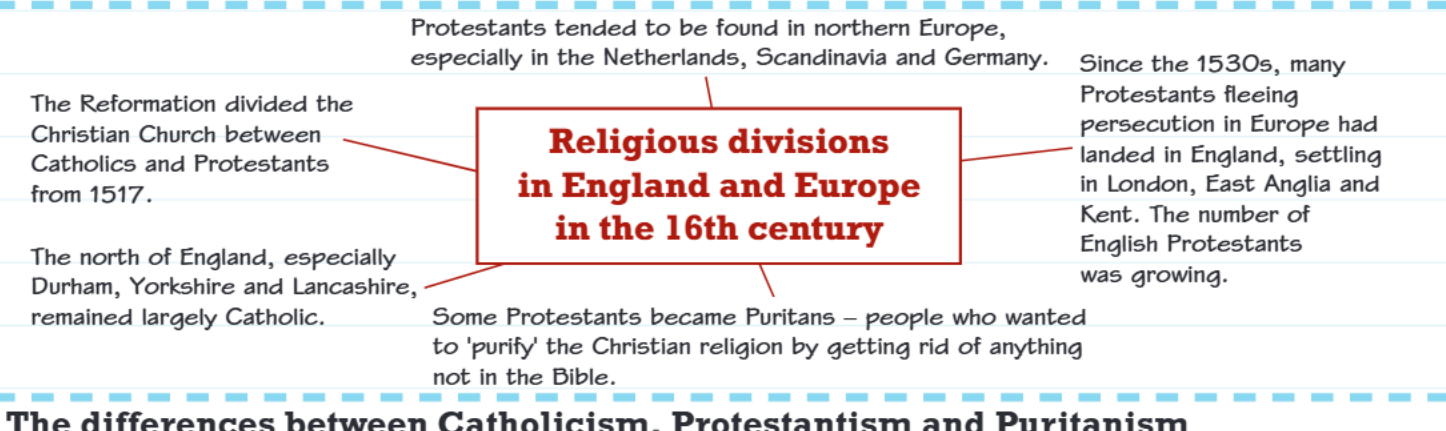
The Protestant Reformation, which began in 1517, had fundamentally divided Christianity across Europe between Catholics and Protestants. This religious split created the backdrop for many of Elizabeth's foreign policy challenges.
Protestant communities had established themselves primarily in northern Europe, particularly in the Netherlands, Scandinavian countries, and various German states. Since the 1530s, many Protestants fleeing religious persecution in Europe had sought refuge in England, settling mainly in London, East Anglia, and Kent. By Elizabeth's reign, the number of English Protestants was steadily growing.
Note
The influx of Protestant refugees from Europe significantly strengthened England's Protestant communities and brought valuable skills and knowledge, but also created additional diplomatic tensions with Catholic powers who viewed England as harbouring religious dissidents.
However, the religious map of England itself remained complex. The northern regions, especially Durham, Yorkshire, and Lancashire, stayed largely Catholic, while Protestant communities were more concentrated in the south-east.
Some Protestants developed even stricter beliefs, becoming known as Puritans. These individuals wanted to 'purify' Christian religion by removing anything not explicitly found in the Bible, creating a third strand of Christianity that would later cause Elizabeth additional challenges.
Comparing the three Christian traditions
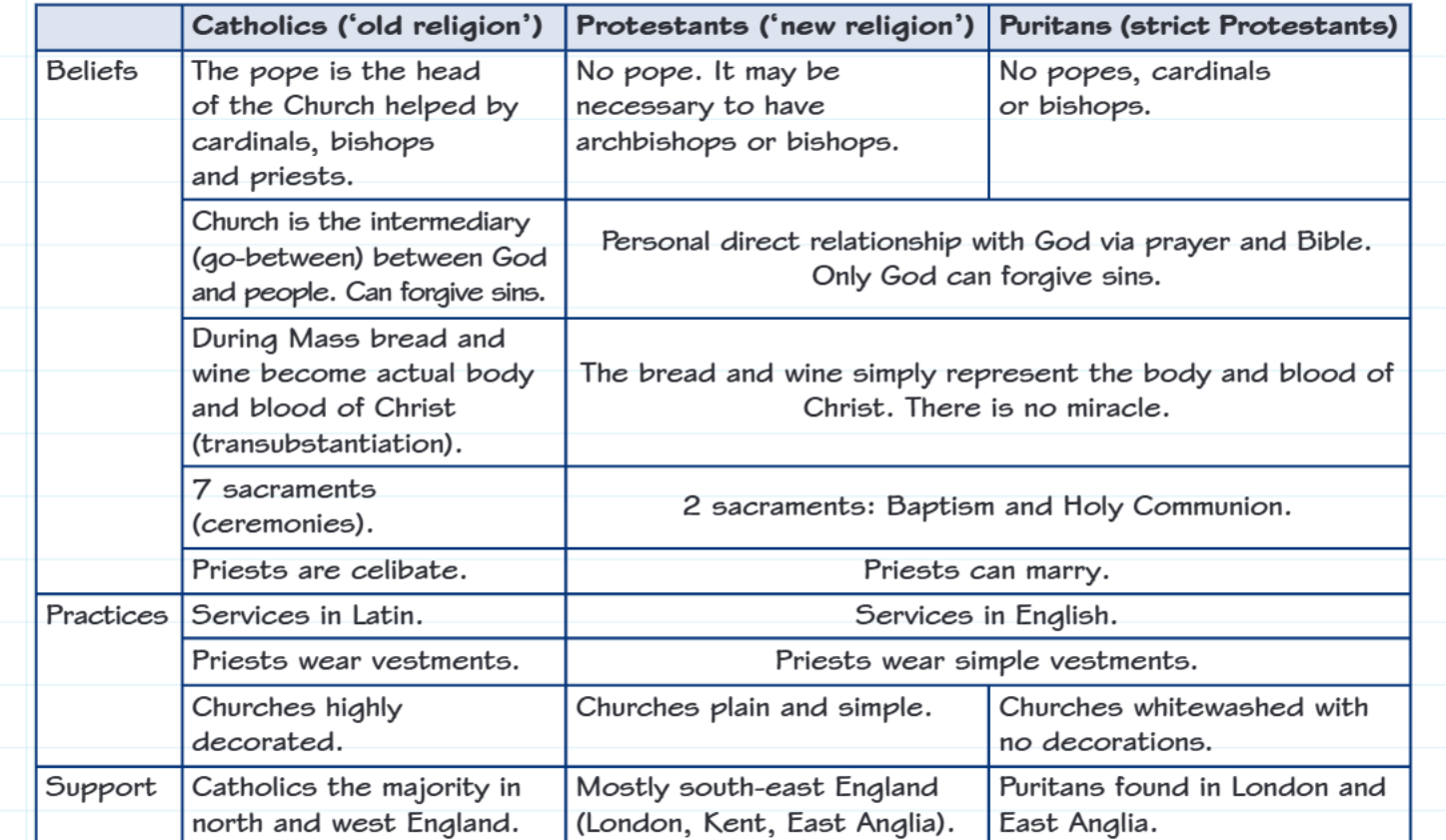
The differences between Catholics, Protestants, and Puritans went far beyond simple theological disagreements - they represented entirely different approaches to Christianity that had major political implications.
Important
These religious differences weren't just about worship styles - they had direct political consequences. Catholic loyalty to the Pope created potential conflicts with royal authority, while Puritan rejection of church hierarchy challenged traditional social order.
Catholic beliefs and practices
Catholics, representing the 'old religion', maintained that the Pope served as head of the Church, supported by cardinals, bishops, and priests in a clear hierarchy. They believed the Church acted as an intermediary between God and people, with the power to forgive sins through priestly confession.
Catholic Mass involved the doctrine of transubstantiation - the belief that bread and wine literally became Christ's body and blood during the ceremony. Catholics recognised seven sacraments as essential religious ceremonies, and their priests remained celibate throughout their lives.
Catholic services were conducted in Latin, with priests wearing elaborate vestments, and churches featured rich decorations that reflected the glory of God. The majority of Catholics lived in northern and western England, maintaining strong connections to traditional practices.
Protestant reformation
Protestants, representing the 'new religion', rejected papal authority entirely. While they might accept archbishops or bishops for organisational purposes, they emphasised that no human should stand between individuals and God.
Protestant theology stressed that people could develop a direct, personal relationship with God through prayer and Bible study. Only God possessed the power to forgive sins, removing the need for priestly confession.
Protestant communion treated bread and wine as symbolic representations of Christ's body and blood rather than literal transformation. They reduced the number of sacraments from seven to just two: baptism and Holy Communion. Protestant clergy were permitted to marry and have families.
Services were conducted in English so ordinary people could understand them, priests wore simple vestments, and churches adopted plain, simple decoration. Protestant communities were most numerous in south-eastern England, particularly London, Kent, and East Anglia.
Puritan extremes
Puritans, described as 'strict Protestants', went even further in rejecting traditional church hierarchy, accepting no popes, cardinals, or bishops at all. They shared Protestant beliefs about direct relationships with God and symbolic communion.
However, Puritans distinguished themselves through their extremely plain church practices. They whitewashed church walls to remove all decorations, believing that any ornamentation distracted from pure worship of God. Puritan communities were primarily found in London and East Anglia.
Timeline of key religious developments
- 1517 - Protestant Reformation begins in Europe
- 1530s onwards - Protestant refugees begin settling in England
- 1558 - Elizabeth I becomes queen of a religiously divided England
- Religious festivals - St Swithin's Day (15 July) and Lammas Day (2 August) remain important in agricultural calendar
Summary
Key Points to Remember:
-
Elizabeth I inherited a predominantly Catholic country as a Protestant queen, creating immediate tensions that affected foreign relations with Catholic powers like France and Spain
-
Religion was central to 16th century life, influencing everything from personal morality to agricultural cycles, making religious change deeply threatening to ordinary people
-
The Protestant Reformation divided Europe geographically, with Protestant strongholds in northern Europe and Catholic regions in the south, setting the stage for international conflicts
-
England's internal religious divisions mirrored European patterns, with Catholics concentrated in the north and west, while Protestants dominated the south-east
-
The emergence of Puritanism as a 'strict Protestant' movement created a third religious faction that would later challenge Elizabeth's religious settlement