Society and government (Edexcel GCSE History): Revision Notes
📚Revision Notes
Society and government under Henry VIII and Wolsey (1509-1529)
When Henry VIII became king in 1509, English society was incredibly structured and rigid. People understood exactly where they belonged in the social order, and this hierarchy shaped every aspect of daily life and government.
English social hierarchy in 1509
English society operated on a strict class system that people believed was ordained by God. This meant that challenging your social position wasn't just difficult - it was seen as going against divine will.
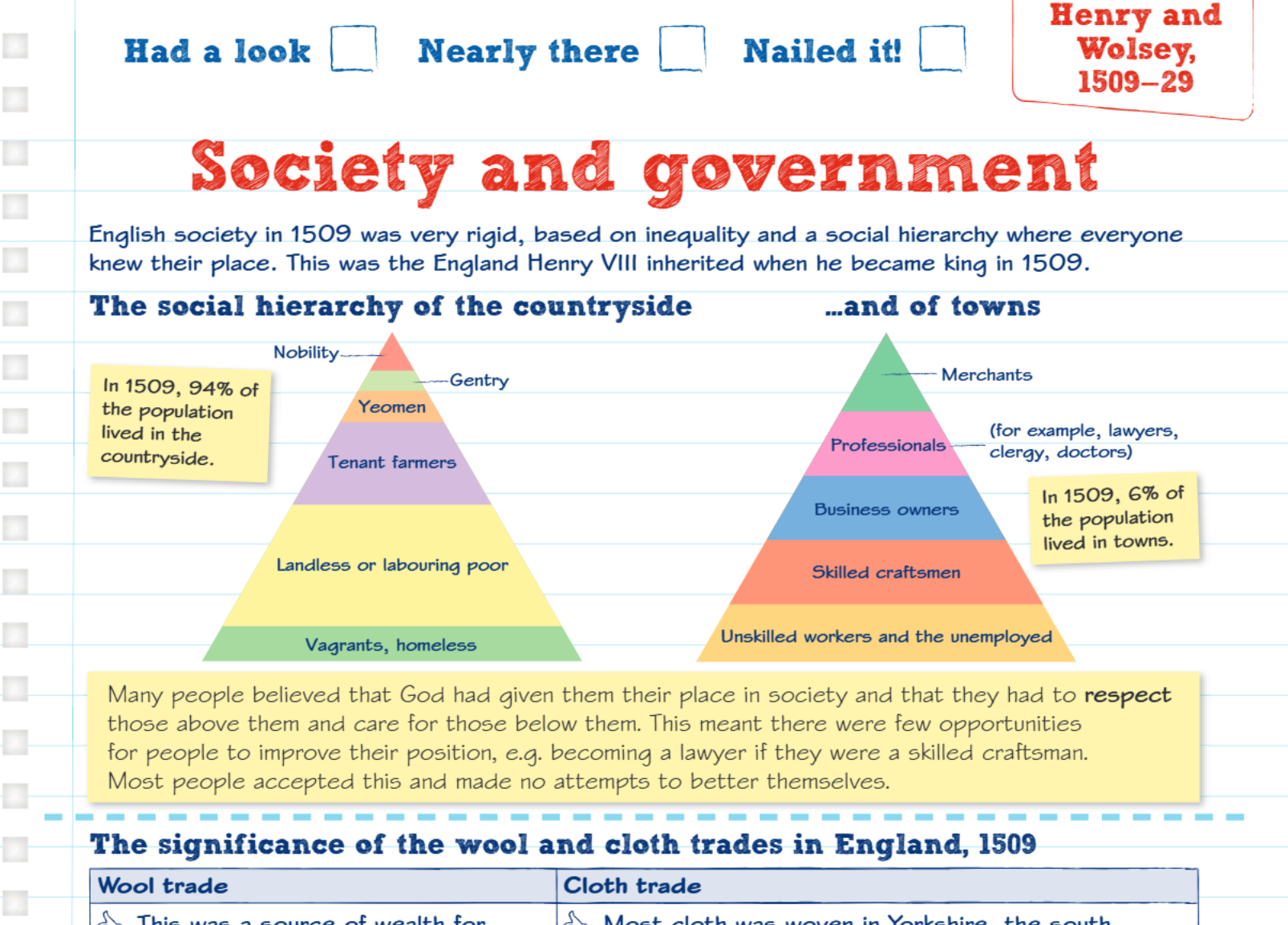
The social structure looked very different depending on where you lived. In the countryside, which housed 94% of England's population, the hierarchy started with the nobility at the top, followed by the gentry (landed gentlemen), yeomen (small landowners), tenant farmers, the landless poor, and finally vagrants at the bottom.
Towns, where only 6% of people lived, had their own social pyramid. Wealthy merchants sat at the top, followed by professionals like lawyers, clergy, and doctors. Below them were business owners, skilled craftsmen, and finally unskilled workers and the unemployed at the base.
Note
The dramatic difference between rural and urban populations meant that England remained predominantly agricultural, with the vast majority of people living lives closely tied to the land and farming cycles.
Religious beliefs about social position
Most people in Tudor England believed that God had personally chosen their place in society. This religious belief created a sense of duty - those at the top had responsibilities to care for those below them, while those lower down were expected to show respect and obedience to their superiors.
Important
This system meant that social mobility was extremely rare, and most people accepted their circumstances as part of God's plan. Attempting to rise above your station was not just practically difficult - it was considered morally wrong and against divine will.
The economic importance of wool and cloth trades
England's economy in 1509 relied heavily on two interconnected industries that brought wealth to different levels of society.
Wool production and export
The wool trade formed the backbone of England's rural economy. Wealthy landowners, including the nobility and gentry, made fortunes by owning large flocks of sheep. Much of this wool was exported, particularly to the Netherlands, creating wealth that flowed up to merchants in port cities like London and Bristol.
Note
The wool trade created a complex economic network that connected rural sheep farmers to international markets. A single sack of wool might travel from a Yorkshire farm to a Flemish weaving centre, generating profits and taxes at multiple points along the journey.
The wool trade also benefited the crown directly. The king collected taxes on each sack of wool that left the country, providing a steady source of royal income. However, this focus on sheep farming had consequences for ordinary people, as landowners often enclosed common land that peasants had traditionally used, reducing the space available for growing food.
Cloth manufacturing and trade
By 1509, England was developing a thriving cloth industry, with most production concentrated in Yorkshire, the south-west, and south-east regions. These areas benefited from their proximity to London markets and their established trading connections.
The cloth trade was carefully controlled through merchant guilds, which regulated quality and kept prices high. This system protected established merchants while creating barriers for newcomers trying to enter the business.
England's cloth exports grew dramatically during this period. By 1540, an impressive 83% of all cloth sold in Europe came from England, making the country the continent's dominant cloth producer. The main markets were the Netherlands and Belgium, where English merchants had built strong trading relationships.
Note
This dominance in European cloth production represented a significant shift from England's earlier role as primarily a raw wool exporter. The country was successfully moving up the value chain, processing its own raw materials into finished goods.
Government structure in 1509
Henry VIII governed through a complex hierarchy that balanced royal power with noble influence and local administration.
At the top sat the king himself, who held ultimate authority. His closest advisors formed the Privy Chamber, while the broader Royal Household included nobles and servants who helped run the court. The Royal Council, made up of nobles and high-ranking churchmen, assisted with major governing decisions.
The Court system allowed nobles to entertain and advise the king in a more informal setting. Parliament, though less powerful than today, still played a role in passing laws that the king proposed.
Note
This governmental structure meant that power flowed in a clear hierarchy from the monarch down through various levels of nobles and officials. However, the king still depended on the cooperation and expertise of his nobles and advisors to govern effectively.
Local government relied on Justices of the Peace - typically members of the nobility who maintained law and order in different areas of the country. This system meant that the same people who held economic power through land ownership also controlled local justice and administration.
Important
The concentration of economic, social, and political power in the hands of the same noble families created a self-reinforcing system that made social change extremely difficult to achieve.
The significance of London
London stood as England's undisputed centre of power, trade, and population. With 60,000 inhabitants, it dwarfed other major towns like Norwich, Exeter, York, and Coventry.
The city served as England's primary trading hub, particularly for the crucial wool and cloth industries. London's location made it perfectly positioned for trade with Europe, including the Netherlands, Spain, and Russia. The presence of the royal court in London meant that political power and economic influence were concentrated in the same place.
Note
London's size was remarkable for its time - it was roughly ten times larger than the next biggest English cities. This concentration of population created unique opportunities for trade, crafts, and services that couldn't exist in smaller communities.
Merchants in London could access both the king and international markets, giving them unique opportunities to build wealth and influence government policy. This concentration of power in London would become increasingly important as Henry VIII's reign progressed.
Timeline of key developments
- 1509: Henry VIII becomes king; England's population is 94% rural, 6% urban
- 1509: London has 60,000 inhabitants, making it England's largest city
- 1509-1529: Wool and cloth trades continue to dominate English economy
- By 1540: England produces 83% of Europe's cloth
Summary
Key Points to Remember:
- English society in 1509 was rigidly hierarchical, with 94% living in the countryside and only 6% in towns
- People believed God had chosen their social position, making social mobility extremely rare
- The wool and cloth trades were England's economic foundation, bringing wealth to landowners, merchants, and the crown
- Government operated through a complex hierarchy from the king down to local Justices of the Peace
- London, with 60,000 people, dominated as the centre of trade, politics, and royal power