The Amicable Grant (Edexcel GCSE History): Revision Notes
📚Revision Notes
The Amicable Grant (1525)
What was the Amicable Grant?
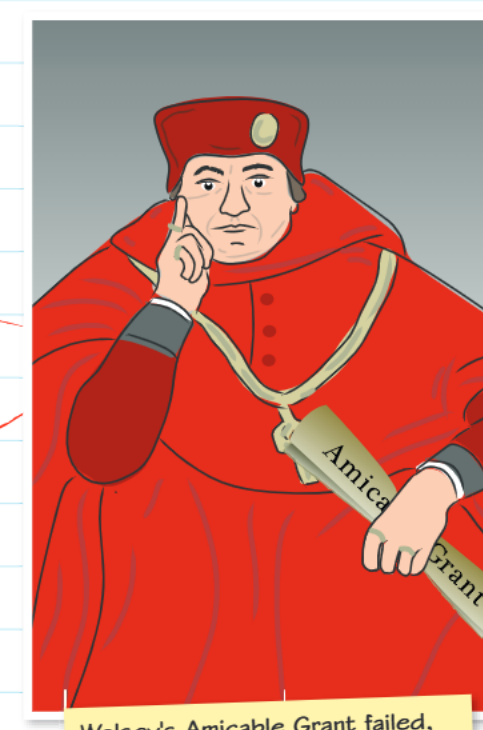
The Amicable Grant was a controversial tax imposed by Henry VIII in 1525 to fund a planned invasion of France. This extraordinary levy marked a significant moment in Henry's reign and had lasting consequences for both the king and his chief minister, Cardinal Wolsey.
Note
The term "Amicable Grant" was deliberately chosen to suggest that this was a voluntary contribution from loyal subjects, though in reality it was a compulsory tax that sparked widespread resistance.
Background and reasons for introduction
The Amicable Grant emerged from Henry VIII's ambitions to expand English territory and influence in Europe. In 1525, the King of France had suffered a major defeat at the hands of Charles V, the Holy Roman Emperor. Henry saw this as a golden opportunity to invade France and reclaim lands that the English Crown had lost during the 15th century.
However, funding such a military campaign required substantial resources. The Amicable Grant was designed as an emergency tax to raise the necessary funds quickly. The tax was set at harsh rates: clergy (priests) were expected to pay one-third of their property's value, while ordinary people faced a tax of one-sixth of their property value.
Important
These tax rates were extraordinarily high for the time period. To put this in perspective, a typical parliamentary subsidy would only demand around 4 shillings in the pound (one-fifth) from the wealthy, making the Amicable Grant's demands particularly burdensome.
Why the Amicable Grant caused controversy
The Amicable Grant sparked immediate opposition for several important reasons. Unlike other taxes such as the subsidy, fifteenth, and tenth, this new levy had not been approved by Parliament. Instead, it was being collected solely by Royal Decree, which many viewed as an abuse of royal power.
The timing also created significant problems. People were given only 10 weeks to pay the tax, which many found impossible given the substantial amounts demanded. This short deadline meant that even those who might have been willing to pay struggled to raise the necessary funds.
Perhaps most concerning was the genuine risk of rebellion. Many people openly resented the demand and declared they simply could not afford to pay. There were serious fears that widespread refusal to pay could lead to open revolt against the king's authority.
Note
The lack of parliamentary approval was particularly significant because it challenged the established principle that extraordinary taxation required the consent of Parliament. This constitutional issue would have long-lasting implications for the relationship between Crown and Parliament.
Short-term consequences
The immediate aftermath of the Amicable Grant proved disastrous for the government. Many people across the country refused to pay the tax, claiming they had no money to meet the demand.
The most serious challenge came in Lavenham, Suffolk, where a full-scale rebellion erupted. Approximately 10,000 men gathered in the town, expressing their loyalty to the king while simultaneously demanding that he understand their anger about the tax. When the Duke of Norfolk and Duke of Suffolk arrived to deal with the situation, the rebels surrendered but were pardoned by the king.
Faced with such widespread resistance, Henry was forced to make a humiliating retreat. The tax was completely abandoned, and the planned French campaign had to be postponed. The king was compelled to make peace with France rather than pursue his military ambitions.
Example
Case Study: The Lavenham Rebellion
The rebellion in Lavenham demonstrates the scale of opposition to the Amicable Grant:
Step 1: Initial resistance - Local people refused to pay the tax Step 2: Escalation - Around 10,000 men gathered in open defiance Step 3: Government response - The Dukes of Norfolk and Suffolk were sent to restore order Step 4: Resolution - The rebels surrendered but were pardoned, showing royal weakness
Long-term consequences
The failure of the Amicable Grant had profound and lasting effects on both Wolsey's career and the nature of royal power in England.
Cardinal Wolsey bore the brunt of responsibility for the tax's failure. His reputation was badly damaged, and rather than the king taking blame, Wolsey had to accept responsibility for the policy disaster. This humiliation significantly weakened his position and made it impossible for him to propose further taxes while he remained the king's chief minister.
The episode also marked the beginning of Henry's doubts about Wolsey's judgement. For perhaps the first time, the king began to question his minister's abilities, starting a process that would eventually lead to Wolsey's downfall.
The failure strengthened the position of Wolsey's enemies at court. His introduction of the Eltham Ordinances may have been partly an attempt to reduce their influence over the king, but the Amicable Grant's failure gave them more ammunition against him.
Most significantly, the episode demonstrated clear limitations on royal power. The failure showed that there were practical constraints on the king's ability to raise taxes without parliamentary consent, establishing an important precedent for the future.
Important
The Amicable Grant's failure established a crucial constitutional principle: even absolute monarchs like Henry VIII could not simply impose taxes without some form of consent from their subjects. This would influence later developments in the relationship between Crown and Parliament throughout the Tudor period.
Timeline
Note
Key Events of the Amicable Grant Crisis
- 1525 (Early): The Amicable Grant is introduced to fund French invasion following French defeat by Charles V
- 1525 (Mid-year): Widespread refusal to pay leads to rebellion in Suffolk
- 1525 (Late): Tax is abandoned and French campaign postponed
Remember!
Summary
Key Points to Remember:
- The Amicable Grant was an emergency tax in 1525 to fund Henry's planned invasion of France
- It was highly controversial because it was imposed by Royal Decree without Parliament's approval
- The tax failed completely due to widespread resistance and rebellion in Suffolk
- Wolsey's reputation was severely damaged, and he had to take responsibility for the failure
- The episode demonstrated important limitations on royal power and the need for parliamentary consent for taxation