Elizabeth Barton and John Fisher (Edexcel GCSE History): Revision Notes
📚Revision Notes
Elizabeth Barton and John Fisher
Overview of the opposition
During Henry VIII's reformation period (1529-40), two prominent religious figures emerged as significant opponents to the king's religious changes: Elizabeth Barton, known as the "Nun of Kent," and John Fisher, Bishop of Rochester. Both individuals challenged Henry's break from Rome and his divorce from Catherine of Aragon, ultimately paying the ultimate price for their resistance.
Note
The English Reformation was a period of major religious and political upheaval when Henry VIII separated the Church of England from papal authority, primarily to secure his divorce from Catherine of Aragon.
Who were these key opponents?
Elizabeth Barton - the "Holy Maid of Kent"
Elizabeth Barton was a nun who gained widespread attention when she became seriously ill and claimed to have received a divine vision of the Virgin Mary that miraculously cured her. Her reputation as a holy woman grew significantly, and many people, including members of the nobility and gentry, came to regard her as someone possessed of miraculous powers who deserved to be taken seriously.
John Fisher - Bishop of Rochester
John Fisher held the important position of Bishop of Rochester from 1504 onwards. He had a particularly close connection to the royal family, having served as a tutor to Henry VIII when the future king was still a young prince. Fisher was renowned as a brilliant scholar and theologian. His relationship with Henry made his later opposition even more significant. In 1535, the Pope elevated Fisher to the rank of Cardinal, though this honour came too late to save his life.
The downfall of Elizabeth Barton
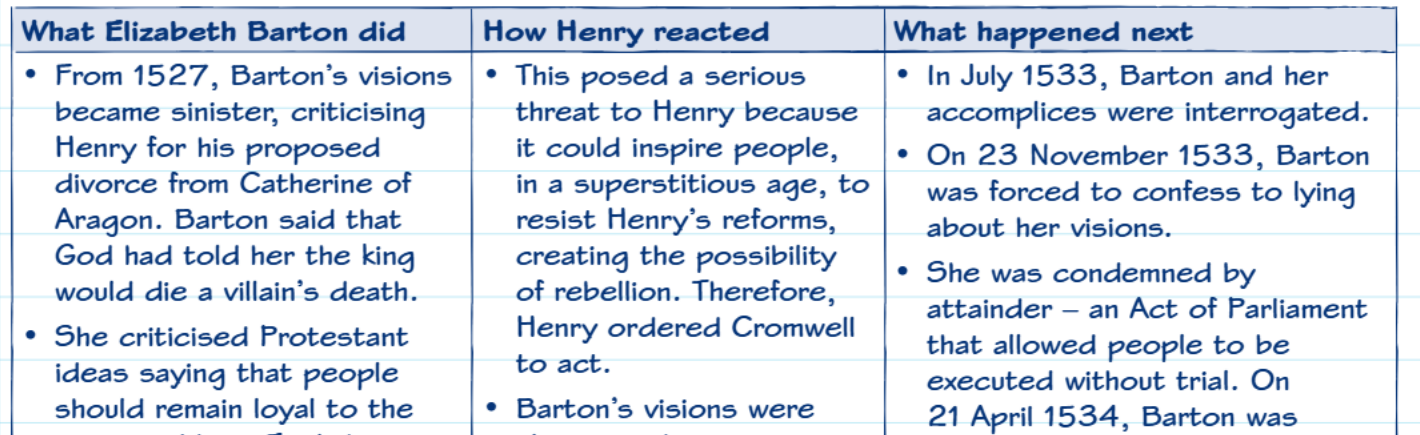
From 1527 onwards, Barton's religious visions became increasingly political and dangerous to Henry's plans. Her prophecies directly challenged Henry's proposed divorce from Catherine of Aragon, with Barton claiming that God had revealed to her that "the King would die a villain's death" if he proceeded with the divorce.
Important
Barton's prophecies posed a serious threat to Henry's authority, as such claims could inspire superstitious people to resist the king's reforms and potentially create the possibility of rebellion.
Barton also became a vocal critic of Protestant ideas, arguing that people should remain loyal to the Pope and should burn English translations of the Bible. Her influence grew when Dr Edward Bocking published "The Nun's Book" in 1533, which contained a collection of Barton's prophecies claiming that Henry would face damnation.
Henry recognised that Barton's visions were not only a theological challenge but also an embarrassment to his royal authority. In response, he ordered Thomas Cromwell to take action against her. In July 1533, Barton and her accomplices were interrogated, and by November 23, 1533, Barton was forced to confess that she had been lying about her visions.
Note
The king dealt with Barton through an Act of Attainder passed by Parliament - a law that allowed people to be executed without a proper trial. This legal mechanism became a common tool for Henry to eliminate opposition.
On April 21, 1534, Barton was executed for treason. Significantly, her execution took place on the same day that Londoners were required to take the Oath of Succession, sending a clear warning about what would happen to those who refused to comply. All 700 copies of "The Nun's Book" were ordered to be burned.
The fate of John Fisher
Fisher's opposition to Henry followed a similar pattern but was complicated by his high position in the Church and his personal relationship with the king. His downfall occurred in three main stages:
Stage 1: Opposing the divorce Fisher condemned Henry's attempts to secure a divorce, viewing this as equivalent to splitting from Rome. Even though Henry personally disliked Fisher's stance, the bishop had not broken any laws, leaving the king with limited options for immediate action. However, Henry remained deeply suspicious of Fisher and kept him under close surveillance.
Stage 2: Connection to Elizabeth Barton Fisher's association with Elizabeth Barton provided Henry with a potential legal avenue for action. The king could have arrested Fisher for treason due to these connections with Barton. Instead, Henry chose to impose a fine of £300 on Fisher, perhaps hoping this would serve as sufficient punishment and warning.
Stage 3: Refusing the Oath of Succession The final break came in April 1534 when Fisher refused to take the Oath of Succession. This act of defiance gave Henry the justification he needed to send Fisher to the Tower of London. Fisher was eventually executed for treason in June 1535, just a few months after the Pope had made him a Cardinal.
Timeline of events
- 1527: Elizabeth Barton begins having visions opposing Henry's divorce
- 1533:
- July: Barton and accomplices interrogated
- November 23: Barton forced to confess to lying
- Publication of "The Nun's Book"
- 1534:
- April: Fisher refuses Oath of Succession and is sent to Tower
- April 21: Elizabeth Barton executed for treason
- 1535:
- Fisher made Cardinal by the Pope
- June: John Fisher executed for treason
Summary
Key Points to Remember:
- Both Barton and Fisher opposed Henry's break with Rome - they represented different types of religious resistance to the Reformation
- Their executions sent a clear message - Henry was willing to execute even respected religious figures who challenged his authority
- The timing was significant - Barton's execution coincided with the Oath of Succession to maximise its warning effect
- Legal methods were used - Henry employed Acts of Attainder and treason charges to give his actions legal legitimacy
- Their resistance had broader impact - both figures inspired others and represented the wider Catholic opposition to Henry's reforms