Pilgrimage of Grace: key events (Edexcel GCSE History): Revision Notes
📚Revision Notes
Pilgrimage of Grace: key events
The Pilgrimage of Grace was a major uprising against Henry VIII's religious reforms that took place in northern England during 1536-37. This rebellion began as separate uprisings in Lincolnshire and Yorkshire but developed into the most serious challenge to Henry's authority during his reign. Understanding the sequence of key events helps explain how this religious and political protest unfolded and why it ultimately failed.
The outbreak of rebellion (October 1536)
The uprising began in early October 1536 with widespread unrest in Lincolnshire. Over a three-week period, around 40,000 rebels organised themselves into nine well-armed groups, each led by members of the nobility. The driving force behind this movement was opposition to Henry's religious changes, particularly the dissolution of monasteries and the introduction of Protestant reforms.
The most significant leader to emerge was Robert Aske, who became the overall commander of what became known as the Pilgrimage of Grace. The rebels were motivated by several key concerns: they wanted an end to Protestant reforms, the restoration of papal authority, the reopening of monasteries, and for Mary (Henry's daughter) to be recognised as legitimate heir to the throne.
Note
The religious motivations behind the Pilgrimage of Grace reflected deep-seated concerns among northern Catholics about the rapid pace of Henry's reforms. The dissolution of monasteries was particularly unpopular as these institutions provided social services, education, and economic support to local communities.
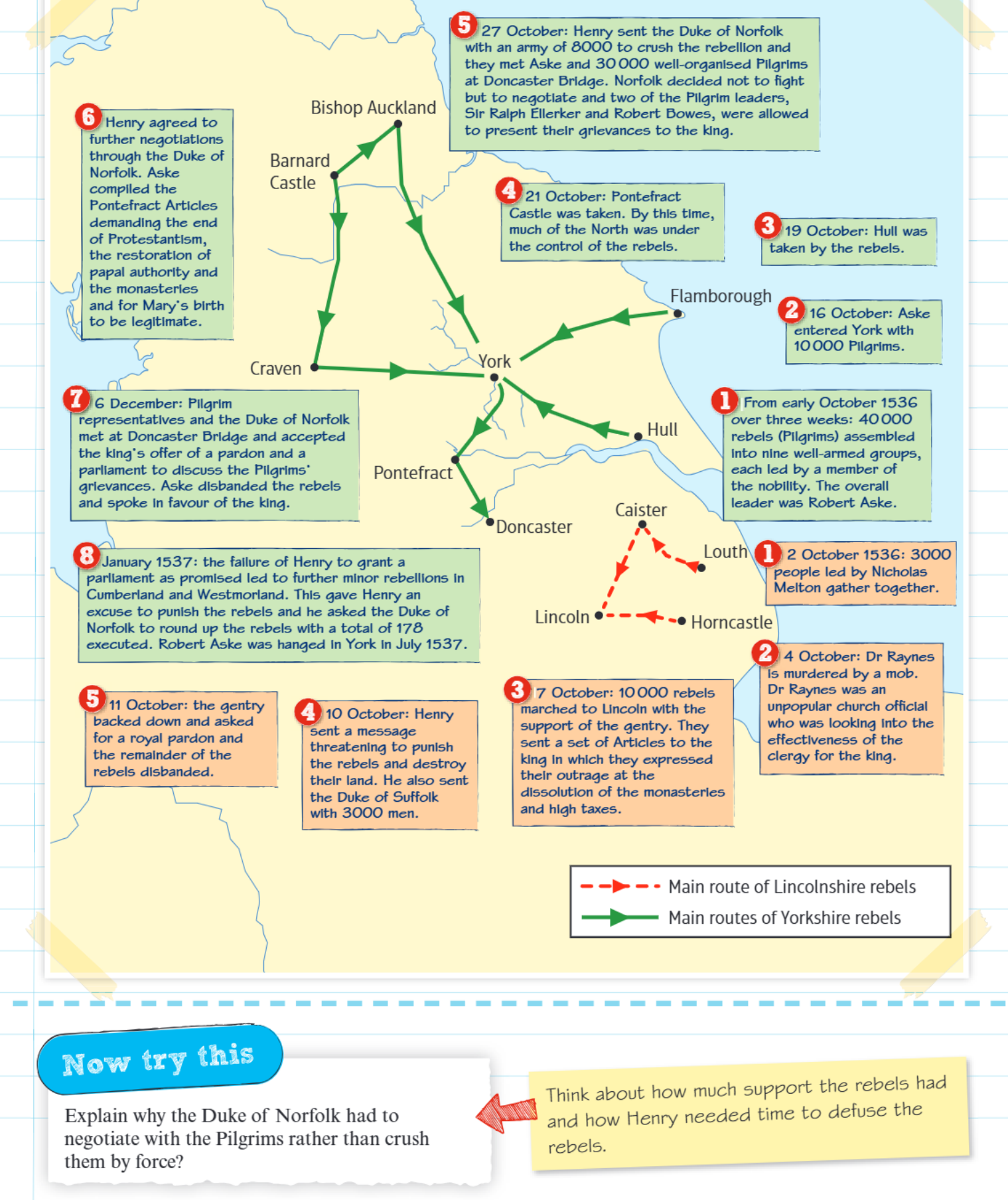
Timeline of major events
October 2, 1536: The rebellion gained momentum when 3,000 people led by Nicholas Melton gathered together, marking the beginning of organised resistance that would spread rapidly across the north.
October 4: Dr Raynes, an unpopular church official, was murdered by a mob. This violent act demonstrated the rebels' anger towards religious changes and showed how the movement was becoming more radical and dangerous for Henry's government.
October 7: A massive force of 10,000 rebels marched towards Lincoln with strong support from the local gentry. They sent formal Articles to the king expressing their grievances about the dissolution of monasteries and high taxes, showing this was becoming a coordinated political protest.
October 10: Henry responded by sending a threatening message to punish the rebels and destroy their land. He also dispatched the Duke of Suffolk with 3,000 men, signalling that he was prepared to use military force to crush the uprising.
October 11: The gentry backing the movement asked for a royal pardon and agreed that the remainder of the rebels should disband. This marked the effective end of the Lincolnshire phase of the rebellion.
The Yorkshire rebellion and negotiations
October 16: Robert Aske entered York with 10,000 Pilgrims, demonstrating that the movement had spread beyond Lincolnshire and was gaining significant support in Yorkshire. This represented a new and more serious phase of the rebellion.
October 19: Hull was taken by the rebels, showing their ability to capture important strategic locations and suggesting the movement was well-organized and militarily capable.
October 21: Pontefract Castle fell to the rebels. By this point, much of northern England was under rebel control, representing the high point of the Pilgrimage of Grace.
Government response and the Pontefract Articles
October 27: Henry sent the Duke of Norfolk with an army of 8,000 to crush the rebellion, but they encountered Aske and 30,000 well-organized Pilgrims at Doncaster Bridge. Significantly, Norfolk chose not to fight but to negotiate, allowing two Pilgrim leaders, Ralph Ellerkar and Robert Bowes, to present their grievances directly to the king.
December 6: Pilgrim representatives met the Duke of Norfolk at Doncaster Bridge and accepted the king's offer of a general pardon and permission for parliament to discuss the Pilgrims' grievances. At this point, Aske disbanded the rebels and spoke in favour of the king, believing the negotiations had been successful.
Henry agreed to further negotiations through the Duke of Norfolk, and Aske compiled the Pontefract Articles. These formal demands included ending Protestant reforms, restoring papal authority, reopening monasteries, and recognising Mary's birth as legitimate.
Important
The Pontefract Articles represented the rebels' formal political demands and showed this was not just a spontaneous uprising, but a coordinated movement with clear objectives. Henry's agreement to negotiate gave the rebels false hope that their concerns would be addressed through peaceful means.
The collapse and brutal suppression
January 1537: Henry's failure to grant a parliament and his decision to break his promises led to further minor uprisings in Cumberland and Westmorland. This gave Henry the excuse he needed to punish the rebels, claiming they had broken the agreed peace terms.
Henry ordered the Duke of Norfolk to round up the rebels, resulting in a total of 178 executions. Robert Aske was hanged in York in July 1537, marking the brutal end of the Pilgrimage of Grace.
Important
Henry's decision to break his promises and brutally suppress the rebellion demonstrated his willingness to use deception and extreme violence to maintain his authority. This betrayal would be remembered as an example of royal duplicity and contributed to long-term resentment in northern England.
Why negotiation was initially preferred
The government's initial choice to negotiate rather than fight reveals important aspects of the rebellion's strength. The rebels had significant support from the gentry and controlled large areas of northern England. Henry needed time to organise military resistance against such a large and well-organized force. The choice to negotiate also reflected the serious challenge this uprising posed to royal authority - it was not something that could be easily crushed by force alone.
Note
The government's decision to negotiate was pragmatic rather than conciliatory. With rebels controlling much of northern England and the royal army outnumbered, Henry used negotiations as a strategy to buy time and divide the rebel leadership before launching his brutal counterattack.
Summary
Key Points to Remember:
- The Pilgrimage of Grace lasted from October 1536 to January 1537 and involved around 40,000 rebels at its peak
- Robert Aske was the key leader who organised the Yorkshire rebellion and compiled the Pontefract Articles expressing the rebels' demands
- The rebellion had both religious and political causes - opposing Protestant reforms, monastery dissolution, and demanding Mary's legitimacy
- Henry initially negotiated through the Duke of Norfolk but broke his promises and brutally suppressed the movement with 178 executions
- The rebellion represented the most serious challenge to Henry VIII's authority and showed the extent of opposition to his religious changes in northern England