Pilgrimage of Grace: reasons (Edexcel GCSE History): Revision Notes
📚Revision Notes
Pilgrimage of Grace: reasons
What was the Pilgrimage of Grace?
The Pilgrimage of Grace was a significant uprising that began in northern England during 1536. This rebellion emerged as a direct response to Henry VIII's religious and political reforms during the early years of the English Reformation.
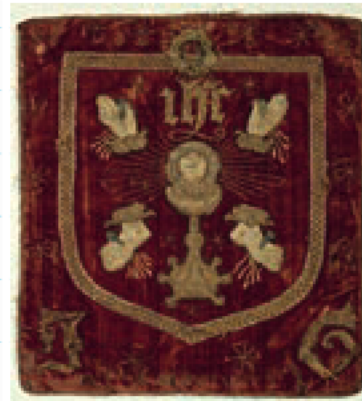
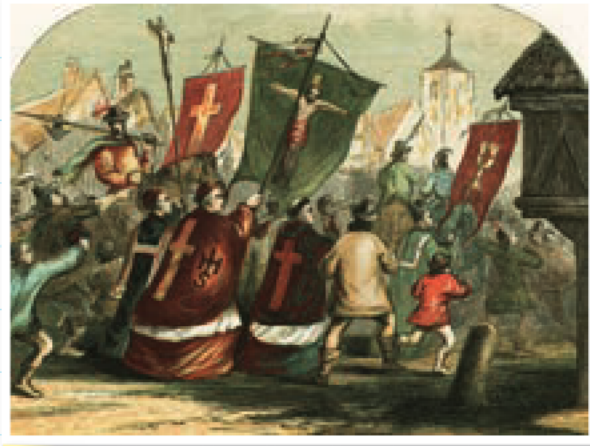
The movement was not a single revolt but rather a series of connected rebellions that spread across Yorkshire, Lincolnshire, Cumberland, and Westmoreland. What made this uprising particularly distinctive was that the participants did not view themselves as rebels fighting against their king. Instead, they saw themselves as "Christ's soldiers" whose mission was to restore traditional Catholic practices to England. Their intention was to negotiate with Henry VIII rather than engage in violent conflict against the crown.
Note
The rebels' self-identification as "Christ's soldiers" reveals the deeply religious motivation behind the uprising. This wasn't simply political resistance but a holy mission in their minds.
The four main causes of the rebellion
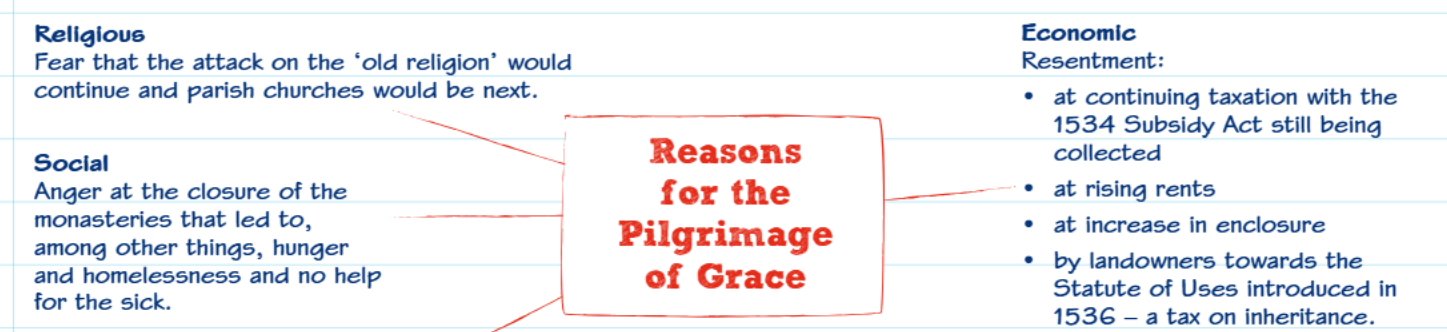
The Pilgrimage of Grace arose from a complex mixture of grievances that affected different aspects of people's lives. These can be organised into four main categories: religious, social, economic, and political concerns.
Religious reasons
The most fundamental driver of the rebellion was the widespread fear that Henry VIII's reforms would continue to attack traditional Catholic worship. Many people in northern England remained deeply attached to the "old religion" and were alarmed by the changes they had already witnessed.
Participants were particularly concerned that the assault on Catholic practices would eventually extend to their local parish churches. These religious buildings were not just places of worship but central to community life, and people feared losing this cornerstone of their traditional way of life. The rebels adopted a powerful symbol - a badge displaying the five wounds of Christ - which demonstrated their commitment to defending Catholic faith and practices.
Important
The fear wasn't just about current changes but about what future reforms might bring. People worried that Henry VIII would eventually target their local parish churches, which were the heart of community life in Tudor England.
Social reasons
The dissolution of monasteries created severe social problems that fuelled popular anger. Monasteries had traditionally provided essential services to local communities, including care for the sick, food for the hungry, and shelter for the homeless. When Henry VIII ordered the closure of these religious houses, these vital social safety nets disappeared almost overnight.
The loss of monastic support left many vulnerable people with nowhere to turn during times of hardship. This created widespread resentment, particularly in northern regions where people depended heavily on monastic charity and assistance.
Economic reasons
Economic grievances formed another major source of discontent. The continuation of heavy taxation through measures like the 1534 Subsidy Act placed significant financial burdens on ordinary people who were already struggling economically.
Additionally, landowners faced rising rents and increasing land enclosure, which restricted traditional farming practices and access to common lands. The 1536 Statute of Uses introduced new inheritance taxes that particularly affected wealthy families and landowners. These economic pressures were made worse by poor weather conditions that led to harvest failures, creating additional hardship and increasing dissatisfaction with government policies.
Note
The economic causes affected different social classes in different ways - ordinary people suffered from taxation and poor harvests, while landowners were hit by inheritance taxes and land restrictions.
Political reasons
The final category of grievances centred on political changes, particularly the growing influence of Thomas Cromwell. Many people resented Cromwell's attempts to centralise power and interfere in local affairs that had previously been managed by regional authorities and traditional elites.
This political resentment was especially strong among the nobility and gentry, who saw their traditional authority and influence being undermined by Cromwell's administrative reforms and the king's new religious policies.
Key figures in the rebellion
Leaders of the rebellion
Robert Aske emerged as the primary leader of the uprising in Yorkshire. As a trained lawyer, Aske brought organisational skills and legal knowledge to the movement. He was able to articulate the rebels' grievances in sophisticated terms and attempted to negotiate with the crown.
Nicholas Melton, a shoemaker, led the rebellion in Lincolnshire. Despite his humble background, Melton successfully organised resistance in his region and coordinated with other rebel leaders.
Lord Darcy, a nobleman, also played a significant role in the rebellion, lending aristocratic legitimacy to the movement and helping to bridge the gap between different social classes involved in the uprising.
Government representatives
The crown responded to the rebellion by sending trusted nobles to suppress it. Charles Brandon, Duke of Suffolk and Thomas Howard, Duke of Norfolk were Henry VIII's chosen representatives for dealing with the uprising. Their involvement demonstrated how seriously the king took this threat to his authority.
Timeline of major events
1534: Subsidy Act passed, creating new taxation burdens
1536:
- Statute of Uses introduced, imposing inheritance taxes
- Pilgrimage of Grace rebellion begins in northern England
- Series of uprisings spread across Yorkshire, Lincolnshire, Cumberland, and Westmoreland
- Government forces mobilised to suppress the rebellion
Summary
Key Points to Remember:
-
The Pilgrimage of Grace (1536) was a major northern uprising against Henry VIII's religious and political reforms, not a simple rebellion but a movement by "Christ's soldiers" seeking to restore Catholicism
-
Four main causes drove the rebellion: religious fears about attacks on traditional Catholic practices, social anger over monastery closures removing vital community support, economic resentment over taxation and poor harvests, and political opposition to Cromwell's centralization policies
-
Key leaders included Robert Aske (lawyer from Yorkshire), Nicholas Melton (shoemaker from Lincolnshire), and Lord Darcy (nobleman), while the government responded through the Duke of Suffolk and Duke of Norfolk
-
The rebels used the symbol of Christ's five wounds and aimed to negotiate with the king rather than fight him, showing their loyalty to the crown despite opposition to his policies
-
This uprising demonstrated the significant resistance Henry VIII faced in implementing his Reformation, particularly in traditional Catholic strongholds of northern England