The Acts of Succession and Supremacy (Edexcel GCSE History): Revision Notes
📚Revision Notes
The Acts of Succession and Supremacy

The Acts of Succession and Supremacy were two crucial pieces of legislation passed in 1534 that fundamentally changed England's religious and political landscape. These laws allowed Henry VIII to break away from papal authority and establish royal control over the English Church, marking a pivotal moment in the English Reformation.
Henry's breakthrough legislation
Henry VIII successfully introduced these groundbreaking laws to gain complete control over the English Church and secure his desired succession. Both Acts were passed in 1534 and worked together to establish a new religious and political order in England.
Note
These two Acts were deliberately designed to work in tandem - the Act of Succession challenged papal authority over marriage, while the Act of Supremacy transferred all papal powers to the English crown, creating a comprehensive break with Rome.
The Act of Succession (1534)
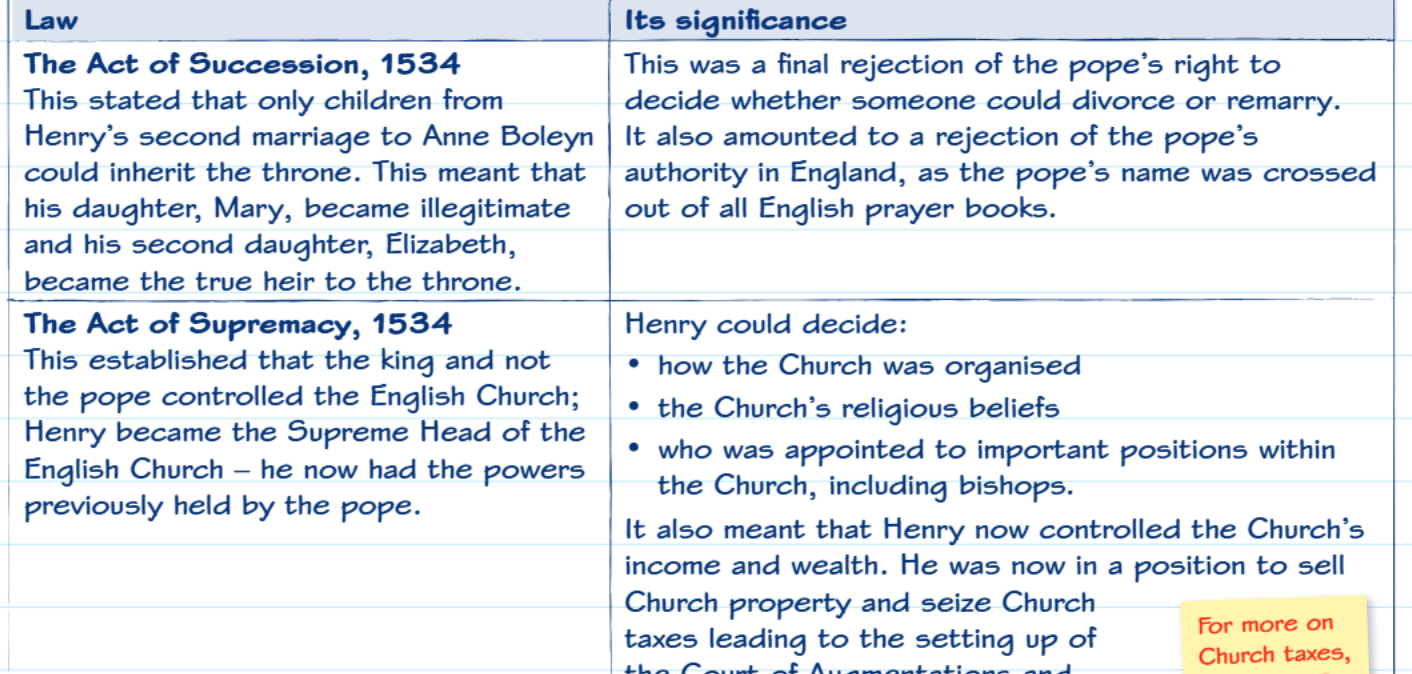
This law fundamentally altered the line of royal inheritance by declaring that only the children from Henry's marriage to Anne Boleyn could succeed to the throne. The Act had several important consequences:
- It declared Henry's daughter Mary (from his first marriage to Catherine of Aragon) illegitimate
- It established Elizabeth, Henry's daughter with Anne Boleyn, as the rightful heir
- It represented a complete rejection of the Pope's authority over marriage and divorce in England
- The Pope's name was removed from all English prayer books, symbolising the break with Rome
Important
The removal of the Pope's name from English prayer books was highly significant - it meant that every church service in England would no longer acknowledge papal authority, making the break with Rome visible to ordinary people in their daily religious practice.
The Act of Supremacy (1534)
This Act established Henry VIII as the Supreme Head of the English Church, transferring all papal powers to the English crown. The significance of this law was enormous:
Religious control: Henry now had the authority to determine how the Church was organised, what religious beliefs were taught, and who was appointed to important Church positions, including bishops.
Financial benefits: The crown gained control over the Church's vast wealth and income. Henry could now sell Church property and collect Church taxes, which led to the establishment of two new government departments - the Court of Augmentations and the Court of First Fruits and Tenths.
Political supremacy: This Act completed Henry's break with Rome and established England as an independent nation in religious matters.
Important
Critical Transformation: The Act of Supremacy didn't just give Henry religious authority - it fundamentally changed the nature of English monarchy. Henry now combined both political and religious power in one person, making him more powerful than any previous English monarch.
Cromwell's enforcement strategy
Thomas Cromwell played a crucial role in making sure these new laws were followed throughout the kingdom. As Vicar-General, Cromwell wielded the king's powers to deal harshly with anyone who opposed Henry's religious changes or questioned his authority over the Church.
Cromwell's approach was based on creating fear among the population. He believed that if people were terrified of the consequences of resistance, they would be too scared to speak out against the king's religious policies or his break with Rome.
Important
Cromwell's Strategy of Fear: Cromwell understood that religious change couldn't be achieved through persuasion alone. By making the consequences of opposition so severe, he ensured that most people would comply with Henry's religious revolution, even if they disagreed with it privately.
The Oath of Succession
All individuals in England, including members of the clergy, were required to swear an Oath of Succession. This oath forced people to publicly recognise Anne Boleyn's right to be queen and accept that her children would inherit the throne.
The consequences of refusing this oath were severe - failure to take it was considered an act of treason and could result in execution.
The Treason Act (1534)
This law dramatically expanded the definition of treason beyond its traditional boundaries. Previously, treason was understood as plotting the king's death, waging war against him, or helping his enemies. The new Treason Act broadened this definition to include simply speaking out against royal supremacy.
Important
Expanded Definition of Treason: Under the traditional definition, you had to actively plot against the king to commit treason. The new law meant that even speaking against Henry's role as head of the Church was now a capital offence - a dramatic expansion of royal power over free speech.
Under this harsh new law, people who criticised Henry's position as head of the Church could face a traitor's death, which involved hanging, drawing, and quartering - one of the most brutal forms of execution.

Many of those who refused to accept Henry's religious changes were imprisoned in places like Beauchamp Tower in the Tower of London, where numerous high-profile prisoners accused of treason were held.
Timeline of key events
- 1534: Act of Succession passed - establishes Anne Boleyn's children as heirs
- 1534: Act of Supremacy passed - makes Henry Supreme Head of English Church
- 1534: Treason Act passed - expands definition of treason to include opposition to royal supremacy
- 1534 onwards: Oath of Succession enforced throughout England
Summary
Key Points to Remember:
- Both the Act of Succession and Act of Supremacy were passed in the same year (1534) and worked together to establish Henry's complete control over Church and state
- The Act of Succession made Elizabeth the rightful heir while declaring Mary illegitimate, directly challenging papal authority over marriage
- The Act of Supremacy transferred all the Pope's powers to Henry, making him Supreme Head of the English Church
- Cromwell enforced these laws through fear, using the expanded Treason Act and mandatory Oath of Succession to silence opposition
- These Acts gave Henry control over Church finances, beliefs, organisation, and appointments, fundamentally changing England's relationship with Rome