John's death and the succession (Edexcel GCSE History): Revision Notes
📚Revision Notes
John's death and the succession
The death of King John
King John passed away in October 1216, at a crucial moment when Prince Louis of France had not yet fully defeated him in the ongoing civil war. Before his death, John named his nine-year-old son Henry as his heir to the English throne. However, England was in a state of chaos due to the civil war that had been raging across the country.
Note
The timing of John's death was particularly significant because it occurred while England was still actively engaged in civil war, leaving the kingdom in a highly vulnerable state during the succession.
The succession crisis
When John died, England faced a major problem regarding who should rule. The king had previously appointed 13 loyal barons to serve as a governing council, but the succession of such a young child had historically led to political instability. The situation was particularly complicated because the rebel barons had already chosen Prince Louis of France as their preferred king, and London remained under rebel control.
Henry was crowned king in Gloucester on 28 October, rather than in the traditional location of Westminster, because the rebels controlled the capital. This unusual coronation highlighted just how precarious the new king's position was at the start of his reign.
Important
The fact that Henry III had to be crowned in Gloucester instead of Westminster demonstrated the weakness of the royal position - the rebels' control of London meant even the coronation couldn't follow traditional protocols.
William Marshal becomes protector
Understanding that a nine-year-old could not effectively rule during such turbulent times, the royal council made a wise decision on 11 November. They elected William Marshal to serve as Protector and regent, meaning he would rule England in young Henry's name. Marshal brought valuable advantages to this role - he was a powerful baron with extensive military experience and strong diplomatic skills, exactly what England needed during this crisis.
Marshal's appointment proved to be a turning point. He quickly moved the royal court to Bristol, where he began implementing the terms of Magna Carta. This was a clever political move because by accepting Magna Carta, Marshal addressed many of the barons' original complaints and removed their main justification for continuing to rebel.
Note
William Marshal's Qualifications: Marshal was an ideal choice for Protector because he combined military expertise with diplomatic skills. His willingness to implement Magna Carta showed pragmatic leadership that helped legitimise Henry's rule and win over moderate barons.
The balance of power in 1216
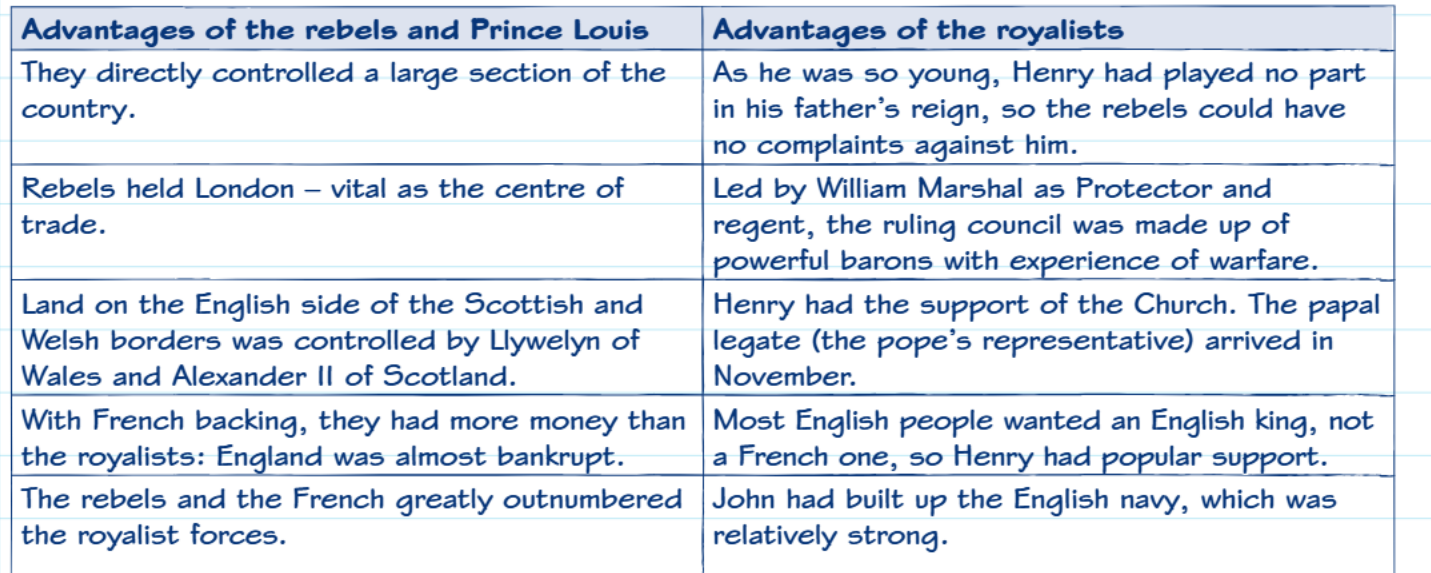
By the end of 1216, both sides in the conflict had distinct advantages and disadvantages:
Note
Rebel Strengths: The rebels initially held strong positions, particularly their control of London, which was vital for trade. They also controlled significant territory and had backing from Prince Louis, which provided them with additional resources and military support. The Welsh and Scottish borders were also under rebel influence through Prince Llywelyn of Wales and Alexander II of Scotland.
Note
Royalist Advantages: However, the royalists began to gain important advantages. Most significantly, many English people preferred to have an English king rather than a French ruler, which gave Henry popular support. The Church also backed Henry, with the papal legate arriving in November to provide official support. Additionally, John had previously strengthened the English navy, giving the royalists naval superiority.
England's condition in 1216
The civil war had devastated England by 1216. The country was divided into different areas of control - some regions remained under royal authority with William Marshal as protector, while other parts were controlled by the rebel barons and Prince Louis. The Welsh and Scottish borders faced particular instability.
Economically, England was in dire straits. Years of warfare had seriously disrupted trade and farming, leaving people much worse off than before the conflict began. The royal treasury was nearly empty because John had spent enormous sums on the war effort and the heavy taxes he had imposed to fund his campaigns. England was essentially bankrupt, which made it even more difficult to continue fighting the civil war effectively.
Important
Economic Crisis: By 1216, England faced complete economic collapse. The combination of disrupted trade, damaged agriculture, and an empty royal treasury created a desperate situation that threatened the kingdom's ability to continue the war effort.
Timeline of key events
- October 1216: King John dies, names Henry as successor
- 28 October 1216: Henry III crowned in Gloucester (age 9)
- 11 November 1216: William Marshal elected as Protector and regent
- Early 1217: Louis returns to France for more resources
- September 1217: Peace treaty signed, Louis gives up claim to English throne
Summary
Key Points to Remember:
- King John died in October 1216 during an ongoing civil war, leaving his 9-year-old son Henry as heir
- William Marshal's appointment as Protector was crucial - his military experience and acceptance of Magna Carta helped turn the tide
- England was divided between royalist and rebel control, with London held by Prince Louis and the rebels
- The royalists gained advantages through English nationalism, Church support, and naval strength
- By 1216, England was economically devastated and nearly bankrupt due to years of civil war and heavy taxation