The nature of kingship (Edexcel GCSE History): Revision Notes
📚Revision Notes
The nature of kingship - Church power and influence
The Church's enormous power in mediaeval England
During the reigns of Richard I and John (1189-1216), the Catholic Church held tremendous influence over English society and posed both support and challenges to royal authority. Understanding the Church's role is essential to grasping how mediaeval kingship functioned and the limitations kings faced.
The Church controlled vast amounts of land and property throughout England. Every person in mediaeval society was expected to attend Mass regularly and contribute a tithe - one-tenth of everything they produced - to the Church annually. This made the Church incredibly wealthy and gave it significant economic leverage over both peasants and nobles.
Note
The tithe system was mathematically simple but economically powerful: if a farmer produced 100 bushels of grain, they owed the Church exactly bushels each year.
The structure and hierarchy of the Church
The mediaeval Church operated as a highly organised international institution with a clear chain of command that sometimes conflicted with royal authority.
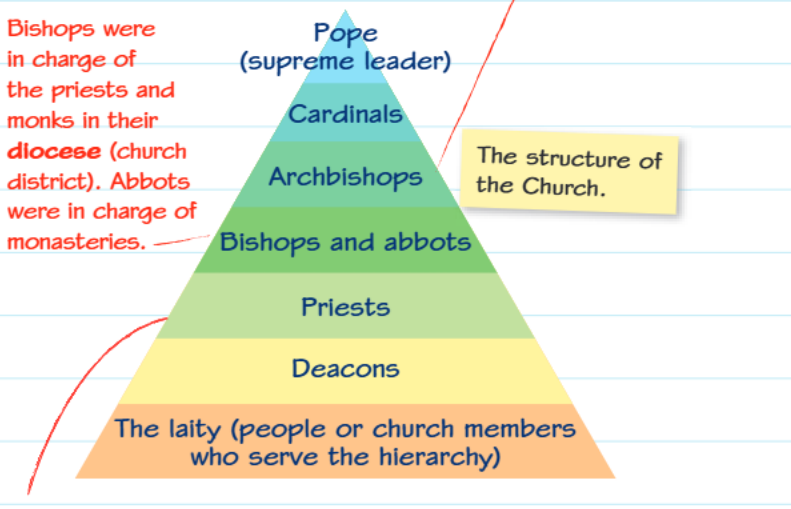
At the apex of this religious hierarchy sat the Pope in Rome, who claimed to be God's supreme representative on Earth. This papal authority extended over all Christians, including kings, which created potential for serious conflicts between religious and secular power.
In England, the Archbishop of Canterbury served as the head of the English Church, supported by the Archbishop of York. These archbishops wielded enormous influence and could challenge royal decisions on religious grounds. Below them, bishops controlled large areas called dioceses, managing the priests and monks within their territories. Abbots ran the monasteries that dotted the English countryside.
Important
Potential for Conflict: The Church hierarchy created a dual loyalty problem - clergy might feel more obligation to papal commands than royal orders, especially when the Pope disagreed with the king's policies.
At the local level, parish priests served individual communities, while deacons assisted them. The laity - ordinary church members - formed the foundation of this religious pyramid, serving and supporting the hierarchy above them.
Why religion mattered so much in mediaeval society
Mediaeval people genuinely believed that God controlled every aspect of life and determined whether souls went to heaven or hell after death. This made pleasing God absolutely vital, and the Church positioned itself as the essential guide for achieving salvation.
The clergy taught people how to live according to Christian principles and provided the sacraments necessary for spiritual life. This gave the Church tremendous moral authority over mediaeval society, including kings who needed to maintain their legitimacy as Christian rulers.
However, this religious authority could create serious problems for royal power. When the Pope disagreed with a king's policies or actions, clergy might feel more loyalty to papal commands than royal ones. This tension between religious and secular authority would prove particularly challenging during John's reign.
The Church's multiple forms of influence
Spiritual influence
The Church guided people's spiritual lives through daily religious practices. Clergy performed essential services including Mass in every village and town across England. They conducted baptisms for newborns, performed marriage ceremonies, and provided last rites for the dying.
This spiritual role gave the Church enormous influence over people's daily lives and major life events. Since everyone believed they needed the Church's guidance and sacraments to reach heaven, challenging Church authority seemed spiritually dangerous.
Economic influence
The Church accumulated massive wealth through several means. It owned extensive lands throughout England and collected rent from tenants who farmed these properties. People frequently donated money and land to the Church, hoping to secure spiritual benefits.
Note
The Tithe System in Practice: Every person had to give the Church exactly of their agricultural produce annually. For a peasant family producing wheat, vegetables, and livestock, this represented a substantial economic burden but was considered essential for salvation.
The annual tithe system provided steady income - every person had to give the Church one-tenth of their agricultural produce. As a major landowner, the Church also employed many people, making numerous communities economically dependent on Church institutions for their livelihoods.
This economic power made the Church an important source of royal taxation. Kings relied on money the Church paid from its extensive properties, creating a complex relationship where monarchs needed Church wealth while sometimes conflicting with Church policies.
Political influence
Church leaders often served as royal advisors and administrators. Many clergy received excellent educations and became valuable government officials, including serving as the king's clerks and secretaries.
However, the Church's international connections created political complications. Since the Pope could influence English Church policies, foreign religious authority sometimes conflicted with royal decisions. The Church's wealth and educated personnel made it a powerful political force that kings had to consider carefully in their decision-making.
Social influence
The Church provided essential social services throughout mediaeval England. Priests and monks offered education, teaching people to read and write when few others could provide such instruction. Some Church buildings housed extensive book collections, preserving knowledge and learning.
Church courts handled many legal matters, and clergy helped maintain law and order in their communities. Monasteries and nunneries cared for the sick, elderly, and poor, providing social support that no other institution could match.
Many Church leaders came from noble families and maintained close connections with the aristocracy, further integrating religious and secular social networks.
Impact on royal authority
The Church's extensive power significantly affected how kings could rule England. While Church support strengthened royal legitimacy, Church opposition could seriously undermine royal authority. Kings needed to carefully balance their policies to maintain Church cooperation while asserting their own political control.
This complex relationship between religious and royal power would become particularly evident during King John's conflicts with Pope Innocent III, demonstrating how Church authority could challenge even the strongest mediaeval monarchs.
Summary
Key Points to Remember:
- The Church was enormously wealthy and powerful, owning vast lands and collecting tithes from everyone in mediaeval society
- Church hierarchy created potential conflicts with royal authority, especially when the Pope disagreed with English kings
- The Church influenced mediaeval life in four key ways: spiritually (through religious services), economically (through land ownership and tithes), politically (through educated advisors), and socially (through education and legal services)
- Mediaeval people's genuine religious beliefs gave the Church tremendous moral authority that even kings had to respect
- Understanding Church power is essential for grasping the limitations and challenges mediaeval kings like Richard I and John faced in governing England