A divided Berlin (Edexcel GCSE History): Revision Notes
📚Revision Notes
A divided Berlin
The division of Berlin after World War II
After Germany's defeat in 1945, the country was split into four occupation zones controlled by the Allied powers. Berlin, although located deep within the Soviet zone, was also divided into four sectors. This arrangement created a unique and potentially explosive situation that would become central to Cold War tensions.
The western sectors of Berlin (American, British, and French) were combined to form West Berlin, while the Soviet sector became East Berlin. This division placed West Berlin as an isolated Western outpost more than 100 miles inside Soviet-controlled East Germany.
Note
The division of Berlin created an unprecedented situation in Cold War history: a Western democratic enclave completely surrounded by communist territory. This geographic anomaly would become one of the most dangerous flashpoints of the Cold War era.
West Berlin's strategic importance
West Berlin's location created both opportunities and problems for the Western powers. The city served as a crucial foothold for the USA and its allies within the Soviet sphere of influence in Eastern Europe. However, its isolated position made it extremely vulnerable to Soviet pressure.
Several factors made West Berlin attractive to people living in East Germany. The western sectors offered better employment opportunities with higher wages compared to the communist-controlled east. The contrast between the two systems became increasingly obvious to East Germans, who could see the economic benefits of capitalism firsthand.
Important
West Berlin's isolation made it completely dependent on Soviet goodwill for access routes through East Germany. This vulnerability meant that any escalation of tensions could quickly cut off the city from the Western world, making it a potential trap for Allied forces.
This situation created significant problems for the Soviet Union and East German government, as it highlighted the failures of their communist system and provided an easy escape route for their citizens.
The refugee crisis in Berlin
Between 1949 and 1961, approximately 2.7 million East Germans crossed into West Germany via West Berlin. This massive population movement had serious consequences for both sides of the divided city.
For East Germany, this exodus created a severe skills shortage as many of the refugees were educated professionals, skilled workers, and young people seeking better opportunities. The loss of so many productive citizens damaged the East German economy and undermined the credibility of the communist government.
From the Soviet perspective, this situation was deeply embarrassing. The constant flow of refugees demonstrated that people clearly preferred the Western way of life over communism. This "brain drain" threatened to hollow out East Germany's workforce and economy.
Note
The refugee crisis represented more than just a humanitarian issue - it became a powerful propaganda tool for the West. Every East German who fled to the West was essentially voting with their feet against the communist system, providing compelling evidence of capitalism's superiority.
For West Germany, while the influx of skilled workers initially benefited the economy, the sheer scale of the refugee problem placed enormous strain on resources and housing in West Berlin.
Khrushchev's Berlin ultimatum (November 1958)
In November 1958, Soviet leader Nikita Khrushchev issued a dramatic ultimatum regarding Berlin's future. He declared that all of Berlin rightfully belonged to East Germany and demanded that Western occupying forces withdraw from the city within six months.
This ultimatum represented a major escalation in Cold War tensions. Khrushchev calculated that the Soviet Union's nuclear capabilities would deter the West from risking war over Berlin. However, he also recognised that direct military action against West Berlin could trigger a nuclear conflict that the Soviet Union could not win, given America's superior nuclear arsenal at the time.
Important
Khrushchev's ultimatum was essentially a high-stakes gamble based on nuclear intimidation. He believed that the threat of nuclear war would force the West to abandon Berlin, but he also had to be careful not to push so hard that he actually triggered the conflict he was trying to avoid.
The ultimatum forced both superpowers into a delicate diplomatic dance, seeking a solution that would avoid war while protecting their vital interests in Berlin.
Summit diplomacy: 1959-1961
The Berlin crisis prompted a series of high-level summit meetings between American and Soviet leaders, aimed at finding a peaceful resolution to the standoff.
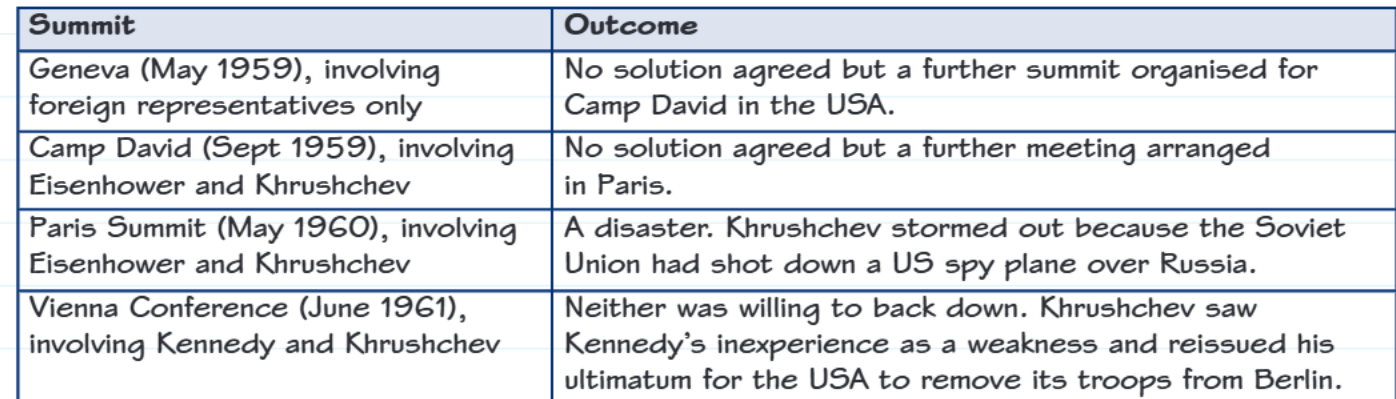
These diplomatic encounters revealed the complexity of the Berlin problem and the difficulty of finding acceptable compromises. Each summit demonstrated the fundamental disagreement between the superpowers while highlighting their mutual desire to avoid nuclear war.
The Geneva Summit in May 1959 involved only foreign representatives and failed to reach any concrete agreements, though it did pave the way for direct talks between the leaders. The Camp David Summit in September 1959 between President Eisenhower and Khrushchev also produced no definitive solutions but established a framework for continued dialogue.
Example
Historical Example: The Paris Summit Disaster (May 1960)
The Paris Summit demonstrated how quickly Cold War diplomacy could collapse:
Step 1: Summit preparations were underway with cautious optimism Step 2: Soviet forces shot down an American U-2 spy plane over Russia Step 3: Khrushchev walked out of the summit in protest Step 4: All diplomatic progress was immediately reversed
This incident showed how intelligence operations could undermine even the most important diplomatic efforts.
The Paris Summit in May 1960 proved to be a complete disaster when Khrushchev walked out after the Soviets shot down an American U-2 spy plane over Russia. This incident demonstrated how quickly Cold War tensions could escalate and derail diplomatic efforts.
The final major summit occurred in Vienna in June 1961 between the new American President John F. Kennedy and Khrushchev. The Soviet leader perceived Kennedy's inexperience as a weakness and reissued his ultimatum, demanding American troop withdrawal from Berlin. This meeting set the stage for the construction of the Berlin Wall just two months later.
Timeline of major events
- 1945: Germany and Berlin divided into four occupation zones
- 1949-1961: 2.7 million East Germans flee to West via Berlin
- November 1958: Khrushchev issues Berlin ultimatum
- May 1959: Geneva Summit (foreign representatives only)
- September 1959: Camp David Summit (Eisenhower and Khrushchev)
- May 1960: Paris Summit collapses due to U-2 incident
- June 1961: Vienna Conference (Kennedy and Khrushchev)
Summary
Key Points to Remember:
- West Berlin's vulnerability: The city was completely surrounded by Soviet-controlled territory, making it a potential flashpoint for conflict
- Refugee crisis impact: 2.7 million East Germans fled west between 1949-1961, creating a major propaganda victory for the West but straining resources
- Nuclear deterrence: Both sides recognised that war over Berlin could lead to nuclear conflict, encouraging diplomatic solutions
- Summit failures: Despite multiple high-level meetings, no lasting solution was found to the Berlin problem during this period
- Escalating tensions: The failed diplomacy of 1958-1961 set the stage for the construction of the Berlin Wall in August 1961