The events of the Cuban Missile Crisis (Edexcel GCSE History): Revision Notes
📚Revision Notes
The events of the Cuban Missile Crisis
Introduction to the crisis
The Cuban Missile Crisis of October 1962 represents one of the most dangerous moments in Cold War history. When America discovered Soviet nuclear missiles stationed on the island of Cuba, just 90 miles from the US coast, it created a situation that brought the world closer to nuclear war than ever before.
Note
The Cuban Missile Crisis lasted for thirteen days and is considered the closest the world has ever come to nuclear warfare during the Cold War period.

Why did the Soviet Union place missiles in Cuba?
The Soviet Union's decision to install missiles in Cuba was driven by strategic military concerns. The USSR faced a significant problem - America had positioned nuclear missiles close to Soviet territory, particularly in countries like the United Kingdom and Turkey. However, the Soviet Union had no similar capability to threaten the United States directly.
Important
Strategic Imbalance Problem
The core issue was that America could strike Soviet territory with nuclear weapons from bases in Europe, but the USSR had no equivalent capability to threaten American cities directly. This created a dangerous imbalance in nuclear deterrence.
Cuba presented the perfect solution to this strategic imbalance. By placing nuclear weapons on the Caribbean island, the Soviets could finally position missiles within striking distance of major American cities. For Cuba's leader Fidel Castro, these Soviet missiles served as protection against potential American invasion attempts, especially after the failed Bay of Pigs invasion in 1961.
In September 1962, Soviet ships began secretly transporting nuclear warheads and missile equipment to Cuba, setting the stage for the most intense superpower confrontation of the Cold War.
The discovery of the missile sites
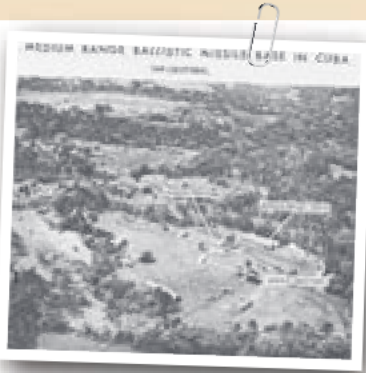
The secret Soviet operation was exposed in October 1962 when American spy planes conducting routine surveillance flights over Cuba captured aerial photographs that revealed something alarming - construction sites that were clearly intended for ballistic missiles.

Note
Intelligence and Surveillance
The discovery came through routine U-2 spy plane flights over Cuba. These high-altitude reconnaissance missions were part of regular American intelligence gathering to monitor Soviet activities in the Caribbean.
When these classified intelligence reports reached President Kennedy and his administration, they confirmed America's worst fears. The Soviet Union had successfully placed nuclear missiles within easy range of the United States mainland. The American public soon learned of this development, creating widespread panic across the nation as people realised they were now vulnerable to Soviet nuclear attack.
Kennedy's response options
President Kennedy found himself facing an incredibly difficult decision with global consequences. His advisers were deeply divided on how America should respond, forming two distinct camps with very different philosophies.
The "hawks" were advisers who favoured immediate military action. They believed America should strike quickly and decisively before the Soviet Union could make their missile sites fully operational. These officials argued that delayed action would only give the Soviets more time to prepare their nuclear weapons.
In contrast, the "doves" were advisers who wanted to avoid nuclear conflict at all costs. They believed that any military action risked escalating into a full-scale nuclear war that could destroy both superpowers and potentially end human civilisation.
Important
The Weight of Decision
Kennedy's choice would determine whether the world would experience its first nuclear war. With both superpowers possessing enough nuclear weapons to destroy each other multiple times over, any miscalculation could have led to global catastrophe.
The range of possible responses
Kennedy and his team carefully considered several different approaches to resolve the crisis:
Option 1: Ignore the missiles completely Some suggested that since America also maintained missile bases near Soviet territory (such as in Turkey), the United States should simply accept this new strategic balance and take no action.
Option 2: Diplomatic negotiations This approach involved offering the Soviet Union a deal - America would remove some of its missile bases close to Soviet territory in exchange for the USSR withdrawing from Cuba.
Option 3: Issue warnings to Castro Kennedy could warn Cuba's leader that his actions were putting his country in serious danger and pressure him to halt the missile site construction voluntarily.
Option 4: Naval blockade of Cuba America could surround Cuba with naval vessels to prevent any additional Soviet missiles or equipment from reaching the island.
Option 5: Destroy the missile sites The United States could launch targeted airstrikes to destroy the Cuban missile installations, avoiding the need for a full invasion.
Option 6: Full invasion of Cuba American troops could invade Cuba completely, remove Castro's government, and eliminate the missile threat entirely.
Option 7: Nuclear attack on the Soviet Union The most extreme option involved launching a preemptive nuclear strike against the Soviet Union before they could use their Cuban missiles against America.
Note
Each option carried significant risks and potential consequences. The challenge was finding an approach that would remove the Soviet missiles without triggering a nuclear war that could destroy both nations.
Timeline of key events
- September 1962: Soviet ships secretly begin transporting nuclear missiles and equipment to Cuba
- October 1962: US spy planes photograph and discover the missile construction sites
- October 1962: Kennedy learns of the missile sites and begins considering response options
- October 1962: News of the crisis reaches the American public, causing widespread concern
The Cuban Missile Crisis would continue to unfold over thirteen tense days, with Kennedy ultimately choosing a combination of diplomatic pressure and naval blockade to resolve the situation without triggering nuclear war.
Summary
Key Points to Remember:
- The Cuban Missile Crisis began when American spy planes discovered Soviet nuclear missile sites being built in Cuba in October 1962
- The Soviet Union placed missiles in Cuba to balance America's missile bases near Soviet territory and to protect Cuba from invasion
- Kennedy's advisers were split between "hawks" who wanted immediate military action and "doves" who wanted to avoid nuclear war
- Kennedy had seven main response options ranging from ignoring the missiles to launching nuclear attacks on the Soviet Union
- The crisis brought the world closer to nuclear war than any other Cold War event, with both superpowers having nuclear weapons aimed at each other from close range