Changing attitudes (Edexcel GCSE History): Revision Notes
📚Revision Notes
The end of the Cold War, 1970-91: Changing attitudes
The end of détente through the Afghan crisis
The period of improved relations between the superpowers, known as détente, came to an abrupt end in December 1979. The Soviet invasion of Afghanistan marked a crucial turning point that revived Cold War tensions and fundamentally changed attitudes between East and West. Soviet leader Leonid Brezhnev believed that the United States would not respond to Soviet control over Afghanistan, but this proved to be a serious miscalculation that would have lasting consequences.
Background to the crisis
The events in Afghanistan must be understood within the broader context of regional instability in 1979. Earlier that year, a revolution in Iran had brought to power a Muslim fundamentalist government, creating concern for the Soviet Union about the spread of Islamic influence. Afghanistan, which bordered the Soviet Union, was seen as strategically vital - serving as an important buffer state between the USSR and Iran.
Note
Afghanistan's geographic position made it highly significant to Soviet interests. The country shared borders with Iran to the west, Pakistan to the south and east, and most importantly, the Soviet Union to the north. This location meant that political developments in Afghanistan could directly impact Soviet security concerns.
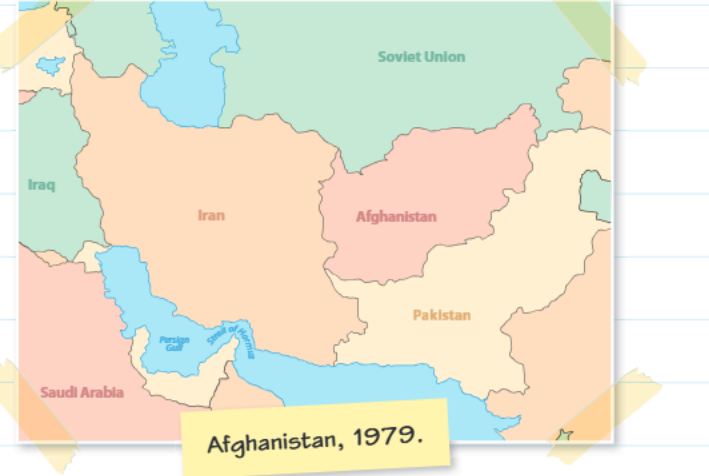
The situation became more complex when considering America's previous responses to Soviet actions. In 1968, the USA had strongly condemned the Soviet invasion of Czechoslovakia but had taken no military action. This lack of concrete response may have encouraged Soviet leaders to believe they could act similarly in Afghanistan without facing serious consequences.
The Soviet invasion unfolds
The crisis began to escalate rapidly in the autumn of 1979. Afghanistan had been within the Soviet sphere of influence, with a pro-Soviet, Moscow-backed government maintaining control since April 1978. However, this arrangement faced a serious challenge in September 1979 when a military coup led by Hafizullah Amin successfully toppled the existing government.
The Soviet Union became increasingly concerned when rumours circulated that Amin might be seeking support from the United States. This potential shift towards Western alignment threatened Soviet influence in a region Moscow considered crucial to its security interests. Soviet leaders felt their position in Afghanistan was being undermined and that decisive action was necessary.
Important
In December 1979, Brezhnev made the fateful decision to order Soviet troops to invade Afghanistan. The official justification was to provide support for Amin's government, but the reality was quite different. On December 27th, Amin was assassinated, almost certainly by Soviet forces, and replaced with Babrak Karmal, who was more reliably pro-Soviet.
The invasion did not go according to Soviet plans. Rather than achieving quick control, Soviet troops found themselves facing determined resistance from Muslim guerrilla fighters known as the mujahideen. These fighters would continue to oppose the Soviet occupation, turning Afghanistan into a prolonged and costly conflict for the USSR.
American concerns and changing attitudes
President Jimmy Carter's reaction to the Soviet invasion revealed the dramatic shift in superpower attitudes that the Afghan crisis had created. The American president had three main concerns that drove his strong response to Soviet actions.
Important
Carter's Three Major Concerns:
First, the USA worried that successful Soviet control over Afghanistan would give the USSR greater influence throughout the Middle East region. This expansion of Soviet power threatened American interests in a strategically vital area of the world.
Second, Carter feared that Soviet success in Afghanistan might lead to increased Soviet influence in Iran. Given Iran's importance as an oil-producing nation and its recent revolution, American leaders were concerned about the potential for further Soviet expansion in the region.
Third, and perhaps most significantly, the invasion threatened to block Middle Eastern oil exports through the Strait of Hormuz. The USA viewed Middle Eastern oil as essential to American prosperity and global economic stability, making any threat to oil supplies a matter of national security.
The significance for changing attitudes
The Soviet invasion of Afghanistan marked the definitive end of détente and the beginning of a new phase of Cold War confrontation. Brezhnev's gamble had spectacularly backfired - instead of passive acceptance from the United States, the invasion provoked a strong American reaction that revived Cold War tensions.
This event demonstrated how quickly superpower attitudes could change when core interests were perceived to be threatened. The period of cooperation and dialogue that had characterised détente was replaced by renewed suspicion and confrontation. The invasion showed that both superpowers remained willing to use military force to protect what they saw as vital interests, even at the cost of improved relations.
Note
The Afghan conflict would prove to be a turning point that contributed to broader changes in the international system. It marked the beginning of a more aggressive phase in the Cold War that would continue into the early 1980s, fundamentally altering the relationship between the United States and Soviet Union.
Timeline of key events
- 1978: Pro-Soviet government established in Afghanistan in April
- 1979: Iranian revolution brings Muslim fundamentalist government to power
- September 1979: Hafizullah Amin leads coup, topples Afghan government
- December 1979: Soviet Union invades Afghanistan
- December 27, 1979: Amin assassinated and replaced by pro-Soviet Babrak Karmal
- 1979 onwards: Mujahideen begin sustained resistance to Soviet occupation
Summary
Key Points to Remember:
- The Soviet invasion of Afghanistan in December 1979 marked the end of détente and revived Cold War tensions
- Brezhnev miscalculated American reactions, believing the USA would not respond strongly to Soviet control over Afghanistan
- President Carter had three main concerns: Soviet expansion in the Middle East, potential influence over Iran, and threats to vital oil supplies through the Strait of Hormuz
- The invasion faced unexpected resistance from mujahideen fighters, turning into a prolonged conflict rather than quick Soviet success
- This crisis demonstrated how superpower attitudes could change rapidly when vital interests were threatened, marking a return to Cold War confrontation