Reagan and the 'Second Cold War' (Edexcel GCSE History): Revision Notes
📚Revision Notes
Reagan and the 'Second Cold War'
Reducing tensions in the 1980s
The period from the mid-1980s marked a significant shift in Cold War relations, largely driven by changes in Soviet leadership and policy. While tensions had escalated earlier in the decade, new approaches from both superpowers began to create opportunities for reduced hostility.
Note
This period represents a crucial turning point in the Cold War, when the confrontational approach of the early 1980s began to give way to more cooperative superpower relations. The changes were driven by both internal Soviet pressures and new leadership willing to pursue different strategies.
Mikhail Gorbachev as leader
When Mikhail Gorbachev came to power in the Soviet Union, he faced enormous challenges that required immediate attention. His leadership approach would prove crucial in transforming superpower relations.
Recognition of soviet problems
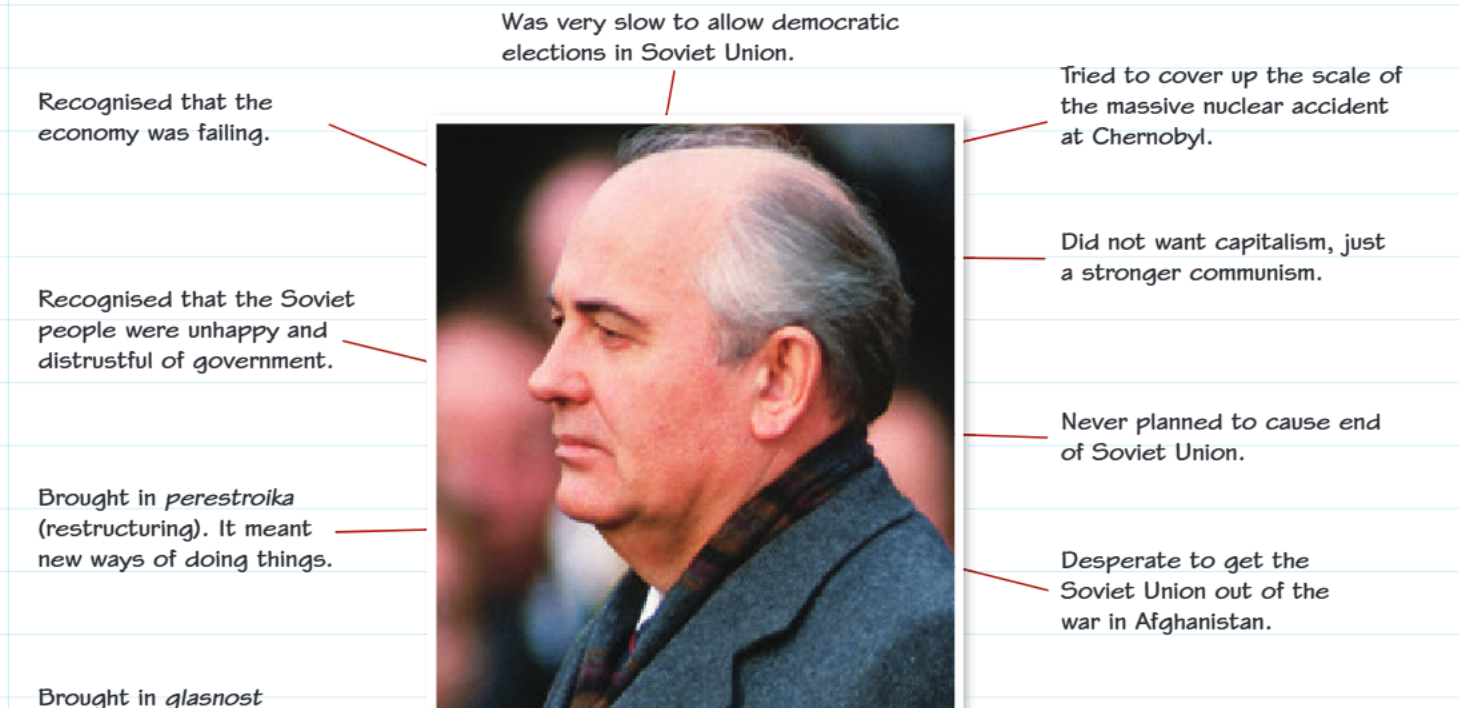
Gorbachev understood that the Soviet Union was experiencing severe difficulties across multiple areas. He acknowledged that the country's economy was struggling and that the Soviet people had grown increasingly dissatisfied with their government. The scale of problems became even more apparent with major crises like the Chernobyl nuclear disaster, which the government initially tried to conceal from the public.
The ongoing war in Afghanistan had also become a significant drain on Soviet resources and morale. Gorbachev recognised that the Soviet Union desperately needed to find a way out of this costly conflict.
Note
The Chernobyl disaster in April 1986 was particularly significant because it exposed the Soviet government's tendency to cover up problems rather than address them openly. This crisis helped convince Gorbachev that greater transparency was essential for effective governance.
Key reforms: perestroika and glasnost
To address these mounting problems, Gorbachev introduced two major reform policies that would reshape Soviet society:
Perestroika (restructuring) represented a fundamental change in how the Soviet system operated. This policy aimed to introduce new ways of doing things and make the communist system more efficient and responsive to people's needs.
Glasnost (openness) allowed much greater freedom for Soviet citizens to express their genuine thoughts and opinions. This marked a dramatic departure from the strict censorship and control that had characterised previous Soviet leadership.
Gorbachev's goals and limitations
It's important to understand that Gorbachev never intended to abandon communism or adopt capitalism. His goal was to make the communist system stronger and more effective, not to replace it entirely. However, he was slow to implement democratic elections within the Soviet Union, showing his cautious approach to political reform.
Important
A common misconception is that Gorbachev deliberately set out to end the Soviet Union and bring capitalism to Russia. In reality, he genuinely believed he could reform and strengthen the communist system. The collapse of the Soviet Union was an unintended consequence of his reforms, not his original goal.
Despite his reforms, Gorbachev never planned to cause the end of the Soviet Union - this was an unintended consequence of his policies.
The Reykjavik Summit, October 1986
This summit between Reagan and Gorbachev proved to be a watershed moment in Cold War relations, demonstrating both the possibilities and limitations of superpower cooperation.
Nuclear weapons negotiations
At Reykjavik, both leaders expressed their commitment to working together to reduce their nuclear arsenals. This marked a significant shift from the arms race mentality that had dominated earlier periods of the Cold War.
However, the summit also revealed fundamental disagreements. Gorbachev wanted Reagan to abandon his Strategic Defence Initiative (SDI), which critics called "Star Wars" - Reagan's plan to develop satellites capable of destroying nuclear missiles in space. Reagan refused to give up this programme, preventing a broader agreement at the time.
Important
The disagreement over SDI at Reykjavik demonstrates how even well-intentioned leaders can struggle to overcome deep strategic differences. Reagan's refusal to abandon SDI seemed to doom the summit, but it actually laid the groundwork for future compromises.
The INF Treaty breakthrough
Despite the immediate disappointment at Reykjavik, the summit laid important groundwork for future agreements. Following continued negotiations, the superpowers met again in Washington in December 1987, where they successfully signed the INF (Intermediate-Range Nuclear Forces) Treaty.
This treaty represented a major breakthrough, as both nations agreed to eliminate all land-based missiles with ranges between 500-5,500 kilometres. This was the first time both superpowers had agreed to actually destroy existing weapons rather than simply limiting future production.
Important
The significance of the INF Treaty cannot be overstated - it marked the first time in the Cold War that both superpowers agreed to actually reduce their nuclear arsenals by destroying existing weapons, rather than just limiting future production. This represented a genuine step towards de-escalation.
Timeline of key events
- 1985: Gorbachev becomes Soviet leader
- 1986: Chernobyl nuclear disaster; Reykjavik Summit in October
- 1987: INF Treaty signed in Washington, December
Summary
Key Points to Remember:
-
Gorbachev's reforms: Perestroika (restructuring) and glasnost (openness) aimed to strengthen communism, not replace it with capitalism
-
Soviet challenges: Economic failure, popular dissatisfaction, Chernobyl disaster, and the Afghanistan war all pressured Gorbachev to seek change
-
Reykjavik Summit (1986): Though initially unsuccessful, it led to breakthrough negotiations and the INF Treaty in 1987
-
INF Treaty significance: First superpower agreement to actually destroy existing nuclear weapons, marking a genuine reduction in tensions
-
Both leaders' roles: Reagan and Gorbachev both played crucial parts in reducing Cold War tensions through their willingness to negotiate and compromise