SALT 2 and the failure of détente (Edexcel GCSE History): Revision Notes
📚Revision Notes
SALT 2 and the failure of détente
Introduction to SALT 2
SALT 2 (Strategic Arms Limitation Treaty) represented a crucial attempt to control the nuclear arms race between the United States and Soviet Union during the 1970s. This arms control agreement ultimately marked the end of détente - the period of improved relations between the superpowers that had begun in the early 1970s.
Note
What was détente? Détente was a period of reduced tensions and improved diplomatic relations between the United States and Soviet Union during the 1970s. It represented a temporary thaw in the Cold War, characterised by increased trade, cultural exchanges, and arms control negotiations.
The treaty was never ratified by the US Senate, primarily due to the Soviet invasion of Afghanistan in December 1979, which dramatically worsened US-Soviet relations.
The arms race context
To understand why SALT 2 was necessary, we need to look at the dramatic nuclear buildup that occurred during the 1960s. Both superpowers had been rapidly expanding their nuclear arsenals throughout the decade.
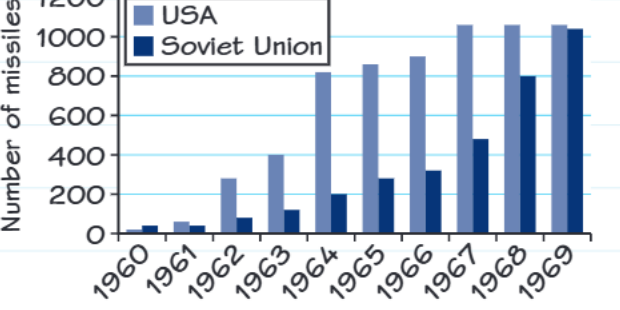
This chart shows how both nations reached over 1,000 missiles by 1969, with the USA generally maintaining higher numbers. The massive scale of this arms race created enormous economic pressure, particularly on the Soviet Union, and increased the risk of nuclear conflict.
Important
The Scale of the Arms Race By the late 1960s, both superpowers possessed enough nuclear weapons to destroy each other many times over. This massive buildup was economically unsustainable and increased global tensions, making arms control agreements essential for world peace.
Details of the SALT 2 treaty (1979)
The Strategic Arms Limitation Treaty was the result of lengthy negotiations that had been ongoing since 1972. The agreement built upon earlier diplomatic efforts, particularly the Vladivostok Accords of 1974, which had established the framework for arms limitations between the US and Soviet governments.
Key features of SALT 2 included:
- Warhead limits: Each superpower was restricted to a maximum of 2,250 warheads
- Comprehensive counting: Unlike SALT 1, which only counted missiles, SALT 2 counted actual warheads, providing more meaningful limits
- New technology restrictions: The treaty imposed limits on new launch systems, including multi-warhead missiles
- Formal signing: Soviet leader Leonid Brezhnev and US President Jimmy Carter signed the agreement in Vienna in June 1979
Why SALT 2 failed
Despite years of careful negotiation, SALT 2 never became official US policy due to several interconnected factors:
West German opposition: Some West German politicians feared the treaty would weaken NATO's defence of West Germany. They worried that if the USA was limited in its nuclear weapons, it would be less likely to use them to defend West Germany against a potential Soviet attack.
US political concerns: Many American politicians believed the treaty made too many concessions to the Soviet Union. They argued that the limitations didn't adequately address Soviet advantages in certain types of weapons systems.
Important
The Afghanistan Crisis: The Final Blow The most decisive factor was the Soviet invasion of Afghanistan in December 1979. This military action completely soured US-Soviet relations and convinced the US Senate that the Soviet Union could not be trusted to honour international agreements. As a result, the treaty was never ratified and never became official US policy.
How successful were the SALT agreements?
Despite SALT 2's failure to be ratified, both SALT 1 and the proposed SALT 2 had important effects on superpower relations and nuclear strategy:
Limiting the arms race: The agreements placed specific limits on anti-ballistic missiles (ABMs), intercontinental ballistic weapons (ICBMs), submarine-launched ballistic missiles (SLBMs), and long-range bombers that each side possessed.
Maintaining nuclear deterrence: The treaties helped preserve a system where nuclear deterrence remained effective. Nuclear deterrence worked because both sides maintained enough nuclear weapons to retaliate if attacked, but neither side had enough to completely destroy the other's nuclear forces in a first strike.
Preventing first-strike capability: By ensuring that neither side could develop first-strike capacity (the ability to destroy all the opponent's nuclear weapons in one attack), the agreements helped maintain stability.
Note
Margaret Thatcher's Perspective As British Prime Minister Margaret Thatcher noted, "nuclear weapons kept the peace in Europe and the world." This reflects the view that nuclear deterrence, despite its risks, prevented larger conventional wars during the Cold War period.
Economic pressures and the arms race
An important factor in the failure of détente was the economic strain of the arms race. By the mid-1970s, nuclear weapons were becoming increasingly expensive to develop and maintain. The Soviet Union's economy was considerably weaker than that of the United States, making it increasingly difficult for the USSR to keep pace in the nuclear competition.
Important
Economic Reality Behind the Arms Race The economic burden of maintaining and expanding nuclear arsenals was unsustainable for both superpowers, but particularly devastating for the Soviet Union. This economic pressure would eventually contribute to the broader problems that led to the end of the Cold War in the following decade.
Timeline of key events
- 1972: SALT 2 negotiations begin
- 1974: Vladivostok Accords establish framework for arms limitations
- June 1979: Brezhnev and Carter sign SALT 2 treaty in Vienna
- December 1979: Soviet Union invades Afghanistan
- 1979-1980: US Senate refuses to ratify SALT 2 treaty
- Result: SALT 2 never becomes official policy; détente ends
Summary
Key Points to Remember:
- SALT 2 was signed in 1979 but never ratified due to the Soviet invasion of Afghanistan
- The treaty would have limited each superpower to 2,250 warheads, providing more comprehensive limits than SALT 1
- Nuclear deterrence worked by ensuring neither side could achieve first-strike capability
- Economic pressures, particularly on the Soviet Union, made the arms race increasingly unsustainable
- The failure of SALT 2 marked the end of détente and a return to more hostile US-Soviet relations